
Zmitser Bandarenka: “Officials understand that opposition is right”
- 29.12.2007, 11:39
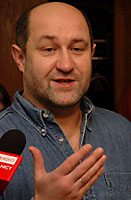
Putin has simply bought loyalty of Lukashenka for the period of elections in Russia, and he is to continue the policy of “stifling” then. Belarusian officials understand that the opposition is right, and start to speak in favour of the European choice publicly, the Charter’97 coordinator believes.
- Minsk has been recently visited by Vladimir Putin. The topic of conversation with Lukashenka is not known fully. To your mind, what was his visit’s aim?
- Though Putin has a huge popularity in Russia, he is in a very difficult situation now. He understands perfectly well that a new President of Russia theoretically could do with him, great Putin, everything he wants. And the latest combinations are focusing efforts at solving one super-task: how to stay at Russia’s political Olympus and preserve his achievements over the eight years. For Putin the transition to a new political capacity is a more difficult and important task than everything he faced over the years of his presidency. To my mind, his visit to Minsk is a safety cushion in the struggle with member of power ministries, who are blaming him all the time for a danger to lose the last ally.
- How do you estimate the achieved agreements on giving Belarus a loan of 1.5 billion dollars and charging a price of $119 per cubic meter?
- Putin has simply bought loyalty of Lukashenka for the period of elections in Russia. It could seem a too expensive gift for the Belarusian ruler for someone, but in the struggle for the Kremlin stakes are much higher. The more so as Lukashenka won’t disappear anywhere. After the election Putin would continue the policy of “stifling”.
And the gas price you’ve mentioned contains the answer: it’s a price for the first three months. It will be $130 per cubic meter in the next three months, while it well may be $180 by the end of the year.
- As long as relations with Moscow are improving, does it mean that Lukashenka would give up on cooperation with Europe?
- No because total Belarus’ foreign debt is more than 10 million dollars. Even the extremely economically advantageous Russian loan won’t rescue Lukashenka’s regime. Moreover, the loan has been given on security of state property, and the deficit in trade in Russia is 5 billion dollars. Export of oil products and potassium fertilizers to Europe gives 4 billion dollars. “Hard cash” goes from the European Union, by the way. Even at the joint press conference with Putin Lukashenka addressed Europeans humbly asking to appreciate stability of energy resources delivery via the territory of Belarus.
- A year ago the European Union offered Belarus 12 proposals on democratization in exchange for serious economical support to the country. Why the Belarusian authorities haven’t adopted the EU recommendations yet?
- Lukashenka is a dictator, and it’s hard to turn into a European leader for him. But he hopes that an exception would be made for him, as for al-Gaddafi for instance. But unfortunately for Alyaksandr Lukashenka, and fortunately for the Belarusians, we are the European nation, and different approaches exist for us. And when Lukashenka asks support, the EU answers him: you are welcome, but first you should qualify for minimal European requirements.
Time goes by, and problems are aggravating. The truth about the real situation in the country, about the read dissatisfaction of people with their living standards and his rule are likely be concealed from Lukashenka. After repeal of benefits millions of people do not simply dislike him, but actively hate him. This information must be concealed from the dictator. That is why social outbursts are to become a surprise for him.
- Since the New Year neighbouring countries have joined the Schengen zone. Both the democratic forces and the regime have called upon the EU countries to reduce the cost of Schengen visas for Belarus. But we will pay more than others still, 60 Euro. Why is it so?
- The European Union does not want to receive uncontrolled emigration. Their experience shows that most refugees are from dictatorships. People escape from the results of “successful” rule of Lukashenka’s friends and colleagues. People from not very rich, but free countries leave for temporary work, but most of them return to their home country. As a rule, people flee from dictatorial countries forever. Until Belarus would not settle down to the course of democratization, limitations for Belarusian citizens would exist.
- The US has imposed sanctions against Belneftekhim. Sanctions against leaders and officials of the Belarusian regime have been imposed many times. Could it influence the changes of the situation in our country?
- These are the first economic sanctions against the country. Freezing accounts of separate citizens cannot be considered economic sanctions against the country. The emotional reaction of influential American officials to swindle by Lukashenka’s administration is understandable. Lukashenka and his entourage cannot act in a different way. Even “strategic partners” of the Belarusian dictator, Russians, often complain that Lukashenka deceives them. It’s a signature style of the Belarusian ruler.
By provoking sanctions of the US, Lukashenka has considerably reduced his room for manoeuvre.
- What is the position of the EU towards Belarus today?
- If there will be no progress in implementing the 12 proposals of the EU, I think Europe would be forced to us economic sanctions. 12 proposals of the EU were the attempt of the progress. Europeans are still hoping that Belarusian rulers have some traces of common sense.
The aid from the EU for the new members of the EU, Poland, Hungary, Romania, Bulgaria, is simply huge. But Lukashenka is taking loans, which are to be returned by the future generations of the Belarusians. There is nothing out of the ordinary in the 12 recommendations. Europe lives according to these rules, and they live very well. And they are offering: Belarusians, let’s live a good life! And Lukashenka is saying: no, Belarusians’ life will be bad! And most Belarusians are still sleeping.
– What role will strengthening of authoritarianism in Russia play for Belarus? The recent parliamentary election in this country was admitted not free.
– The great human rights activist of today Natan Shcharanski revealed a secret of survival of dictator regimes in one of his books. Big dictatorships support little ones and when oil prices fall, even big dictatorships collapse. Putin won’t go anywhere now, because another rule is working: big dictatorship always wants to change an uncomfortable dictator in a “friendly” country to a comfortable one. It will soon happen with Lukashenka, and unfortunately we can’t change a vector of the development of the country.
– The opposition offered the authorities a dialog at the beginning of the year. Are you sure now the strategy chosen was right?
– Certainly, I’m sure. The authorities, conducting the mass campaign “For independent Belarus!” facilitated the considerable growth of patriotic, independence tones in the society. It is the first advantage. The second advantage is tha we have reduce repressions, at least during rallies. Hundreds of people weren’t beaten by clubs at heads and backs – it’s very important.
The third advantage is the dialog and offer of the opposition to find a common way out of crisis, to normalise relation with Europe, creation of legal channel of promotion the European idea, among others, among state officials. They understand, the opposition is right and Belarus has interests in Europe. Officials began to speak for European choice.
– Nevertheless, Viktar Ivashkevich, one of the initiators of the dialog, was arrested for 15 days, the action “For Independent Belarus!” on October Square was dispersed brutally. How should we treat it?
– The authorities are don’t’ know indeed how to react to new challenges. It is like in Gorbochov’s times – two law were adopted: on cooperation and on struggle with non-labour incomes. It was said about the necessity of democratisation and t the same time demonstrations in Minsk and Tbilisi were cracked down. Such ambivalence can’t last long, as it was at that time.
– What should happen the authorities go at last to a dialog with the opposition?
– On a certain stage a part of high-ranked officials began to realise it would be better for them to live in a normal democratic country, than to live in dictatorship. They and their families would have a better life, and they could realise their aspirations in the new situation, not in tyranny. The elites of power and opposition began to come in contact.
After our neighbours joined the Schengen Zone, these sentiments will grow stronger and stronger. It is obvious that our neighbours have chosen the right way, and special Lukashenka’s way is a deadlock.
Tens, and hundreds of countries rose from dictatorship to democracy. Belarus has a chance to join the European Union at the earliest possible date after it release itself of dictatorship. It will be a guarantee of repetition of authoritarianism, the thing, countries of Latin America are suffering from. A certain autarchy of Latin America is determined by geographical position and colonial past that hinders progressive advance towards democracy. But we, as other people of former European dictatorships, will have a real chance to quick integration to the EU and live a normal life. To become citizens of the United Europe and have the same guaranteed rights that Englishmen, French, Italians, germans have.
– Mass actions on the Day of Freedom, Charnobylski Shlyalh, European March took place in Belarus in 2007. Are the democratic forces going to continue the struggle by means of street actions next year?
– This year the opposition had the initiative. The Day of Freedom, Charnobylski Shlyalh, the European March, rising of entrepreneurs before the New Year’s Eve, protests against visit of Putin – it all is achievements of the opposition. The democrats used the aikido principle to use bad force and hang-ups of an opponent. Even famous critic of teh Belarusian opposition Pavel Sheremet advised Russian democrats to learn the experience of their Belarusian colleagues. Boris Nemtsov called to boycott presidential election in Russia, though he had been convincing his partners in Belarus in absolute necessity of participation in election under dictatorship.
– So do you support for boycott of parliamentary election 2008 at ours? The oppositional forces haven’t yet agreed on this question...
– I think the opposition shouldn’t participate in election farce, and must announce it clearly. It’s a Lukashenka’s problem, how he will explain to the world why there were no free election in Belarus. The democratic forces should demand the election to be held freely, political prisoners to be released, repression to be stopped, opposition candidates to be registered, opposition to be present at vote count.
It can’t be so, that we are demanding abstractedly, and the authorities agree abstractedly. These agreements can come into action only via meaningful dialog by a mediation of international community. It’s silly to take part in the traditional scenario of the authorities today. The opposition should be compellingly firm. Then both dialog and realisation of 12 EU’s offers will be possible.
– What is your forecast for 2008?
– The forecast is good. The year will be dynamic. The changes, we have been waiting for so long, will take place.