
Revival of Belarus started with Dzyady (Photo, video)
1- 7.10.2008, 17:56
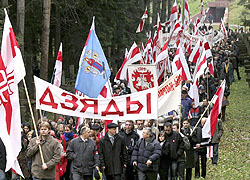
The memorial march and meeting dedicated to Dzyady, the All Saints or the day when Belarusians commemorate their deceased forefathers, is to be held on November 2 in Minsk. This year the 20th anniversary of the first nation-wide rally is marked. This rally was the beginning of Revival in Belarus.
An application for holding the rally has been already filed to Minsk city executive committee. It has been signed by the chairman of the Belarusian Popular Front Lyavon Barshcheuski and his assistant Viktar Ivashkevich. It is planned that the rally would start on November 2 at noon at the Eastern (Uskhodniya) cemetery of Minsk. People are offered to lay flowers to the tomb of Uladzimir Karatkevich, Henadz Karpenka, Pimen Panchanka, Vasil Bykau and other our famous fellow countrymen. Then the column would go along Kalinouski Street and Lahojski Trakt to the wooded area Kurapaty where the meeting would be held.
Today the press-conference of the leaders of the Belarusian Popular Front and well-known Belarusian poets, historians, painters who were participants of the events in 1988 was held at the BPF headquarters.
As we have informed, on October 30, 1988 in Minsk a mass demonstration in memory of Stalinism victims was held. There were at least 5,000 participants in it. People marched with white-red-white flags. The government disbanded them with policemen's truncheons and tear gas, which was the first occasion in the Soviet Union. As a result, opposition sentiments increased, and an Organizing committee for creation of the Belarusian People's Front was created.
Today representatives of Belarusian intelligentsia have adopted a common address to the Belarusian society. They have stated:
"20 years ago the first all-nation Dzyady action was held. It has become history forever. Thousands of people from all parts of Belarus gathered then near Uskhodniya cemetery in order to pay tribute to the memory of forefathers, who lived in this land, preserved its spiritual treasures, defended it from enemies, died for its freedom and independence.
Despite of the cruel resistance of the Communist regime, Dzyady-1988 roused the society giving it new ideals and ideas. On that exactly day during the meeting on the way to Kurapaty a white-red-white flag was raised for the first time in several decades. Soon it became a state flag of an independent Belarus.
Today's regime makes new attempts to wipe out the historical memory of Belarusians, to build "Stalin's line" in our minds. But we know where from our nation is. We have a history of 1000 years, and we remember our heroes. They set an example for us, reinforce our confidence in democratic European future."
During the press-confeernce its participants said about the great role played by Dzyady-88 in the history of modern Belarus. They recalled historical events they witnessed personally.
"20 years ago during Dzyady well-known historical events took place. They became well-known all over the world, and it made us to treat this day in a special way. Moreover Dyzdy in 1988 played an important role in formation of the Belarusian people's Front. That is why we view this celebration of Dzyady in this aspect too. As one of the important elements where it is possible to bring to mind the way we have passed over these 20 years. I held negotiations with the leader of the Belarusian Christian party Belarusian People's Front Zyanon Paznyak, one of the founders and the first leader of the BPF. First we underlined that the route of the first march should be repeated, and then Paznyak's colleagues said that it is better to go the route of recent years. We believe that we should start the event from Uskhodniya cemetery laying flowers to tombs of our Revival's great sons, and the can continue the march together. It is not a disagreement in any way. We simply see that it is logical to repeat the same route and the same possibility after 20 years, on the sacred day of memory, Dzyady," Lyavon Barshcheuski, the leader of the Belarusian Popular Front stated.
People's poet of Belarus Henadz Buraukin reminded how famous people behaved during the events in Minsk in 1988. For example, according to Buraukin, Belarusian poet Pimen Panchanka refused to sign a resolution of the commission, created after dispersal of a rally on Dzyady by the Council of Ministers of the BSSR, and which said there had been no Stalin's repressions in Kurapaty.
"In 1988 I was in Ukraine, but I remember what was after that. When I returned to Minsk, this event was discussed and debated actively. Now, I can say with certainty that it was a real important event in the history of Belarus. If it hadn't been for this event, there wouldn't have been many things in the society, there would have been no this enthusiasm, which caused Revival in 1990ies. In my view, it will be right to remind the people about true events. Moreover, we have witnesses and documental proofs. I think recollection of this event is very important for moral feelings of our society. To my mind, we must lay flowers to Belarusian poet Pimen Panchanka, too. Such people as he meant much in those times. For example, in 1988, after Dzyady, the Council of Ministers formed a commission, which said there had been no Stalin's repressions there. Panchanka refused to sign this false resolution. He wrote on a newspaper, he brought there with him, words of Belarusian poet Kolas: "We were given Constitution, doors were opened for us, but we were guarded to prison and are being tortured there." He viewed the situation in this way.
I also remember our night emotional talks with Heorhy Tarazevich, chairman of the Supreme Council of the BSSR. He probable wanted to deal in the situation and preserve morality, but was broken by security officials, who falsified the facts. By the way, these falsifications were revealed after the security officials said cheryomukha gas hadn't been used against people who had come to celebrate Dzyady. When we tell about those events, may people wil understand that our officials haven't invented anything. They do the same things, that were known long ago," Henadz Buraukin said.
Belarusian writer and historian Uladzimir Arlou reminded how the Belarusian cleric sent a letter to Mikhail Gorbachev protesting against crackdown of a peaceful action on Dzyady.
"We have many remembrances and it will be pleasant for us to share them with journalists. I can tell about Tarazevich, who saved me from exile to Polatsk, because after my speech at a rally on Dzyady, militia officers began to draw up reports against me for living in Minsk without registration. They warned that intentional avoidance of registration may cause deportation back to Polatsk or throwing in prison. When a writers' session gathered in the House of Writers, Tarazevich came to persuade us not to send a telegram to Gorbachev demanding to investigate the dispersal of the meeting, and I spoke directly to him and asked to defend me. He said: "Comrade Arlou, believe me, militia lieutenant Salnik won't visit you from tomorrow." It happened - comrade Salnik didn't visit me any more. However, Tarazevich didn't known that the telegram had been sent to Gorbachev before the session. We had no other choice but to sent it," Uladzimir Arlou told.
Famous Belarusian artist Ales Marachkin told how his wife, son and he were detained by militia on October 30, 1988.
"Dzyady is a holy day for Belarus. I think that Dzyady stands in a line with the holidays, celebrated by the real Belarusian. Dzyady is bright and martyr day that will strengthen our nation. What concerns recollections, of course, there was a rise then. I remember that arrest. They were first mass arrests that I met. The most interesting that my son Ihar and I were detained. When we sit in a bus among the militiamen, my wife asked: "And me? Why did you forgot me?" and she joined us. Reports were drawn up against us, there were many people in a militia station. I remember how they were breaking arms of artist Mikalo Kupava... I remember that when I was in the bus, it was full of soldiers from Azerbaijan and Kazakhstan. I think now what happened to these people, they probable remember how they used cheryomukha gas against us. Their peoples set on the way of independence, and who knows what happened to these soldiers, on which side of the barricade they were. I want to believe that they were on their side," Ales Marachkin said.
Deputy head of the Belarusian Popular Front Viktar Ivashkevich noted that that only national ideals, white-red-white national flag, Belarusian language, respect for ancestors will give strength to the Belarusian national democratic movement.
"In 1988, Dzyady celebration was organised by the Confederation of Belarusian Youth Organisations and the Association of Young Writers "Tuteishya". We will phone to those who were in the organising committee of the "Martyrology of Belarus" and the Belarusian Popular Front in 1988, and also invite the today's leaders of Belarusian youth organisations to form a big organising committee. We hope the youth leaders will bear the brunt of the preparation for a rally on Dzyady this year. I am sure, joint efforts of the older generation and the youth will give the effect, which was reached 20 years ago. I am sure that this action will have the character, it had in 1989, when 10.000 people gathered at Uskhodniya cemetery, laid flowers and had a peaceful rally to Kurapaty. I hope, in the today's context of Europeisation, the authorities won't repeat a scenario of 1988 with dispersal and cheryomukha gas. The life makes different people understand that life teaches, and we hope God will give wisdom to the authorities.
There have been many discussions recently about policy in Belarus: moral, pragmatic, or cynical. What was the result of the discussion? The end of this "electoral campaign" should bring us to conclusion that only our national ideals, our national white-red-white flag, Belarusian language, respect for our ancestors will give strength to our democratic national movement, because the movement should be democratic and national, and all these "real politics" do not have perspectives to influence the situation in Belarus. We stand for policy as struggle for moral values, because cheap politics can't solve an issue of democracy and independence of Belarus," Viktar Ivashkevich said.