
Henryk Litwin: “We want Belarus to develop”
- 5.10.2009, 13:30
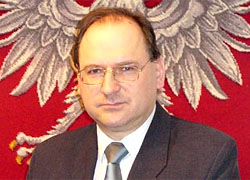
Ambassador of Poland to Belarus Henryk Litwin has given an exclusive interview to www.charter97.org website:
- Mr Ambassador, before your arrival there were no Polish Ambassador in Belarus for two years. You work in our country for two years. What has changed in the relations of Poland and Belarus over this time?
- In these two years structures that existed before, but didn’t work for different reasons, get to work. We open new spheres of activity. I won’t enumerate all these working groups, bilateral and mixed commissions, but they are plenty. And there are concrete results. The work is certainly faster in some directions, and in some is slower.
It should be noted that economic relations between our countries developed well, trade turnover was growing. But there will be no growth this year for sure. It is not connected to lower activity of economic entities. It is caused by the financial crisis. So this year we are to observe downfall in trade turnover as compared to 2007-2008.
- 20th anniversary of victory of the Solidarity trade union in the first free election is celebrated in your country this year in your country. What does Solidarity mean to you?
- I am a member of the generation for whom the whole life is connected to Solidarity. If the word “solidarity” is said to us, we immediately think of our “Solidarity” of 1980-1989. I cannot speak about that unemotionally – it is my own life, after all. During the first “outbreak” of “Solidarity” activities, I was still a student, and took part in all these events…
In the usual situation of the People's Republic of Poland, the opposition consisted of a small number but really active people. They published illegal books and newspapers, organised defence of people, who were repressed. The majority of the society however, who didn’t agree to what was going on around, were not still ready to take part in the Resistance movement actively. They were sitting in their kitchens and expressed their indignation over a glass of cognac. But after “Solidarity” emerged, after the events of 1980 and 1981, the majority who kept silent, expressed their opinion openly at last, as they felt that it could be done with no extreme risk.
Since 1980 “Solidarity” was a huge movement of practically entire Polish nation. Several millions of people were members of the trade union, but in reality, there were more people involved in it, it was almost half of the population.
Undoubtedly, charges in Europe and in the world started with the Poles’ freedom fight. It wasn’t certainly the only factor, but if it were not for that strike of “Solidarity”, that outburst which brought freedom to Eastern and Central European countries, the Soviet Union would hardly come up to “perestroika” and reconsidering of some of its actions.
- You are who you are thanks to “Solidarity”, aren’t you?
- Certainly. Before 1989 I could not think I will work in the Foreign Ministry, or become a diplomat. I was sure that my life would take a completely different direction. I was trying to find a place which would allow me to be active, but without taking part in the official life of the People's Republic of Poland. We lived in an “internal immigration” at that time. I couldn’t agree to what was going on in the country, and I didn’t want to emigrate from Poland.
But then completely different opportunities opened up, as thanks to “Solidarity” enormous changes took place in the country. In 1991 the Foreign Ministry of Poland was looking for new people, and experts who could conduct a new Eastern policy were especially sought-after. If you remember, then Poland was conducting a policy of maintaining maximally good relations with Moscow, and at the same time offered strong support to Vilnius, Minsk and Kyiv. It was before the events in Viskuli took place. We opened new representations in all these countries. As a historian, I studied Ukraine, so I got into Lviv, and then I decided to stay in the Foreign Ministry.
- Poland and Belarus had the same starting positions after the collapse of the Communist regimes. It happened in Poland in 1989, and two years after, in 1991, in Belarus. To your mind, why Belarus is lagging behind in its development so seriously today?
- I will not agree that starting conditions were equal. No matter what is said about the People's Republic of Poland, it was a separate state with its state structures and cadres. Belarus didn’t have that. Belarusians were taking part in the work of a different state at the level of a republic, despite of the well-known membership in the UN. So the difference in great. Not to mention that start of the states that were part of the so-called Socialist camp and were not part of the Soviet Union, was not so difficult.
Poland wasn’t a typical “barrack” in that “camp”. Bulat Okudzhava once said that it was “the merriest barrack”. And generally speaking that was true. Poles could contact with the normal world. In times of Edward Gierek we could receive foreign passports and travel in Europe. It was difficult certainly, but many Poles knew how a normal life of a European state looks like. The Soviet Union was much more isolated.
Now there is a difference between Poland and Belarus as well, and the reasons for that are obvious. We have chosen two different paths. They say openly in Belarus that the country is march its own, some kind of a third way. And we haven’t been looking for any third way. We simply adopted a model and tried to develop on that model. This process is not finished yet of course, but it is obvious already that it was the only way for us. We are naturally persuading everybody around that it is a good choice. But every country is to decide for itself.
- Polish Foreign Ministry was a locomotive in the process of dragging the Belarusian authorities into the European sphere and tearing off Lukashenka form Russia. Today in the UN Belarus votes against the territorial integrity of Georgia, Russian tanks and paratroopers are stationed near Brest, repressions against oppositionists and the civil society in Belarus continue. Are these the results the Polish leadership expected from the “dialogue” of the EU with the Belarusian regime?
- The policy of Poland towards Belarus should be looked at in a different way. We are neighbours of Belarus and a nation which history is closely interrelated with the history of Belarusians. We want to be a friendly neighbour of Belarus, and we think in the first place that we will live next to you in 50 years, in 100 years and in 150 years.
Today we would like to have both contacts with the oppositional circles of Belarus and circles close to the current government. But we cannot think about politics only, though it cannot be avoided. We have tasks of bilateral cooperation, which should be solved irrespective of whether we like the political system of Belarus or not, whether the relations between our leaders are good or not. We just have to do that. It is a responsibility before the society, and before the people who will live in the future.
We cannot stop concern ourselves with economy, ecology, borders’ issues. We have to maintain contacts, develop cooperation in many spheres no matter how we are close politically. That’s the fact the Polish policy proceeds from, and not from some political combinations.
As for Poland’s being a kind of a locomotive in involving Belarusian authorities in the European sphere, the situation is a little bit different. Please pay attention to the events of 2005-2007. Then the relations between Poland and Belarus were much at a much lower level of dynamism, then the relations of your country with other European countries. In the next years we simply trying to catch up with others and restored a technically normal level of contacts.
A thaw in the relations of the EU and Belarus has happened firstly as a result of re-evaluation of the Eastern policy of the EU after the Georgian crisis. As a result of this reconsideration, the EU has made a conclusion that its presence in the Eastern European countries should be enhanced and be more active. Not that the European Union has started some kind of competition with Russia concerning the place of Belarus. Belarus will be there where it would decide to be itself. I would like to repeat once again, these are simply changes in activeness intensity, and one cannot be active without contacts with the official authorities. We had contacts with Belarusian oppositional structures and the civil society, we have them now, and we are sure to have them in the future.
- But despite of the contacts with the regime, crackdown on the Union of Poles in Belarus does not stop.
- Polish organisations and the Polish minority in Belarus is one of the issues we haven’t been able to solve. It’s true, recently we received several signals which are giving rise to doubt. However the dialogue goes on, though it is a complicated dialogue. We were seriously alienated at some moment, and it is not so easy to return to a more or less normal situation. Our duty is to try to mend this situation. Poland has no two ways about it. Many our compatriots live in Belarus, and they want to interact with Poland actively. Questions of Belarusians in Poland and Poles in Belarus are very important, so we should look for a way out of hard situations together, though it is difficult.
- In many countries of our region, GDP decrease was from 10% to 20%. And only in Poland and Belarus this index hasn’t dropped. What is the secret of our countries’ economies’ stability?
- Frankly speaking, I cannot understand how Belarus has managed to prevent the loss, and even ensured growth of the GDP after such a sharp decline of Belarusian export by 40% or even more per cent.
As for Poland, against the background of the rest of Europe, it is certainly an interesting contract. The GDP has decreased in all European countries except Poland, Cyprus, and maybe Malta. There were different preconditions for that, certainly. In our country it is related to the internal structure of the economy. Small and medium companies yield the majority of profit in our country. They are not so dependant on the financial market, and probable that was the reason their reaction to the financial crisis was not so acute. These enterprises are more “flexible”. Let’s look at the turnover with Belarus. By the middle of this year there was no decline of Polish export to Belarus. There was a decline of volume of currency, but it was connected with financial processes, and primarily with Polish currency’s fall. Our export was growing thanks to small and average companies – they have been always flexible in their response to market changes.
Product range Poland sold to Belarus and Russia, was changing every year, as these small firms reacted to the situation and changed their range of items. It seems to me, that is the reason we are overcoming this crisis pretty easily. But it is not the end. Let’s see what is yet to come. Certainly, there are reason to be optimistic, but one cannot be one hundred percent sure that there won’t be difficulties any more.
- Previously embassies of the EU countries and the US promptly made statements of protest after human rights violations in Belarus, and Belarusians felt that the international community is following the situation in the country. On September 9 and 16 peaceful oppositional rallies, against Russian troops in Belarus and the one dedicated to the Day of Solidarity, were brutally dispersed in Belarus. However, there has been no reaction from the EU Embassies to crackdown on these and many other protests so far. Why?
- There was a reaction from Swedish Embassy, the country which is presiding in the EU now. It should be understood as the reaction of the EU. But you should speak about details with my Swedish colleague, as he speaks on behalf of us, and we are trying not to interfere with our statements, which are to be made by the presiding country. Poland certainly supports the latest statement of protest.
- Today Kalinouski program is realized in Poland: young activists expelled from Belarusian universities on political reasons can get education in your country; an independent TC channel Belsat has been created. The Belarusian authorities are highly displeased by these programs. Could it influence the fate of these projects?
- We know that the Belarusian authorities are displeased by these projects, as we watch the Belarusian TV sometimes. But I can say that neither Kalinouski program nor Belsat have never been a negotiating point in Belarusian-Polish meetings. The Belarusian side has never raised that question.
It should be underlined that Kalinouski program and Belsat TV channel are projects which have governmental support. It is an element of the common European structure of financing public purpose projects. In simple terms, there is a kind of a “pocket” in budget of European countries with money for financing NGO projects. Official structures just choose which project to finance. The idea to support Kalinouski program and Belsat emerged in the Polish society, and it was supported by Belarusians. As the necessity of these projects hasn’t disappeared for any of the sides, I do not think some changes in financing are possible. Though the financial crisis should not be disregarded of course, and some redistribution of finances is possible.
- Belarusian oppositionists view the Belarusian dictator’s welcoming in European capitals as betrayal of Belarusian democracy. Today Polish press calls the decision of the US not to place anti-missile shield elements in Poland and the Czech Republic a betrayal of interests of the new EU and NATO members. Does it mean that the democratic countries are defeated by dictatorships, totalitarian regimes?
- Such a dramatic question is a right and a duty of a journalist. A right and a duty of a diplomat is a balanced and composed reaction. I am sorry, but I do not want to evaluate actions of the neighbouring friendly state. It seems to me that you should address the first part of the question to my Lithuanian counterpart.
And speaking about anti-missile system, it is a very complex issue. We do not know a lot so far. We know that the project has been changed, but the idea remained. We would be able to evaluate everything, when we will know exactly, how that changed project would look like. One shouldn’t forget that it was an initiative of the US, which is primarily connected to the security of the US, and only then with the security of European countries. We have answered the initiative of the US, but the US changed its plans. What could be done? I am absolutely sure that Barack Obama and his entourage think about the security of the US no less than any other American president. As before, America links its safety ensuring with tight cooperation with the NATO countries. It coincides with our vision of security in Poland and all over Europe. So nothing has changes seriously, to my mind.
- Poland was actively advocating Belarus’ joining the Eastern Partnership program. How can this program tangibly influence the situation with human rights in Belarus?
- It is a really interesting question. We believe that participation of different Belarusian structures in close cooperation with the EU, in realization of concrete programs cannot but influence the public and political situation o the country positively. But using computer language, I still cannot name concrete “links” thanks to which some positive changes would take place. We will implement projects in which representatives of the civil society and governmental structures are to take part in equal measure. It seems to us that it should change their relations. The first programs which have been prepared and which are being realized are aimed at acquainting member countries of the Eastern partnership with some procedures and means of receiving money from European structures. These programs still work separately for representatives of the opposition and for government institutions, but I have no doubts that projects with participation of the both sides are to be realized in the future. Thanks to that relations between the government and the opposition could be mended.
- Many Belarusians note that difficulties exist when receiving a visa to Poland. Will this procedure be facilitated in the near future?
- The procedure is the same everywhere. But previous experience of receiving visas in Polish consulates still influences the evaluation of the process strongly. We have paid for the first period of Poland’s existence in Schengen system. First the system was not working very good, but now many things have changed, and the procedure of receiving visas have become quicker. We are issuing a huge number of long-term visas.
Earlier everything was more difficult. A Belarusian citizen who came to get a visa was first to receive something like a receipt, which shows that the citizen can hand in documents after a certain period of time. It made the procedure more complicated, but now such things do not exist: Belarusian citizens can visit any consulate of Poland any time and bring their documents immediately. But they still have to wait for a visa, as it does not depend on us only, but on all countries of the Schengen treaty.
This formality takes a little more time in our embassy only because much more people apply for a visa to our embassy. For instance, 700 persons in one day can bring their documents to our embassy to receive a visa, while only 30 can apply to another embassy. It seems to me that the society has already got used to Schengen visas, and sees there are difficulties, but there are also advantages. We have rather cheap national visas, and the procedure is much easier. But most people prefer to wait and receive Schengen visa, as it is very convenient. After paying 65 Euro, one can travel to Europe for the whole year.
- It is known that you have received master’s degree of Warsaw University in history, received postgraduate education in the History Institute of the Polish Academy of Sciences, wrote master's thesis. Many Belarusian historians believe that the Treaty of Riga of 1921 was the same event for Belarus as the Molotov–Ribbentrop Pact of 1939 for Poland. What do you thing about that as a historian?
- I certainly know about such opinions and evaluation. But it is very strange for a historian to treat history from only one point of view, disregarding relevant political, social and other circumstances. There is great difference between these events yet.
In what situation the Riga Treaty was signed? A revolution took place in the former Russian Empire. After 120 years a Polish state emerged at last. There was a powerful public movement on the one side, and a national liberation movement on the other side. The level of national development of Poles, Lithuanians, Belarusians and Ukrainians was different due to many reasons. Te idea of Belarusians statehood was relatively weak. In Poland at the same time when the state was constructed, a discussion was held, how it should look like. There were two possible variants: a federal state and unitary state. This discussion was finished by the Red Army, and then the advance of the Polish Army to the East. Frightful to think of what could happen in Europe after Poles’ not being able to defend the Vistula line. So the Polish army which first defended its own territory, then followed the retreating Red Army, and a situation emerged in which the issue of borders was to be solved, and primarily from the point of view of the alignment of forces of the Soviet and Polish states.
As a result, the Belarusian factor wasn’t taken into consideration. It looked differently with the Ukrainian factor and again differently with the Lithuanian factor. The country which made reference to the traditions of the Polish-Lithuanian Commonwealth, could not view the territorial question in this context. It was happening in line with national ambitions of Ukrainians, Lithuanians and Belarusians. And the force of these ambitions gave such a result.
In 1939 there was a completely different situation. It should be better looked at from the viewpoint of the international law: an independent state existed (though it could be debated for a long time whether it was favourable for Belarusians, and there is plenty to talk about). But the state which existed in line with the international law, was liquidated in the framework of an agreement of two other states! Besides, these states earlier concluded a non-aggression treaty with the country they liquidated. These actions were totally illegal from the point of view of the international law.
Everything changed in 1944-1945, when agreements between Poland and other countries were concluded, and new borders of the country were determined. From our internal point of view, certainly, we unambiguously believe that Poland is a legal successor of that state, and we respect all these international agreements and consider the present borders of the state inviolable.
But in reality one could ask whether Poland and the Soviet Russia had a moral right to decide the fate of the Belarusian nation in 1921.
- A monument to the Pope was opened in Vitsebsk on the 30th anniversary of John Paul II election to the Holy See. You were present at the opening ceremony. To your mind, why the great Pope hadn’t visited Belarus?
- It seems to me that the relations between the Catholic Church and the Orthodox Church then hadn’t reached an adequate level. John Paul II would not visit Belarus or Russia without an unequivocal agreement and invitation from the Orthodox Church. There was no such invitation from the Patriarch or Metropolitan, so he could not arrive. But everybody knows he wanted to visit Belarus and Russia very much.
- Mr Ambassador, it’s been several years since you live in Minsk, observing live in Belarus and people loving here. What is your vision of the future in our country in two years?
- I hope to stay in Minsk after two years and see everything for myself. I think Minsk is a good and comfortable place to live. Me and my family like it a lot. Once we tried to count in how many flats and houses had we lived over the last 20 years, but lost count. Our favourite city is Roma. This place is incomparable. And after it, frankly speaking, goes Minsk.
How do I see Belarus in two years? It’s hard for me to say something concrete, as you are asking the acting ambassador in such a way for him to evaluate the current government. It’s your right, and the right of a diplomat and ambassador to evade such questions.
I would like to wish Belarus to flourish and to develop, for the Belarusian economy to grow, and the living standards to grow. You know our Polish proposal to Belarus. You get to choose.
Interview by Natalia Radina
We express gratitude to Pawel Marczuk, First Secretary of the Embassy of Poland to Belarus, for his help in organising the interview