
World Bank: Only credits keep Belarus from default as yet
28- 24.06.2009, 10:27
The ratio of the short-term foreign debt to gold and foreign currency reserves of Belarus is the highest among developing countries of Europe and Central Asia.
In fact, only active foreign loans keep our country from default. Such a conclusion has been made in the study of the World Bank published on Monday “Global Development Finance 2009: Charting a Global Recovery”, the BDG newspaper writes.
According to the information as of February, the short-term gross external debt of Belarus exceeded gold and currency reserves almost three times.
Foreign loans help to improve this statistics a little. According to the statistics of the National Bank, by April 1, 2009 the short-term foreign debt of Belarus was $8.194 billion, while international reserve assets of the country, according to the IMF, were $3.955 billion. In fact our country is on the list of the countries of the region that are saving themselves from default only thanks to taking foreign loans actively.
Latvia’s indicators are also alarming. Its short-term foreign debt in February exceeded the gold and foreign currency reserves in two and a half times, and Bulgaria is almost in the same situation. In the case when the foreign debt would be demanded to be paid by the reserves, Poland, Macedonia, Moldova, Romania and Kazakhstan would have to spend more than a half of their gold and foreign currency reserves. According to the World Bank, this year the CIS countries should pay foreign debts equal to $283 billion dollars, however among the countries with the high short-term debt only Russia has money to cover the debt.
In such a situation the developing countries of Europe and Central Asia are trying to attract financing of international financial institutions. From September 2008 to May 2009 9 countries of the region including Belarus reached an agreement with the IMF on attracting $55.8 billion in total, and 6 countries adopted agreements with institutions cooperating with the World Bank. It is informed that Turkey and Lithuania are also studying variants of cooperation in stabilization programs of the IMF.
The situation looks more serious for the little developing countries of our region, as their financial systems have faced decrease of takings from Russia. “For the first time in the decade remittances from Russia by the CIS countries have decreased by 25%,” the report informs. In the fourth quarter of the last year inflow to the CIS countries from Russia was $3.17 billion, which is $2 billion less than in the previous quarter.
Analysts of the World Bank underline that because of the crisis in Russia, little emerging countries which economies are tightly interconnected with the Russian’s and that import oil from Russia, are in the most difficult situation. Among them are Armenia, which GDP is to drop by 6% in 2009, Belarus – by 3.3%, and Moldova – by 3%. In decrease in the CIS countries in general is to make 6.2%.
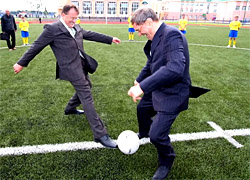
Pyotr Prakapovich, National Bank head, and Kanstantsin Sumar, chairman of Brest regional executive committee, are fond of kicking the ball about. Photo by “Zarya” newspaper