

Krzysztof Zanussi: “The most important thing is to wake up conscience”
6- 22.09.2010, 12:41

Krzysztof Zanussi’s performance „Death and the Maiden”has become a real shock for a Minsk viewer.
The play Death and the Maiden by Chilean playwright Ariel Dorfman was staged by the famous Polish director Krzysztof Zanussi in Gorky Russian Drama Theatre in Minsk. The time in the play is the present and the place, a country that is probably Chile but could be any country that has given itself a democratic government just after a long period of dictatorship. The heroine of the film, whose husband is the chairman of the Human Rights Committee, meets a man, who tortured, beat and raped her many years ago when she was a young oppositionist. The woman remembers sufferings she underwent, and she wants to have revenge upon her tormenter. She tied him and held a court…
The first night of “Death and the Maiden” was on September 21. The day before Krzysztof Zanussi gave an exclusive interview to charter97.org website.
- Do you understand how relevant for Belarus is the topic raised by you in the play? Under Lukashenka’s rule people are abducted and murdered, oppositionists are imprisoned under false charges, they are beaten and intimidated?
- As I have chosen this play and decided to stage it in Belarus, I certainly knew that it correlates with your experience, your reality, your sufferings. But I cannot judge to what degree. It is to judge for those who live here and see what is going on here, what is sanctioned and prohibited here. I hope that I will see by the reactions of the public what are the concerns this country.
- What could you say about the response of the Belarusian public to “Death and the Maiden”?
- I felt that people understand the plot unmistakably, and they are not indifferent. There was response to certain thoughts, words. I staged this play in Germany, Poland. In every country it has different meaning. I saw it in New York, and it means something completely different there. But in the countries where crimes of the authorities were most massive, this play is more relevant.
- Do you realize the risk of staging this play in Belarus, and that the play could be prohibited by the authorities?
- Certainly they can. However I do not think so, as today the theatre cannot cause a revolution. When Victor Hugo created “Hernani”, a revolution in Paris started. But the people who went to theatre then were different. Today TV has real influence, and the theatre has always been for elite. Unfortunately.
- What is your vision of solution of the deep problem discussed in the play? How the society which is liberated from tyranny should treat those who had been making them suffer for many years?
- Undoubtedly, the most important thing is to wake up conscience. For people should know what is good and what is evil. And they should not think that evil is acceptable under certain conditions. Repentance and punishment should come. There is no development of society without that.
It is a great problem. All societies which tried to forget without repentance, later returned to instability, as the younger generation lost trust to their parents and grandparents. Such a situation happened in France, which had not settled accounts with Vichy regime, and in Italy, which had not settles accounts with fascism completely. Later social instability came to all these countries. So one should always look back on the history, not forgetting conscience, not falling into stupid cynicism and pragmatism, when people say: “Let’s move on, let’s forget the past.” It must not be forgotten. As Boris Pasternak wonderfully said: “We are not living in the nature, we are living in the history.”
- What would you like to say to the doctor who is not tied today yet, but is sitting in the audience hall?
- He should not forget that he answers to his conscience and to people for hid deeds.
***
Krzysztof Zanussi invited a potential presidential candidate for presidency in Belarus, leader of “European Belarus” civil campaign Andrei Sannikov to the show before the premiere. He knows him personally.
“When I received an invitation from Krzysztof Zanussi, I set aside all my affairs, which are rather numerous now, and went to the theatre. Zanussi is a wise person, that is why in his play he does not speak about a dictatorship of today, but about the things we will have to face very soon. After a dictatorship the society needs a return to normal human relations, to morality. There could be different comprehensions of this play. For me the idea of the author and of the stage director sounds as following: for a society not to develop a fatal disease, it should be rescued from hideousness of dictatorship as soon as possible,” Andrei Sannikov said.
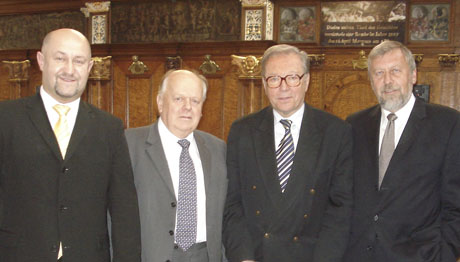
Andrei Sannikov, Stanislau Shushkevich and Zmitser Bandarenka with Krzysztof Zanussi (archive photo)