
Gazeta.ru: Putin chose the time for "lukashenkization" Russia poorly
14- 9.07.2012, 11:05
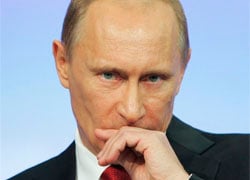
The main obstacles for the Russian president will be openness of the country and the economic situation.
By almost daily increasing repression, the Russian government is trying to put Russia into a stupor like that which the Byelorussians have under the yoke of Alexander Lukashenko. But Russia is not as similar to Belarus as the Kremlin would see it.
Whether instinctual or by some sort of plan, our government's attempt to emulate Lukashenko isn't important. What is important is an ever-increasing amount of people understand what is happening.
"This is a show trial, Lukashenko's policy," says an anonymous source in law enforcement, talking about the persecution of the so called riot participants in Bolotnaya square.
And Ombudsman Vladimir Lukin laments that the Russian investigation of Bolotnaya case resembles the Belorussian persecution of protest rally participants in December 2010.
But it is not only the ombudsman who laments, and not only because of the hastily created show-trial about Bolotnaya. Almost all governmental actions have created conflicts.
A more exemplary case is the Punk Prayer by Pussy Riot, which looks like a medieval witch hunt, but not many people are ready to publicly justify the eagerness of the persecutors and the silence of the Patriarch's entourage.
Many of professional agitators that government employs, who habitually jumped over themselves to explain the feminists' arrest, are now trying to move aside.
On the contrary, there's a letter from cultural celebrities, talking about the secular grounds of our state and the illegality of persecution for anti-clericalism. Many of the signees are people who proved their loyalty to the government several times. Nevertheless, not only mercy, but very practical thoughts about their reputation forced them to detach themselves from this unfolding story that is detrimental to their contacts with colleagues from civilized countries.
This letter was recently supported in the Presidential Council for human rights, which dissociated itself from the case hoping, in to avoid influencing its course and to show its rejection of such actions.
The chairman of the said council has sent a letter to Duma speaker Sergei Naryshkin asking him not to adopt a punitive law against non-commercial organizations.
Even the Public Chamber, the most tame and disciplined squad of the artificially created "Civic society structures" has condemned the law.
Almost all the members of the Public Chamber are ready to collaborate with the authorities in many things, but not in the hunt for the "foreign agents", since any of them can be easily put among the victims, if necessary.
The State Duma has passed a similar test. The General Prosecution's demand that the parliamentary immunity be lifted from deputy Bessonov, accused under dubious pretenses, contradicts the interests of all deputies without exception. It was not the fate of Bessonov, but their own fate that United Russia deputies decided when they voted to deprive the deputy of his immunity.
The opposition that has recently appeared in the State Duma after many years of absence, is already able to make some noise, but it's not strong enough and sure of itself to stand up successfully for at least some of its ideas. But is the other side powerful?
President Putin has, until now, avoided saying any concrete words about his new course, keeping the right to disavow what he has sanctioned previously. Meanwhile, a new layer of people is building itself, people who have firmly and irreversibly fell into "Lukashenkization" trap. These are judges, prosecutors, lawmakers and all those who secure the seamless work of the political repressive conveyor belt.
There are not so many of defenders of the repression, and the most active gain notoriety fast. The most famous is surely the chief of the Investigation Committee, Alexander Bastrykin, who takes on the responsibility of a high judge, sentencing those who are not yet convicted according to the law. Here is what he says about Bessonov: "No pressure from the outside… will save this man, having the status of the Duma deputy, from the responsibility set by the law."
The disposition is clear. There's a fast and forceful advance on society, meeting stormy but dispersed protests. The similarity between this and the rule of Alexander Lukashenko is evident, but it looks more like its earlier phase than the current one.
The thing that our authorities are doing now, Lukashenko, who headed Belarus in 1994, already did in the 90's. By the time Yeltsin passed his presidency to Putin, it all already had happened in Belarus: the leader's power was unlimited, opposition marginalized, the official class was radically cleansed and beaten into submission.
It's not that the little Belarus is easier to govern manually more than the power vertical is shorter in Belarus and thus much more reliable.
It's more important that the "Lukashenkization" experiment has started here in another historical period – not right after the fall of the Soviet Union, but after more than two decades of capitalism, even if distorted and not in a small and isolated country, but in a country more or less open to the world. The Russian state is much less suitable for this barbarian procedure today than Belarus was 18 years ago.
Of course, they can try.
Surely, the class of Moscow educated professionals, a large share of businessmen and the enlightened part of the bureaucracy would like to live in the XXI century, not in the stagnation of a banana republic. And even the majority of Putin-era new people are connected to the West with their commercial and personal interests and are afraid to lose these connections.
But if repressive pressure goes on long enough and hard enough, both could be forced to retreat. There aren't so many in this class, in the country's scale.
It will be harder with the people though. Putin of 2012 is not Lukashenko of 1994, elected Belorussian president in a tide of non-imitated enthusiasm.
The love has long passed, the idea that the bosses go too far has become common.
There is not even solidarity with the authorities in front of a hostile west. In all-Russian polls by agencies FOM and Levada-center about the Magnitsky list there's a double majority of those who approve the ban for the law enforcement generals from this list to enter the USA.
The acts of "Lukashenkization" have not drawn upon the people's sympathies either. Russians take it either as an untimely revenge by the authorities, or as – and this is a much more important signal – an attempt to shut the mouths of all the discontent, including simple people from the provinces.
And the number of the discontented grows after the short fall. The balance index of protest attitude, counted by the FOM has grown in the last 3 eeks from 25.7 to 30.3 percentage points.
This is basically the level of the end of last year. On July 1 the rating of concern with the price raise has grown sharply, although the real bump in discontent with the rise of communal tariffs, fines and excise taxes is in front of us.
All this combined brings us to the thought that the time chosen for Russia's lukashenkization was chosen badly. And in few more months the untimeliness of these actions could look even worse. We are waiting for manipulations to the pension system that the people won't like, inflation groth, and the sequestering of social spending.
The internal and global economic situation doesn't allow the Russian authorities the opportunity to have popular politics. There is a choice between several unpopular alternatives coming up.
To add here the repressive campaigns executed by the people who have lost sense of time and aren't approved by the majority high and low is simply rocking the boat. It is a bad time for political experiments.