


How Belarusians United with the Help of Courtyard Chats
- 12.08.2021, 11:43
- 5,816

A unique phenomenon that was born in the country last summer.
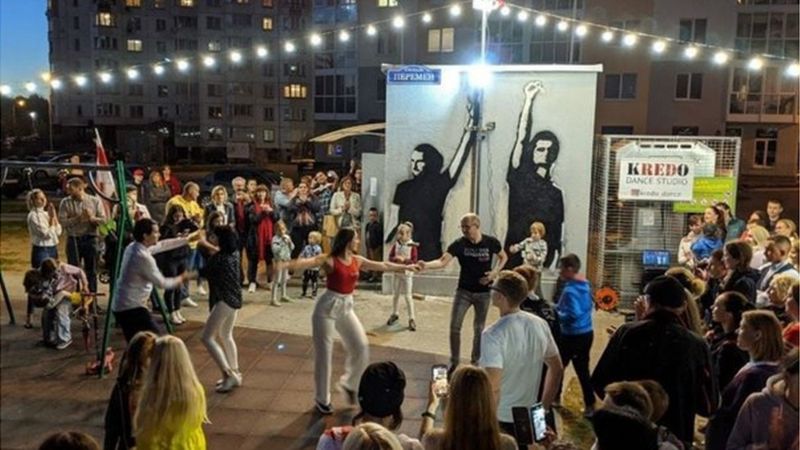
Yard chats are small groups in the Telegram messenger that brought together neighbors in a house or micro-district. Against the background of the growth of protest activity, these chats allowed neighbors, who had barely greeted before, to really get to know each other and coordinate their actions - from going to a protest rally to drinking tea together. The motto of the participants was a line from the song of the band Splin: "We did not know each other until this summer," the BBC website writes.
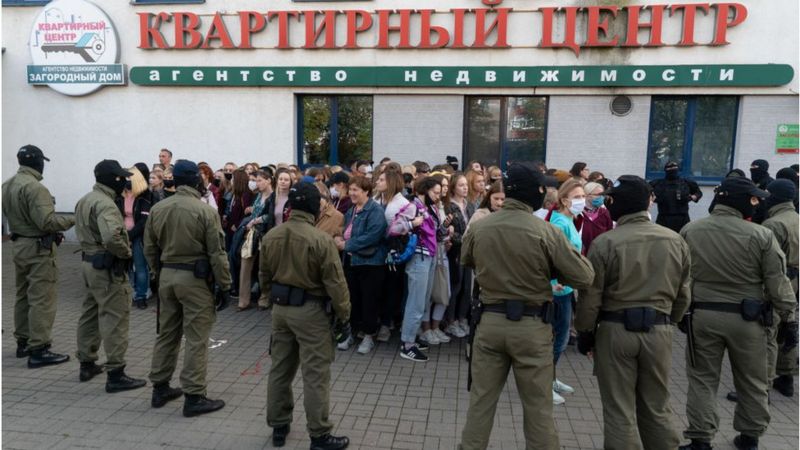
It is impossible to establish how many of these chats were there, but the authorities themselves reported sweeping of thousands of such groups throughout the country. The siloviki forced people to delete these chats or infiltrated them themselves - they posted red-green flags and threats against the participants. Administrators were put on the wanted list, forced to flee the country, forced to apologize on video cameras.
In the spring and summer of 2021, the pressure increased even more. The Investigative Committee of Belarus announced that participation in such chats is equivalent to extremist activity - the authorities considered that the main focus of these "formations" is "radical actions." Their administration, thus, began to be interpreted as the organization of an extremist group - according to Belarusian laws, this is up to seven years in prison.
The Belarusian authorities did not name the exact number of people detained during the chats; activists talk about dozens of people who have come under searches, administrative or criminal prosecution.
Chats were created as open and public, now the few remaining are closed - you can get there only by personal acquaintance. They are not used under their real names, and their administrators have de facto gone underground.
In Belarus, where its own independent media have been destroyed and many foreign ones have been blocked, Telegram, according to some estimates, had 2.4 million users in August 2020 (the country's population is 9.3 million). Major news channels such as Nexta, which had 2.1 million readers in August 2020, have been deemed extremist. Thus, courtyard chats remained one of the last opportunities to receive news and communicate with each other.
Let's go have some tea?
Olga (she asked not to indicate her last name for security reasons) lived on the outskirts of Minsk. “In a past life, I was a good accountant,” she says about herself.
Olga was the chat administrator of her neighborhood. The chat was created in the first half of 2020 and performed purely utilitarian functions: people discussed in which store which goods to buy, where it is better to repair household appliances, and so on.
Olga says that, after the events of August 9-12 - the presidential elections and the first protest demonstrations, the need for people to meet, talk and reflect on what was happening was enormous. And then she just wrote to this chat: we have a wood-fired samovar, let's go have some tea. Dozens of people responded to the proposal.
Tea parties happened every night, people came there after work. We discussed news, came up with local actions like hanging red and white ribbons in the colors of the national flag. They were very careful: there were no symbols or alcohol on the tea parties themselves. Either could have been a reason for the police to intervene.
In August-September, at the peak of activity, up to 150 people gathered for tea, Olga says, there were about 1.5 thousand participants in the chat itself (the population of the micro-district is about 10 thousand people). People brought their samovars, cookies and sweets, bacon and sausage. There were many children, Olga recalls, happy that, unlike at home, they could eat their sweets here without any limits.
People discussed both politics and assistance to the detainees and completely ordinary things: the condition of their homes and yards, children, their academic performance, and schools.
The police often watched what was happening, but did not intervene.
Starting in October 2020, Olga started having problems. First, she was fined about 25 basic units (about 300 euros) for hanging red and white ribbons, then she was detained for trying to rescue a woman from the police whom they wanted to detain. Finally, Olga says, she received 12 days for painting the railing of an old staircase that led to a local pond in red and white.
The tea parties did not stop. “The neighbors responded to my first arrest by taking out the barbecue,” she laughs.
“We went out even in cold weather, it was a great pity to lose what we had gained. We have developed a relationship - even more than kinship. We helped each other not only in protest activities but also in everyday things. Not all families have such relationships,” Olga says now.
In February 2021, Olga says, they came for her daughter, a student, and tried to accuse her of administering the district chat. Then the mother and daughter were able to prove that this is not so. "Calm your mother down, then we will leave you alone," quotes Olega words spoken to her daughter.
Literally, a few days after that, Olga was summoned for interrogation to the Investigative Committee of Belarus, although, before that, she had communicated only with the regional security officials.
On the phone, Olga laughed it off: "Say, to come to you for an hour? You can't trust men in general, and especially your profession." She asked for a short reprieve due to a cold, immediately after that the family collected a minimum of things and left first to Ukraine and, from there, to one of the Baltic countries.
Olga still does not know whether a case has been initiated against them. By indirect indications, yes: according to her, her daughter was expelled from the university for being wanted.
Now the chat room of their micro-district has been seized by the security forces and discredited. Olga even corresponded with these people from time to time. “After they landed the plane with Pratasevich, they wrote to my daughter and me: wait, soon it will be the same with you. I will not quote to you what I wrote back to them,” she says.
"I pressed a button, and here we go!"
Ksenia (she asks not to give her last name for security reasons) is an employee of one of the IT companies. In August last year, she rented an apartment in a Khrushchev building in the center of Minsk.
“I pressed the button - and here we go!” this is how she describes the creation of a chat in early September 2020. “At that time, it was already clear that such small parties began in many houses and districts, and I would like to have the same for me.”
According to Ksenia's observations, courtyard chats first appeared on the outskirts of Minsk in new houses. People drove there and united to solve everyday problems even before the protests. The innovation reached the center later.
Ksenia shared her idea with a friend, they created a chat, printed ads. Plus one of the famous Belarusian bloggers in those days suggested: send me the names of the chats, and I will advertise them.
In the very first days of the existence of the chat, about three hundred were added there, at the peak - Ksenia recalls - there were about 1.3 thousand participants. Ksenia offered to meet in one of the courtyards, about fifty people came to the meeting. "And it started immediately: let's publish a newspaper, let's make leaflets. Someone says: let's arrange a vote on the Internet for the flag of our micro-district. I say: why on the Internet, let's arrange real voting with ballot boxes right here!" she recalls.
“It was the kind of psychotherapy that we all needed so much then,” says Ksenia.
Soon, concerts began in the courtyards. Once Ksenia was walking down the street, and she liked the band playing in another yard not far from her house. She called the musicians to them - and they immediately agreed.
Here the militiamen, too, at first observed and did not interfere, sometimes demonstratively drove a "busik" (that's what they call a paddy wagon in Belarus), but no one was scared.
They tried to coordinate the protest activity through the chat, but it quickly became clear that the security forces were reading it - at first, it was also open. Both attempts to get together and go to the protest procession were thwarted by the security forces.
"I understood that it was dangerous: chat administrators were caught back in September, they were forced to delete chats, I know of a couple of cases when they were accused of participating in mass riots. But I didn't think about it," says Ksenia. "Otherwise, it would be impossible to do anything because of this fear."
On October 28, 2020, they came for her. She woke up at nine in the morning from the fact that the intercom was ringing without interruption. “I immediately realized that it was after me, normal people do not come to me at such a time,” she says.
The same chat helped: Ksenia's friends drove the car right to the entrance, gave her 15 minutes to get ready, and then she was lucky - the car with the security forces left. As it turned out a little later, they went to bring the owner of the rented apartment and conduct a search.
“I never believed that they could come for me; I'm not a politician, I just started a chat room,” Ksenia is still surprised.
Friends took her to a border town, she spent the night with a classmate, whom she had not seen for seven years. “Hello, I'm facing a criminal offense here,” Ksenia greeted her.
She now lives in a country in Europe. "The level of repression overcame our fearlessness, it became clear that this was definitely going to last," she says. "The authorities are angry at us for our protests and will not rest until they shut us up."
"Field commanders"
Courtyard chats did not exist autonomously, their administrators got to know each other and contacted each other. Along with small ones, there were also chats for thousands of people - groups of people from this or that region.
We talk to their coordinators in an extra encrypted chat room, which can only be accessed by invitation - a link that stops working once it has been used.
One of the interlocutors asks me to send him any post of mine on the social network and edit it, first putting a punctuation mark, and then immediately removing it. This is how they make sure that I am who I say I am.
“The regime calls us “field commanders,” and worse, this is how it treats us. For people like me, at the slightest suspicion, they cut our doors with a grinder," explains one of the interlocutors the importance of such conspiracy.
One of the interlocutors asks to name him in the text “C for Chat” (analogy with the cult film “V for Vendetta” for protesters around the world).
He says that, in August 2020, he became the moderator of one of these large chats. If supporters of Aliaksandr Lukashenka came there, he tried to convince them or simply banned them.
C for Chat realized in September that people in his occupation were in danger. “During the arrests, the security forces began to seize people's accounts. At first, it all came down to vandalism. They either deleted the found chats and channels or posted their trash there. Then the security forces grew wiser and began to encrypt themselves. The activist was arrested, forced to give passwords to devices and accounts, and the security forces pretended to be him in chats. And we worked out ways to counteract this."
In the summer of 2020, when this activity was just beginning, people used their real names and their phones. Now, for such communication within Belarus, specially purchased devices with virtual or foreign SIM cards are needed, where the main messengers are protected by two-factor authentication.
“This is a systematic opposition of power structures to self-organization of civil society in the country. They are purposefully looking for coordinators," he sums up. "They blackmail the arrested, try to persuade them to "voluntary" cooperation, torture them. I know of cases when an activist was tortured in a car so that he would lure his friend out of the house. I know how another admin was captured right at the crosswalk."
Three stages in the life of chats
Another BBC interviewee who asked to be named Mr. Mountain divides the short history of courtyard chats into several stages.
The first stage is euphoria and those same courtyard tea parties. People met near their homes after the rallies, shared their impressions, exchanged red and white umbrellas and bracelets. When they first felt that their yards belonged to them, they cleaned and planted trees there.
“It felt like before the fall of the Berlin Wall, but, in our case, it only cracked,” says the BBC's interlocutor.
The second stage, says Mr. Mountain, is the protection of the conquered values. People gathered and laughed at local police officers and employees of housing and communal services, who were forced to cut off red and white ribbons and paint over slogans of the same color. And, in the evening of the same day, they painted and hung them up again, and then they hid from the security officials who were walking around the courtyards.
Finally, the third stage came in late autumn, when marches and processions ceased to be urban and became local. Then the chat admins took on the role of their organizers and coordinators - and instantly became the number one goal for the authorities.
“In a narrow circle of administrators and activists, we thought over a collection point, a route and tried to work out various scenarios - taking into account the fact that it was about the 15th Sunday in a row without a mobile Internet in the country (the Belarusian authorities have been jamming the Internet on weekends since the summer of 2020 - BBC). A huge number of ideas were invented to help the residents of the area return home from the march safe and sound,” the BBC's interlocutor says.
“Of course, we were not surprised that the main target was the creators of the protest infrastructure - the admins of the courtyard chats,” says Mr. Mountain. "After taking over the leadership of the marches, the yard administrators realized that this was a one-way road. That our freedom, and maybe life, will also be at stake."
***
“There is an outflow from open chats. People are tired of negativity, there have been no big marches for a long time, and it seems that there is no one left and nothing is happening," says the BBC's interlocutor with the nickname "C for Chat." “But it’s not true: people will never forgive Lukashenka.”