

Ukrainian Army Breaking Through To Svatove: New Battle Maps
1- 8.11.2022, 16:50
- 26,360
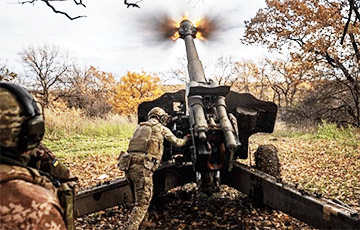
The Armed Forces of Ukraine are advancing in the Luhansk direction.
The Ukrainian forces are conducting counter-offensive operations on the Svatove-Kreminna line, while stubborn battles are going on in the Donetsk line, and the troops of the Armed Forces of Ukraine repel enemy assaults. Meanwhile, the invaders continue to “evacuate” the population from Kherson to the left bank of the Dnieper.
This has been reported by the Institute for the Study of War (ISW).
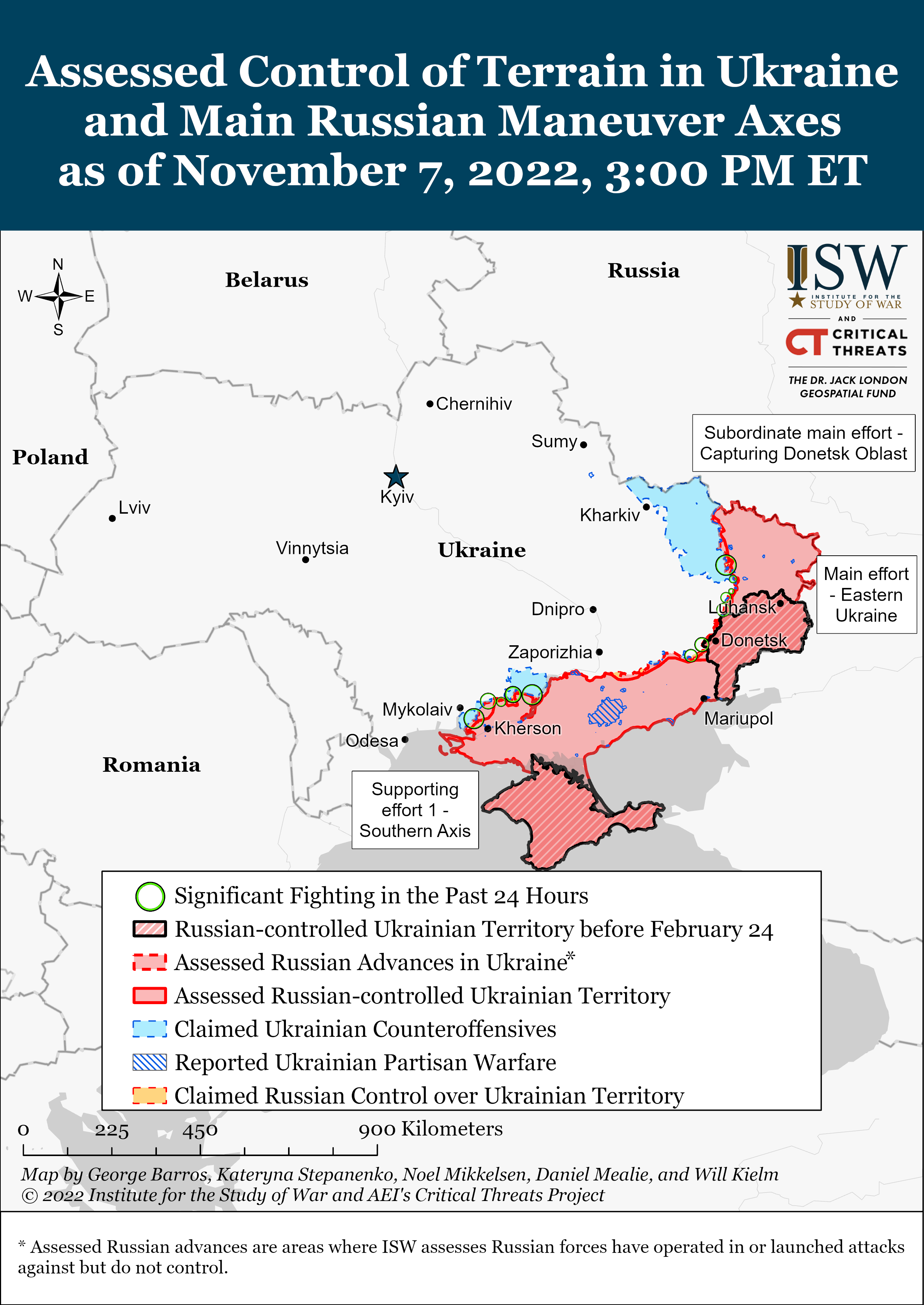
Counteroffensive of the Armed Forces of Ukraine in the Luhansk direction
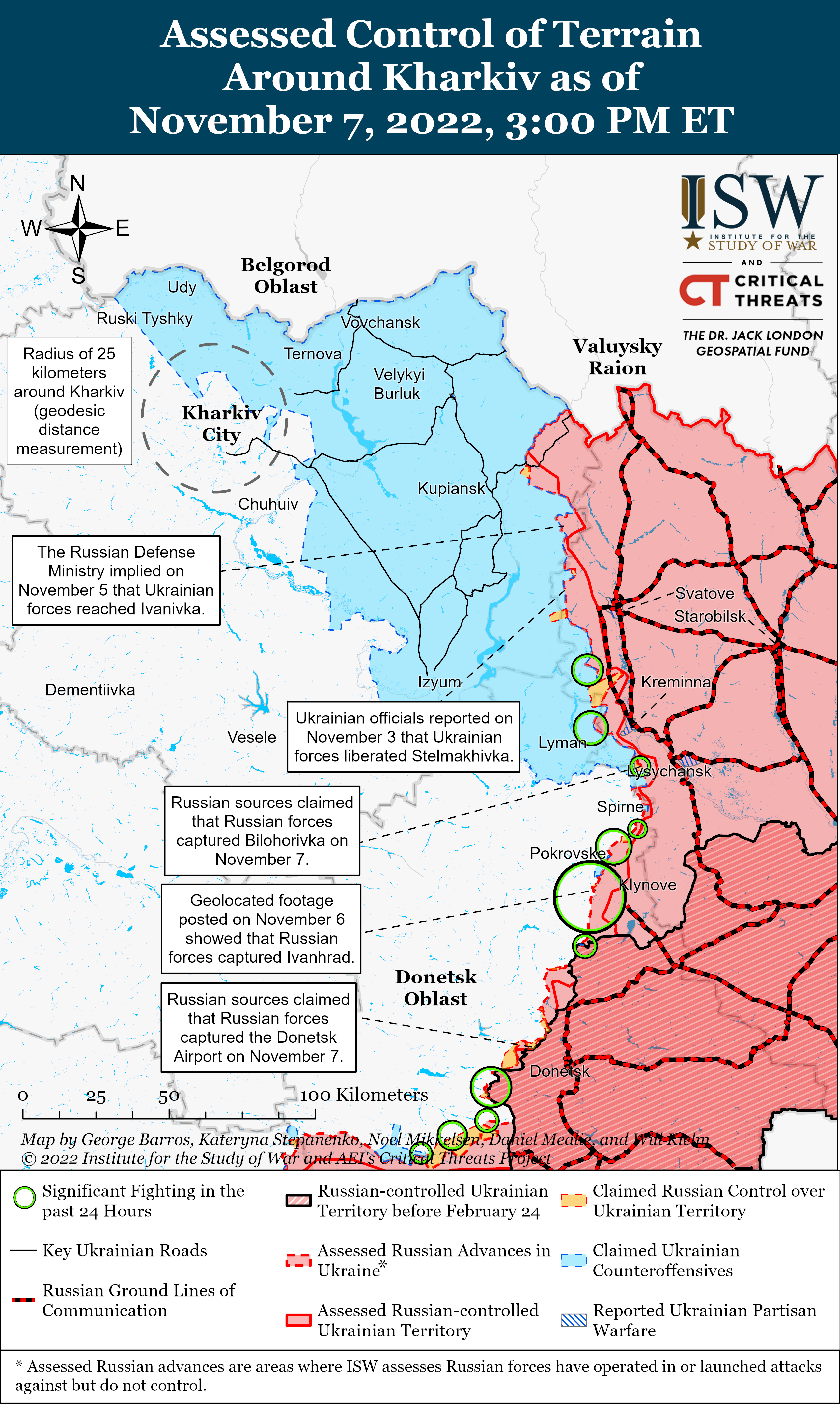
According to Russian sources, on November 6 and 7, the Ukrainian troops continued counter-offensive operations in the direction of Svatove. On November 7, the Russian Ministry of Defense announced that the Ukrainian Armed Forces had attacked Nizhnya Duvanka, about 15 kilometers north of Svatove along the R66 Svatove-Kreminna highway. In addition, it was reported that on November 6 and 7, Ukrainian troops advanced towards Novoselovsky, 14 km north-west of Svatove, and on November 7, fighting in the area north-west of Svatove acquired a “positional character”.
Russian milbloggers claimed that units of the 1st Guards Tank Army of the Russian Federation were on the defensive in the Svatove region, they showed footage of the Russian military firing from the TOS-1 thermobaric multiple launch rocket system at the positions of the Armed Forces of Ukraine in the Svatove region.
“The use of such a means of the military district in this area may indicate either that the Russian troops are increasingly giving priority to the defense of the Svatove-Kreminna line, or that Russian troops have largely used up ammunition that would be more suitable for close combat,” says the material.
On November 6 and 7, the Russian occupiers launched limited counterattacks to recover lost positions west of Kreminna and Makiivka. The General Staff of Ukraine stated that on November 6 the attacks were repelled in the direction of Yampolivka (17 km west of Kreminna) and in the direction of Yampol (18 km southwest of Kreminna) on November 7.
Attacks on Bilohorivka
Russian sources widely claimed that proxy forces and the Wagner PMC entered Bilohorivka (10km south of Kreminna) on November 7 after months of heavy fighting along the Donetsk region. At the same time, the Ukrainian General Staff did not confirm such information and noted that on November 7, an attack by the Armed Forces of Ukraine damaged a unit of the Chechen Akhmat battalion in Lysychansk, about 10 km east of Bilohorivka.
“The Russian forces are likely seeking to regain lost positions along the border of the Donetsk-Luhansk regions in order to push the Ukrainian troops away from the critical sector of Severodonetsk-Lysychansk,” the analysts write.
“Evacuation” in the Kherson region
The Russian occupation authorities are likely to begin a new stage of evacuation from the Kherson region. Thus, Gauleiter of Kherson region Kirill Stremousov said that November 7 would be the last day of organized evacuation from the western bank of the Dnieper to the eastern.
At the same time, Russian publics claim that private evacuations will continue from November 8 amid concerns over a “growing threat to the civilian population.”
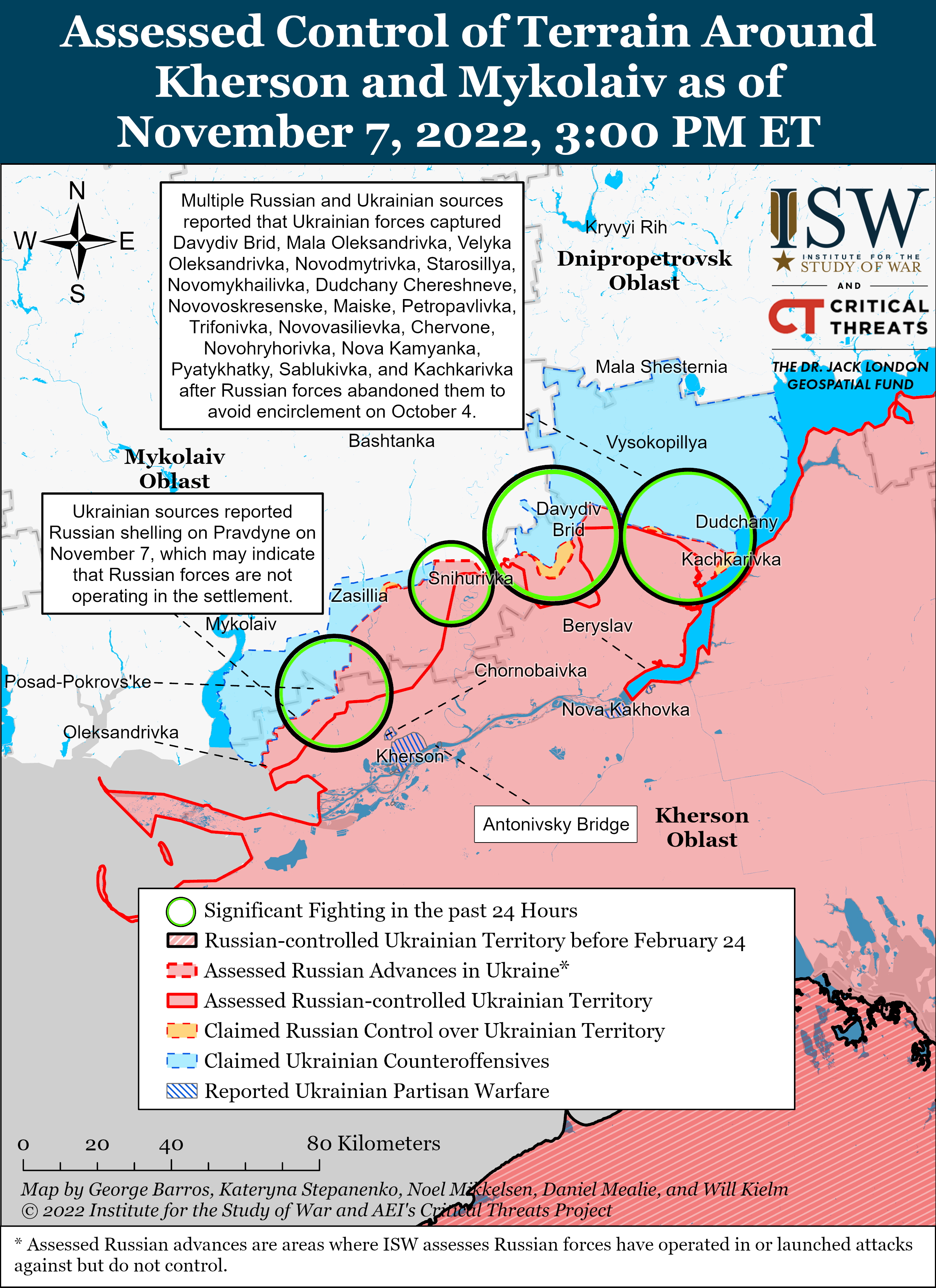
The situation in the Kherson region
On November 6 and 7, Ukrainian forces continued their campaign to block the areas of concentration of Russian troops throughout the Kherson region.
Footage from November 6 shows the aftermath of a UAF strike on the Golden Pheasant hotel in Radensk (about 23km southeast of the city of Kherson), where the Russian troops were stationed.
Russia strengthens the border with the Ukrainian Kharkiv region
The Russian troops apparently continued to fortify the border from the northeast of the Kharkiv region, conducting minor attacks across the border on November 6. Location footage posted on social media on November 6 also shows the Russian troops digging trenches near the state border in the Belgorod region.
According to the analysts, such actions are likely aimed at “squeezing” the Armed Forces of Ukraine to the northern international border, but do not portend a major Russian offensive that the occupiers are unable to carry out.
Russian attacks on Bakhmut
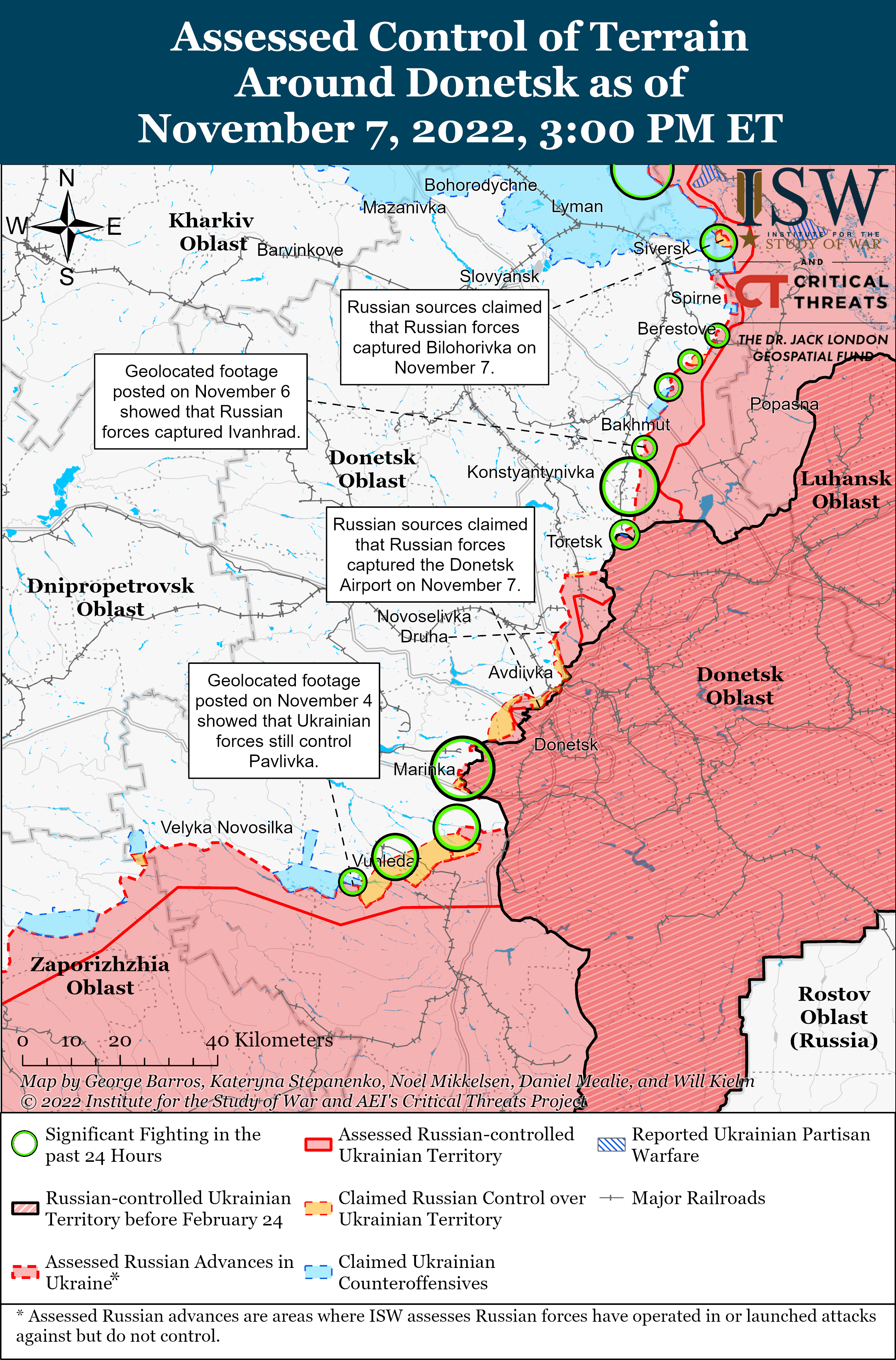
The Russian troops continued their offensive operation in the Bakhmut area on 6 and 7 November. The General Staff of the Armed Forces of Ukraine said that the Ukrainian troops repelled enemy attacks within a radius of 26 km northeast of Bakhmut in the area of Bakhmutske, Berestove and Yakovlivka, and within a radius of 20 km south of Bakhmut in the area of Andriivka, Mayorsk, Ozaryanivka, and Opytne on 6 and 7 November.
Russian sources claimed that the Russian troops took full control of Ivanhrad on 6 November, and continued to conduct offensive operations south of Bakhmut to take Opytne as of 7 November.
The Russian troops continued offensive operations in the Avdiivka-Donetsk region on 6 and 7 November. Enemy attacks within a radius of 27 km south of Avdiivka in the area of Makiivka, Marinka and Krasnohorivka were repulsed, the General Staff of the Armed Forces of Ukraine noted.
The situation in the Donetsk line
The Russian forces continued offensive operations in the west of the Donetsk region on 6 and 7 November. The General Staff of Ukraine reported that these days the Ukrainian forces repelled attacks by Russian troops in the area of Pavlivka and Novomykhailivka in the Donetsk region.
Russian troops could face a dilemma in the Pavlivka area, when they have to withdraw the battered units, but do not have fresh forces to replace them. Russian “military correspondents” claim that the weather and mud in the Vuhledar area make it difficult for Russian troops to move through the fields, and establish logistics support.
The Ministry of Defense of the Russian Federation responds to public criticism due to losses
On November 7, the Russian Ministry of Defense issued a rare statement in response to extensive outcry from Russian bloggers over reports of heavy losses near Pavlivka, Donetsk region, and poor command in the Pacific Fleet's 155th Marine Brigade.
The Russian Defense Ministry assured that the brigade's losses were less than 1% killed and less than 7% wounded over the past 10 days, while the Ukrainian forces allegedly suffered heavy losses.
“The discussion about the large-scale failures of the Russian military establishment has gone beyond the information space of military bloggers, and is increasingly coloring the social dynamics. The failure of the Russian Defense Ministry to properly address these systemic problems and their root causes is likely to exacerbate these social tensions throughout the war,” analysts say.