“Losing This War Is The Only Way Out For Russia”
10- 9.06.2022, 13:33
- 15,502
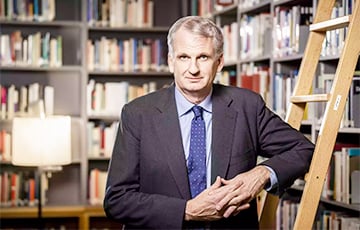
The famous historian Timothy Snyder believes that Putin's personal trauma resulted in the aggression against Ukraine.
An American writer and historian, an expert on the history of Central and Eastern Europe and the Holocaust, gave a public lecture for the Kyiv School of Economics and the Ukrainian Global University as part of the Global Minds 4Ukraine project.
Liga.net publishes the lecture theses by the historian, which help to understand how schizo-fascism became the basis of Russia's foreign policy.
Ivan Gomza, PhD in Political Science, Head of the Department of Public Administration of the Kyiv School of Economics, conducted the interview.
Schizo-fascism as the basis of Russia's foreign policy
When I use the term "schizo-fascism" to describe Russia, I mean specific people. For example, Alexander Dugin (Russian philosopher, fascist publicist) or Alexander Prokhanov (Russian writer, journalist). I am quoting documents of obviously fascist individuals who give such a characterization to other people, not fascists at all.
Since 2014, schizo-fascism has been at the center of Russian politics, and the invasion of Ukraine is one of its egregious examples: when such a regime invades another country, claiming that fascism reigns there. Schizo-fascism started as a single phenomenon and became the basis of Russia's foreign policy.
Russia is a fascist state. And here are the signs
Fascism is the priority of will over reason, a project of the political imagination. It implies a rejection of both factual and logical reality by itself.
Some signs of postmodernism: the rejection of factual reality and the insistence on subjectivity could be interpreted as fascist. Suddenly we moved from what seemed to be an emancipatory idea (meaning only individual subjectivity) to an openly repressive idea, that one person can establish a monopoly on subjectivity by declaring that there is no such thing as truth.
There are non-obvious ways to achieve fascism. The notion that politics means victory may be an interpretation of fascism. The word "fascism" in the Soviet Union and in Putin's Russia lost all content and began to mean any enemy.
A fascist in the Russian understanding is not someone who has fascist views. A fascist is just an antagonist. Politics begins with the definition of an enemy under a fascist regime. Using the term "fascist" to refer to an enemy is a sign of fascism. Perhaps it has its roots in the Soviet era.
Russia is a fascist state. There is only one ruling party that decides everything in addition to the cult of personality. Elections there exist only as a ritual. There are fantasies about a golden age in the past, which can only be restored by healing violence.
That is the ideology of Russian President Vladimir Putin regarding the invasion of Ukraine. Russia is even approaching the fascist notion that the very essence of politics lies in sacrifice and that the task of a national leader is to give political meaning to death.
There is also total control over the media, the reuse of very simple forms of state propaganda, and Putin's idea that the West is corrupt and has abandoned the core values that have survived in Russia.
Ruscism as a substitute for fascism
The term of "ruscism" is widely used in Ukraine. Obviously, ruscism is a kind of fascism because of the way the word is spelt and sounds.
It is difficult for people in the West to imagine that Russian fascism can exist because its outer layer is anti-fascist rhetoric and the Soviet legacy of anti-fascism. A word that unites Russia and fascism can really become useful.
Atrocities in Bucha that the world has seen
Putin's ideas are of great importance for the war unleashed by Russia in Ukraine. But, like Hitler's ideas, they begin with the assumption that a country is realized only outside its borders.
Hitler's idea was that the German race had a mission that could only be fulfilled outside of Germany. Putin said that Russia can only exist as long as it absorbs Ukraine.
The process by which such an intention becomes a policy of mass murder can only be understood when this intention coincides with reality. In the case of Germany, Hitler intended to wipe the Jewish people out of existence. The Red Army, the American and British peoples opposed this intention. Then he set out to kill the representatives of the Jewish people where they lived.
In Russia's Ukraine policy, Putin's intention was for Ukraine to capitulate, kill the Ukrainian political elite, and leave the rest of the Ukrainian people as an indeterminate mass that would merge with Russia. The aggravation began when this did not happen. More people identifying as Ukrainian means more deported and killed.
Some representatives of the left-wing tend to be in solidarity with Russia, despite their prominent anti-imperialism. Why is it so
People who support Russia have never been to Ukraine. Remember the Revolution of Dignity, which was much worse debated, and Russian propaganda worked much better than it does now.
People who were in Ukraine, as a rule, saw the Ukrainians, their actions, understood their goals and desires, so they were less likely to accept the Russian view of events. People who were in Ukraine, as a rule, saw Ukrainians, their actions, understood their goals and desires, so they were less likely to accept the Russian view of events. Ideologies are quite easy to analyze by intellectuals, while experience and vision of the future, as a rule, require more personal contact.
Most people who know Russian do not know Ukrainian. It matters a lot whether they perceive the Ukrainian people as subject or rely on Russian interpretations of Ukraine.
The big problem is that left-wing Americans and Germans are engaged in reverse nationalism. If you're a right-wing American, you think everything America does in the world is great. If you're a left-wing American, you think everything America does in the world is bad.
Therefore, once they take this inverted imperialist position, it seems to them that Russia had no choice. Then they begin to argue: the Ukrainians have no choice, they must surrender. Also, they may believe that the Ukrainians really don’t fight and it’s just an intermediary war and the Americans are entirely guilty. This is convenient because it confirms their deep assumption that America is responsible for everything.
There is another key problem: if no one knows anything about Ukrainian history, this opens the way for simple narratives, such as that Ukraine has never existed, or that Ukraine and its culture have always been a part of Russian culture.
In general, I agree with those on the left who say that American history should be taken critically. There is a big debate going on in America right now about whether or not to tell children an "inconvenient" history. I believe it's necessary. Your own history is always inconvenient.
China and Russia should be treated the same way. If history is about embarrassing things, one cannot approve of its oblivion by the Russians and put a taboo for the Holodomor. If there is a need to cast doubt on some empire and decenter it, then it is necessary to do that for all the others.
Russia is not an alternative to the United States. It looks more like a cracked mirror. If we allow our own oligarchy to go to extremes, we will end up in a country like Russia. So we are using Russia as a template for the path we shouldn't take.
The role of dictator Putin's personal trauma in Russia's war of conquest
It is bad when a person's prejudice or traumatic experience in relation to the community becomes the basis of politics. When there is an old obsessive dictator who is getting more and more uncontrollable, we get something similar. It is more difficult for a tyrant to distinguish his own traumas and obsessions from the interests of his country, and currently, Putin does not see this difference at all.
An understanding of Russian politics and the future of Russia, these things are missing. Once a state becomes an oligarchy, there is no future for it anymore. Nothing can be changed at this stage. You can only act on the basis of the past.
The "politics of eternity" in Russia
European countries tend to lose imperial wars. France had to lose the wars in Algeria and Vietnam to become what it is today. Germany had to lose on the eastern front. The Netherlands had to lose in Indonesia. Portugal and Spain - in Africa.
Losing this war is the only way out for Russia.
Imperialism allows you to return to the old days. That's what Putin is doing. Ideas about past greatness as a replacement for current politics break only when faced with a very cruel reality. Its essence lies in the fact that you cannot be considered an imperial state when you lose a war against a much smaller enemy.
There are discussions in Russia about what Russia really is. The "politics of eternity" in Russia can become a thing of the past only when the political discussion stops to consider the destruction of people as a way to become themselves.