


Why Lukashenka Unlikely To Be Accepted Into BRICS
4- 21.08.2023, 8:40
- 11,660
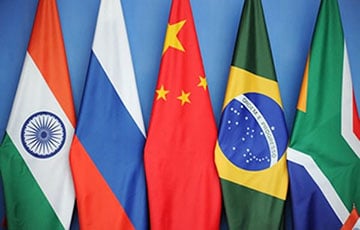
This ambitious project has already failed.
Official Minsk recently decided to join the BRICS (Brazil, Russia, India, China and South Africa) and submitted an application.
Belarus will also be taking part in BRICS summit events for the first time: Foreign Minister Siarhei Aleinik will attend the meeting in South Africa on 22-24 August.
Salidarnasts explains how BRICS turned out to be a disappointment and why Belarus is unlikely to be accepted there.
The collapse of an ambitious political project and a zombie bank
The BRICS came into being because of the ambitions of its member states, which represent around 40% of the world's population. Before the 2008 crisis, their economies were growing rapidly and they had geopolitical ambitions.
The first BRICS summit was held in 2009. In the years that followed, it seemed that the new grouping could provide an alternative to the G8.
Political observer and historian Alexander Fridman noted in his commentary:
- On the one hand, the BRICS is certainly an influential interstate association, since it includes China, India and Brazil - the most important states of the global South. The members of the association are trying to act in coordination to counter Western dominance. On the other hand, while this association is important for India, China and South Africa primarily in terms of economic cooperation, Russia has tried from the very beginning to politicise BRICS and contrast it with the Western world. In fact, BRICS is a very diverse grouping that includes both democratic states (India, Brazil, South Africa) and authoritarian states (China, Russia).
In other words, BRICS is not really a monolith, as it is often portrayed.
In fact, the Russian authorities have made no secret of the fact that from the very beginning of BRICS' creation, the grouping would contribute to a multipolar world and put an end to the West's hegemony in international relations. The Kremlin was particularly counting on this after 2014, when Russia came under Western sanctions for its annexation of Crimea and was kicked out of the G8.
Moscow wanted revenge, but failed. Experts have long said that the idea of a powerful political project in the form of BRICS has failed. In fact, this association does not play a significant role in the world. Why is that?
Because only China shared Russia's geopolitical ambitions. The other countries, as already mentioned, were primarily interested in expanding economic cooperation.
Brazil, South Africa and India do not want to confront the West. The latter has even embarked on a course of deepening military and political cooperation with the US. They are also developing in extremely different ways, with almost nothing in common. And India and China are geopolitical rivals.
By and large, BRICS has remained a platform for dialogue that Western experts describe as artificial.
Attempts to create common institutions have also failed.
The new BRICS Development Bank was set up to provide an alternative to the IMF and World Bank for financing infrastructure and sustainable development projects. But now it is in poor condition. According to a recent article in the Wall Street Journal: the NDB is struggling to survive, turning into a zombie bank.
Russia's attack on Ukraine left NDB without dollars: investors refused to support the bank, whose founders include the aggressor country. The bank itself found it necessary to announce that it was refusing new projects in Russia because of the sanctions.
However, Russian propaganda persistently glosses over these facts and still insists that the BRICS members are about to unite to confront the West. Aliaksandr Lukashenka repeats the same thesis. Recently, he said that Minsk consistently supports the pairing of the SCO, EEU and BRICS formats, which will help to counter the policy of containment of "undesirable countries" pursued by the West....
Belarus in the queue
Why did BRICS need to invite a Belarusian delegation to the summit in South Africa and what can it give Minsk?
Alexander Fridman notes:
- Belarus' interest is clear: BRICS comprises countries with huge markets and economies. It is logical that Minsk is rushing there and trying to establish integration processes at a time when the opportunities for co-operation with the West are extremely limited.
Since the Belarusian authorities show great interest in BRICS, a great desire to co-operate and have even applied for membership, they were encouraged by an invitation to the summit.
But how likely is the scenario that the giant countries will approve the entry of 9-million Belarus with a stagnating economy into the association?
- Belarus' application for membership is a long way off from being considered and even more from being approved. The BRICS countries view Belarus basically as an appendage of Russia; they are not that interested in it," Fridman said. - It's not enough to have lobbyists in BRICS (Russia and, perhaps, China), it's necessary to interest all the other participants.
According to the expert, how far Belarus is away from close cooperation with BRICS is demonstrated by the fact that not Lukashenka or even Prime Minister Golovchenko is going to the summit, but Foreign Minister Aleinik.
Small countries have long been invited to the BRICS summits out of courtesy. So in 2017-2018, representatives of Thailand, Tajikistan, Botswana, Madagascar and many other states visited it.
As for applications to join BRICS, according to TASS, at the moment 23 countries have already sent them. The problem is that the association is not going to expand.
China is trying to promote this idea, but the leaders of India, Brazil and South Africa believe that BRICS has enough contradictions without new members.
The South Africa asked Vladimir Putin not to attend the upcoming summit due to the arrest warrant issued by the International Criminal Court.