

American General On AFU Counteroffensive: Such Large-Scale Operations Not Developed Since 1944
1- 28.08.2023, 12:48
- 9,406
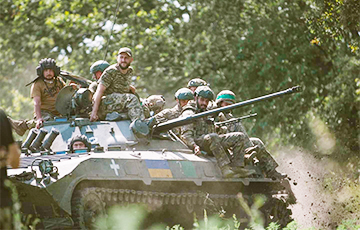
Kyiv has chosen its strategy, which fully justifies itself.
Those in the U.S. military who are expressing frustration about the way Ukraine is storming Russian positions seem to have unrealistic expectations of what a single counteroffensive operation can achieve, warns retired U.S. Army four-star general Jack Keane in a column for The Wall Street Journal.
According to the former deputy chief of staff of the Army (1999-2003), this is "alarming" and Washington should be focused on helping Ukraine fight the war "the way it wants to, not chirping from the sidelines."
The national security analyst for Fox News and other resources reminded that the U.S. military leadership wants Ukraine to concentrate the forces that the West has equipped and prepared for a counteroffensive in one area in Zaporizhzhia region for a "quick" breakthrough and de-occupation of Melitopol. It is puzzled why the Defence Forces are keeping large numbers of troops in the east, especially around Bakhmut, and why several offensives are being conducted in Zaporizhzhia region rather than one massive one.
Keane writes that as of 2023, "no one in the U.S. Army has designed large-scale mechanized operations against a serious and capable enemy using a comprehensive defence" and that the last time this was done was the Metz campaign in France in 1944, led by General George Patton.
The former strategic advisor to PMC Academi and ex-director of defence giant General Dynamics added that, yes, the massive attack on Melitopol demanded by some military leaders in the US "is the most obvious thing Ukraine can do" and it would concentrate Ukraine's offensive power on the shortest route to the sea.
"This approach seems attractive and sound from a military point of view. The trouble is that the Russians have had the same idea: they have deployed the strongest of their remaining forces in defence in that direction, dug deep, extensive trenches and covered the ground with mines. Their best pilots, flying state-of-the-art attack helicopters, are based in the area and ready for a Ukrainian attack. They have been fortifying Melitopol and the next town north, Tokmak, for a year now. This shortest road to the sea is also the most prepared part of Russian defence in the war theatre," Keane wrote.
He noted that the Ukrainians have made this "route" a de facto priority and have recently made "important gains" there, just as they have stormed eastward in Zaporizhzhia region - "and made gains there as well."
Keane believes that "what seems to irritate U.S. officials the most" is the Ukrainian effort to retake Bakhmut, which terrorists from Russia's Wagner Group captured this spring at the cost of tens of thousands of casualties. U.S. military officials want the AFU to focus on Melitopol rather than conducting operations near Bakhmut or anywhere else.
"Such advice is military negligence," Keane emphasized.
According to him, well-designed mechanized campaigns almost always advance on several fronts rather than one. That is what the American-led coalition did in Iraq in 1991 and 2003, and that is how the Americans, Germans and Soviets fought in World War II.
"The reason is simple: advancing along one axis allows the defender to concentrate fully on stopping that advance. In this case, the Russians would almost certainly have moved forces from other parts of the theatre as quickly as they could to stop the Ukrainian advance on Melitopol," Keane added.
He argues that the Russians sent reserves to Zaporizhzhia region, "but did not send additional reinforcements, in part because Ukrainian attacks constrained them along the entire line," and the Ukrainian counteroffensive near Bakhmut drew troops from several Russian airborne divisions and separate brigades to hold the line.
These units were fighting in Luhansk and Kharkiv regions and could have been available to reinforce the occupiers' Melitopol direction, but now they are being destroyed near Bakhmut, the retired general wrote. The Ukrainian armed forces' offensives further east in Zaporizhzhia region have also constrained Russian forces that Russia might otherwise have displaced to the west. Similar smaller-scale Ukrainian attacks elsewhere along the line have had the same effect.
The general writes: Ukrainian pressure in this direction has deprived the Russians of virtually any meaningful reserves with which to counter a major Ukrainian breakthrough, and capturing Melitopol alone will not win the war.
"Demands that Ukraine focus all efforts on this area, combined with warnings that the West will not resupply Ukraine for future operations, suggest that at least some of those criticizing the Ukrainian offensive are not serious about helping Ukraine liberate all of its territory. If that is the case, and if the Pentagon's position is that it does not expect Ukraine to liberate its people, it would be better to say so clearly than to make indirect and incorrect attacks on the way Ukraine is fighting," the laureate of the Presidential Medal of Freedom noted.
Keane emphasized - a vital US national security interest is Ukraine's liberation of its land and its people from Russian aggression, and "America should stop criticizing what Ukraine is doing and instead focus on helping Ukraine achieve our shared goals as quickly as possible."
"That would be a sound strategy," the retired four-star general summarized.