

Strike On Russian A-50 In Taganrog: New Satellite Data Available
7- 10.03.2024, 14:14
- 41,040
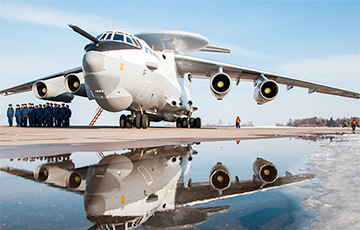
The S-300/400 system failed to protect the aircraft.
New satellite images confirmed the hit of Ukrainian drones on the building of an aircraft repair plant in Taganrog, dialog.ua reports.
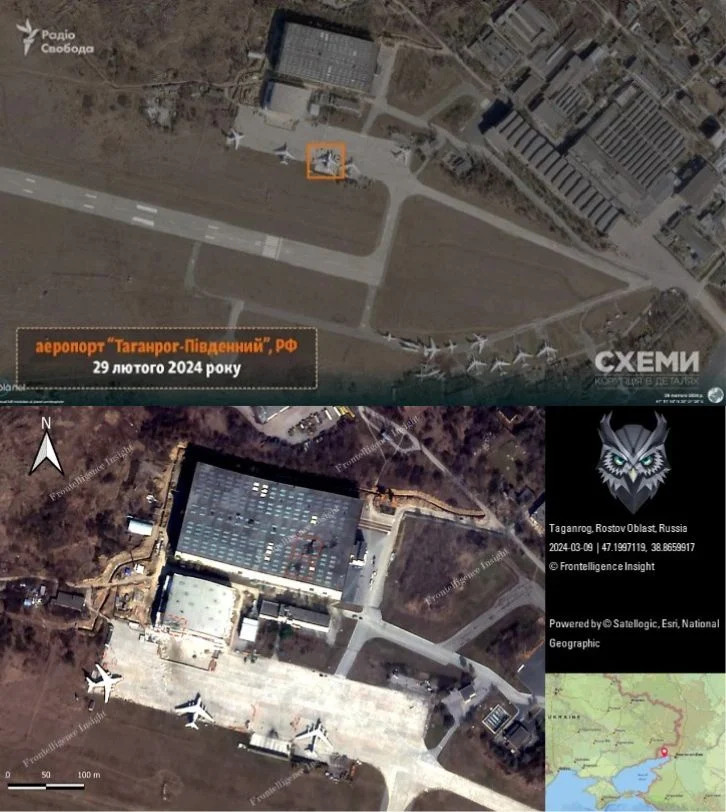
There is no A-50 aircraft near the buildings of the Beriev Aircraft Plant in the published pictures. The plant fell under attack by Ukrainian drones on the night of March 9 in Taganrog. It was standing next to the plant 9 days before.
Another satellite picture was published by military observer Yigal Levin.
"OSINT researchers found that the blow fell on the hangar, aircraft in maintenance are usually placed (the fourth photo is the pre-war view of this hangar). Most likely, the target was the A-50. Russian propagandists started talking about restarting production of this type recently," he wrote.
Researchers of the OSINT project Frontelligence Insight believe that at the time of the impact, this aircraft could have been in the plant's buildings.
Visible damage to the building on the satellites is enough to damage the aircraft being repaired inside the enterprise.
Satellite images confirmed the hit of Ukrainian drones on the building of an aircraft repair plant in Taganrog, which became the main target of a massive strike on the Rostov region on Saturday night.
Geospatial analysis of the images was conducted by the Ukrainian analytical group Frontelligence Insight.
They compared the pictures of the plant from February 29, March 8 and March 9. In the picture dated February 29, published by the investigative project Schemes of the Ukrainian service of Radio Liberty, four aircraft stood next to the hangar for repair, one of which was the A-50. On March 8 and 9, three aircraft remained on the site of the plant, and the A-50 was not among them.
“It is unclear if it was in the building at the time of the attack,” Frontelligence Insight analysts wrote.
Comparative analysis of the images revealed traces of fire on the roof of the final assembly workshop, where the A-50 was allegedly repaired, Frontelligence Insight researchers reported.
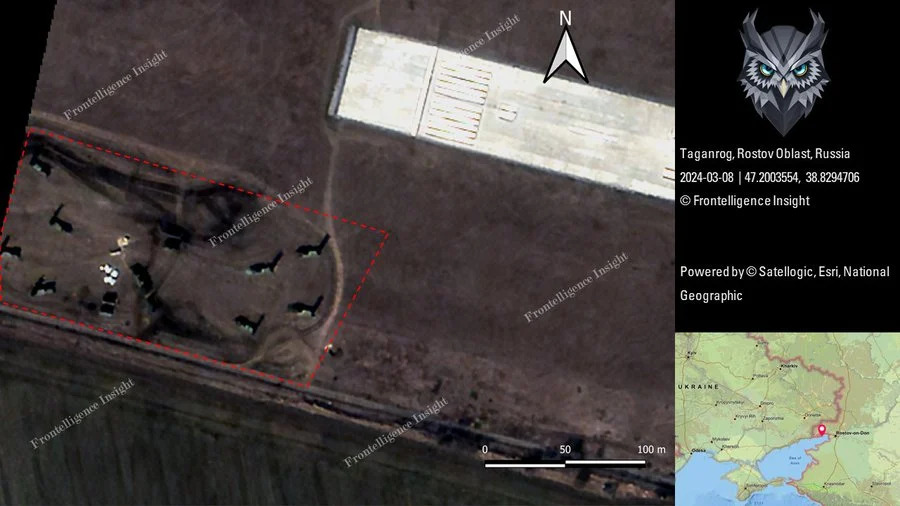
Explosions occurred near the entrance of the building, according to the analysis. Analysis of satellite images shows that at least one S-300/400 system was at the airfield during the attack.
If it does not serve as a bait, this indicates the ability of the Ukrainian UAV to overcome Russian air defence systems even in the immediate vicinity of strategic facilities.
The payload of the drones would be enough to damage the weapons and aircraft inside the building, the authors of the analysis write.
At the same time, they note the absence of visible signs of secondary explosions or a strong fire.
Therefore, as Frontelligence Insight clarifies, it is difficult to state unequivocally that the aircraft was destroyed or damaged.
Analysts called the overcoming of the Russian air defence a significant achievement of the Ukrainian forces. The S-300 or S-400 system was located at the airfield, the Frontelligence Insight project concluded on the basis of the satellite images.
"If this air defence system was not a target, this indicates the ability of Ukrainian drones to effectively overcome Russian air defence systems even near strategic facilities," experts said.
If the A-50 was indeed damaged as a result of the attack on Taganrog, then this is the third aircraft of this class that has been disabled by the Ukrainian military since the beginning of the year.
In January and February, the Ukrainian forces shot down two A-50U aircraft (a modernized version of the A-50) over the Sea of Azov.
On March 1, the editor of the Radio Liberty news service, Mark Krutov, wrote that along with the A-50 in Taganrog, Russia had three such aircraft that took off after February 23, when the second of the two aircraft was shot down over the Sea of Azov.
The A-50 is a long-range radar detection and control aircraft worth up to $330 million (the upgraded A-50U costs up to $500 million).
It is used to search for air and ground targets and control fighter jets. It is also called “flying radar”.