


Russia Fails First Robotic Ground Assault: Forbes Unveils Details
4- 31.03.2024, 10:10
- 13,826
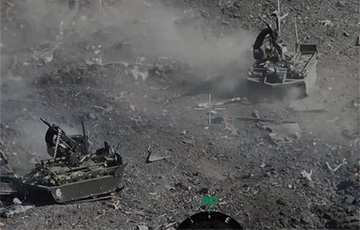
Things didn't end well for the robots.
Ukraine and Russia, in the third year of the war, deployed numerous air and sea drones, but neither side deployed ground drones en masse. This situation may be explained by the presence of obstacles on the ground.
Forbes writes that both Ukrainians and Russians use small ground robots to refresh supplies, evacuate the wounded, and lay mines.
That combat exception ended somewhere around the ruins of Bakhmut in eastern Ukraine, when the Russian army sent at least two—and possibly many more—small, tracked, grenade-launcher-armed unmanned ground vehicles on what appears to have been a direct assault on the Ukrainian 53rd Mechanized Brigade. It didn’t end well for the robots.
In late 2020, analysts with the California think-tank RAND gamed out a clash between U.S. Army and Russian army mechanized infantry companies in some near-future setting after the U.S. Army has integrated armed ground robots into its force structure. In the game, 11 wheeled and tracked UGVs complemented the Americans’ four M-1 tanks and 11 M-2-style infantry fighting vehicles.
What analysts referred to as “robotic combat vehicles” didn’t perform very well in the think-tank’s various offensive and defensive scenarios—and for one major reason. RAND’s RCVs were controlled via radio by a remote operator, just like Russia’s actual UGVs surely are. And that means they were vulnerable to getting cut off from their operators—either by the terrain or by enemy jamming.
“In the baseline game, the need to maintain unobstructed and un-jammed line-of-sight communications to the RCVs imposed significant constraints on [U.S.] forces, slowing the pace and complicating the management of [the U.S.] advance,” the analysts explained.
“In particular, [Russian forces’] effective use of backpack jammers (placed before the battle) substantially limited [U.S. forces’] ability to use the RCVs.”
Frequently idled as their operators struggled to stay in control, the robots rolled into battle in erratic fits and starts — and got knocked out by enemy fire.
Ukrainian forces’ expert application of electronic warfare — flooding key radio channels with noise, rendering them unusable for drone-operators — is one reason why, in some sectors, the Ukrainians have been able to achieve local air-superiority with their own un-jammed aerial drones. If the Russians widen their deployment of armed ground robots, expect the Ukrainians, in response, to widen their radio-jamming.