
Putin Has Given An Important Signal
7- 8.10.2025, 16:30
- 13,590
Counting on "persuasion" is futile.
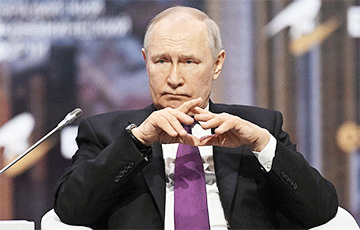
Vladimir Putin's speech at the Valdai Forum in October 2025 was a kind of summary and manifesto of the Kremlin's current policy. The reluctance to end the war in Ukraine manifested itself in shifting the blame to Kiev and the West and in the absence of any peace initiatives on Russia's part. Threats to the West (from a "convincing" military response to Europe to U.S. hints and nuclear blackmail) showed the continuation of the course of confrontation and escalation.
In parallel, Putin presented an alternative reality of the war, where Russia is supposedly winning and the West is to blame for the continued bloodshed. This distorted picture is meant to justify the Kremlin's actions and undermine international support for Ukraine. The speech also clearly emphasized Russia's self-isolation from the West. The Russian leader contrasted himself and his country with "decaying" Europe, betting on his own strength and "chosen" allies. Finally, the form and content of the speech reflected Putin's authoritarian style of government. The monopolization of the "voice" of national policy, intolerance of dissent, and the use of propaganda to legitimize an aggressive course.
For the outside world, this speech was yet another signal that Moscow is not changing its course. Despite international pressure, sanctions and military setbacks, Putin's rhetoric has remained unyielding. He showed no willingness to compromise on the war in Ukraine or on restoring relations with the West. On the contrary, new threats and conditions have been voiced. This means that the war and confrontation with NATO will, unfortunately, drag on, unless there are fundamental changes in the balance of forces or approaches. Counting on Putin's "entreaties" is pointless. A tough and coordinated policy of containment is necessary. Putin will not agree to peace voluntarily; he can only be forced into it, but this requires not just threats of supplying Ukraine with Tomahawks, but their actual use.
In Russia itself, the speech probably fulfilled the propaganda task of consolidating the elites and the population around the leader. However, the somewhat hysterical repetition that "everything in February 2022 was done correctly" shows that the Russian elite itself has some doubts about this. And the SBU drones hitting Russian oil refineries already beyond the Urals are a good signal to the Russian ruling class that not everything is "going according to plan" in the so-called SWO. The key aspect of the Valdai speech is the authoritarian nature of both the content and the presentation of Putin's speech. Vladimir Putin's annual speeches at the Valdai Forum are carefully planned actions designed to reinforce the Kremlin's desired agenda. The 2025 speech confirmed this assessment. It was structured as a monologue by the head of state, with no opposition or critical questions, and contained a set of talking points typical of official Russian propaganda.
The style of the speech was deliberately one-sided. Putin spoke confidently, from a position of supreme authority, without the slightest self-criticism or doubts about the rightness of his decisions. This confidence was supported by numerous historical references, ideological declarations, and conspiracy hints. A typical mixture that he uses to justify his policies. The speech turned into a kind of "performance" where Putin himself played the role of narrator, judge and lawyer at the same time. For example, even before the full-scale war, in his speeches at the Valdai Forum he liked to accuse the West of all sins and present Russia as the defender of the offended. This time the rhetoric was similar. Russia appeared in his words as a force for good, which is "forced" to oppose the "hegemony" and "neocolonialism" of the West, and all aggressive actions are justified by the highest moral goals.
This interpretation of reality, of course, is not new. It has been repeated many times before. For example, in a 2022 speech at Valdai. Putin called the West's policy "bloody and dirty," accused it of inciting war, and presented himself as a fighter for a "just peace." These words are not just emotional rhetoric, but part of a holistic strategy to rewrite a narrative that transforms Russia from an aggressor into a defender of traditional values and a world order that it declares "just."
Putin's speech clearly displayed the logic inherent in a regime of personalist autocracy. He repeatedly referred to his own decisions, his own intuition, his own vision as decisive factors in politics. There were several "messages of last resort" from the Russian leader. From readiness to use force to assessments of international events. Everything was presented as if the alternative opinion did not exist or was unworthy of attention.
It is worth emphasizing the peculiarity of Putin's tone. While outwardly restrained, it contained hidden aggression. Neutrality and calmness of presentation were a kind of shell under which radical positions were hidden: threats, distortion of facts, rigid rejection of dissent. This is typical of his authoritarian rhetoric. Extreme ideas are often presented as inevitable measures. The dictator simply never "has no choice." He is forced to fight, kill, and slaughter his own citizens. He is simply "forced" to do so. He himself is kind, "he will not hurt a fly," but he is constantly "forced" to aggression.
At the same time, Putin spoke in a confident, almost bureaucratic style about things that are actually extremely dangerous (for example, about the prospect of nuclear strikes or war "to the victorious end"). This manner is designed to make an aggressive policy respectable in the eyes of the listener, to create an impression of its normality. It is part of the image of the "strongman-realist" that Putin cultivates: he only states reality soberly and has to act tough.
The speech at the Valdai Forum 2025 once again showed all the features of Putin's authoritarian style. He single-handedly sets the agenda, operates with his own interpretation of facts, does not tolerate objections and makes far-reaching statements on behalf of the state, relying on personal power. The combination of self-confidence, threats and ideological rhetoric in his speech confirmed that the Russian leader continues to stick firmly to the course of personal autocracy, with which, apparently, normal countries are simply "not on the way".
Petr Oleshchuk, Doctor of Political Science, Professor of Taras Shevchenko National University, specially for Charter97.org.

Bank's name: Bank Millennium S.A.
Address: ul. Stanislawa Zaryna, 2A, 02-593, Warszawa
IBAN: PL97116022020000000216711123
SWIFT: BIGBPLPW
Name of the account holder: Fundacja “KARTA ‘97”
Purpose/title of payment: Donation for statuary aims
You can contact us by the e-mail charter97@gmail.com