
German Election Results: Merz's Victory, Fantastic Intrigue
3- 24.02.2025, 8:05
- 21,070
Who will be part of the new government?
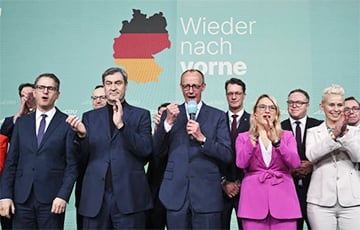
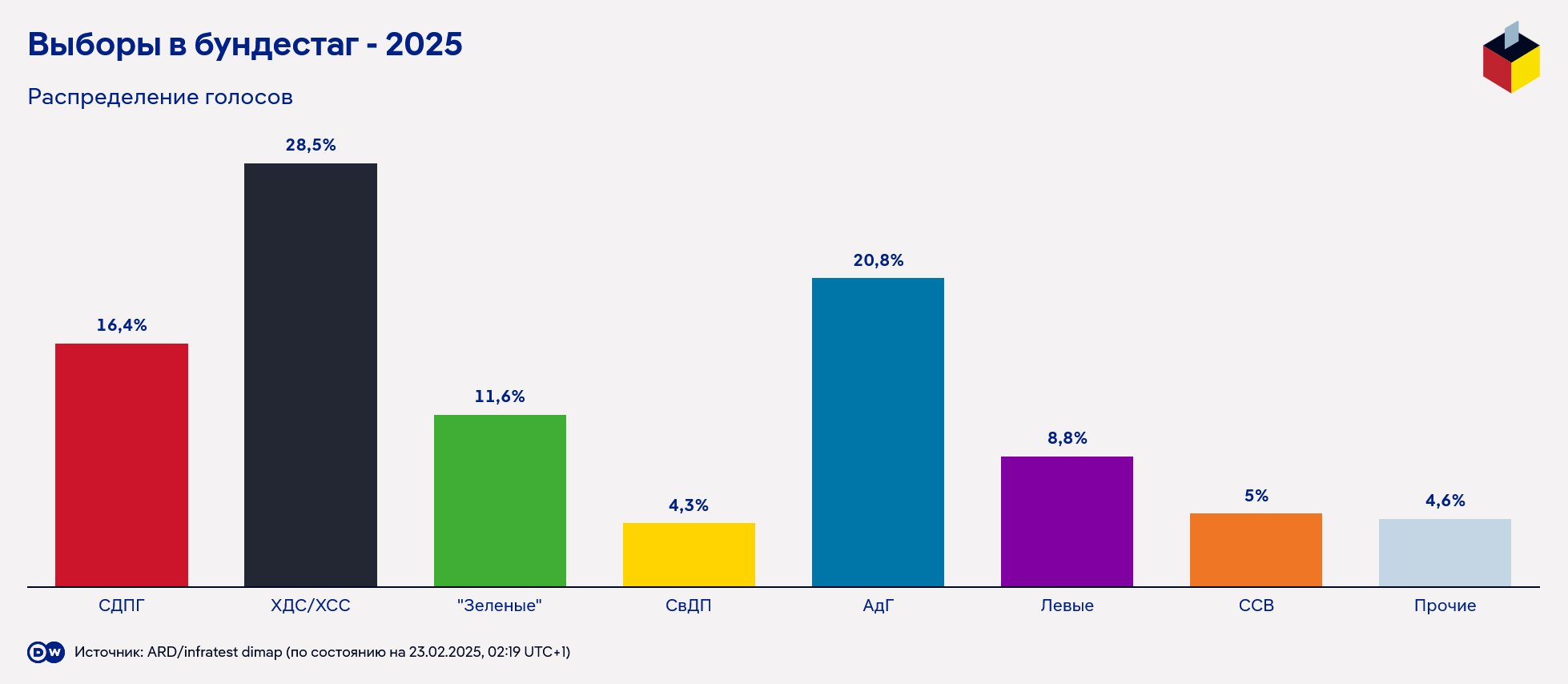
Germany has voted for a change of government. In early elections to the Bundestag, held on Sunday, February 23, the opposition conservative CDU/CSU bloc won with 28.5 per cent of the vote. This is 2-5 percentage points less than the maximum the bloc has gained in the three and a half years it has been in opposition, Deutsche Welle reported.
Sociologists quoted by Tagesschau.de believe that one reason for the weaker-than-expected result is the legacy of Chancellor Angela Merkel and her liberal migration policies. The leader of the Christian Democratic Union, Friedrich Merz, has long announced a change of course, but he seems to have failed to convince all those who were ready to vote for the party until recently. Merz hopes to move into the federal chancellor's office in the centre of Berlin by Easter at the end of April.
The intrigue about possible CDU/CSU partners in the future ruling coalition remained until deep into the night. If the left-populist Union of Sahra Wagenknecht (BSW) succeeded in passing the five per cent threshold required to enter parliament, only a governing coalition consisting of the CDU/CSU, the SPD and the left-liberal Union 90/Greens would be possible. This would make forming a government much more difficult, as the Conservatives have deep divisions with the Greens. However, with 4.972 per cent, the BSW failed to pass the Bundestag and a majority government coalition could be formed by the CDU/CSU and SPD without the Greens. Bringing the far-right Alternative for Germany into the government is by definition not considered by the centrist parties.
Scholz Leaves, Party Remains in Power
Current Chancellor Olaf Scholz is packing his bags, although he will remain at the head of the minority government for a few more weeks. His Social Democratic Party of Germany (SPD) lost with a landslide, with 16.4 per cent - the worst result the party has ever had.
However, having lost the election, the SPD will remain in power as a junior coalition partner. The Social Democrats have ruled in Germany in different coalitions since 1998 - with one break. It is an open question who will represent them in Merz's new government. Scholz has said he is leaving and will not be negotiating. It is possible that the Social Democrats will choose a new party leadership. One possible candidate is Defence Minister Boris Pistorius, Germany's most popular politician.
SPD Put Out of Commission
The Free Democratic Party of Germany, a traditional partner of the CDU/CSU in government coalitions, is not in the Bundestag. It gains only 4.4 per cent. The leader of the Free Democrats, Christian Linder, announced that he was leaving politics because his party failed to pass to the Bundestag.
Triumph of Extreme Right and Unexpected Success of Left
In addition to the CDU, the opposition extreme right-wing party Alternative for Germany (AdG), which, among other things, favours radical restrictions on migration, Germany's withdrawal from the European Union, the cessation of arms supplies to Ukraine and the lifting of sanctions against Russia, considers itself the winner of the elections. The AdG has the second place, receiving 20.8 per cent and doubling its 2021 result.
Party co-chair and chancellor candidate Alice Weidel was smiling a lot and in high spirits during the TV interview. She is convinced that the Merz government will be unstable, will collapse, and in a few years the AdG will come out on top. Such an option, although considered unlikely, is no longer far-fetched. Weidel reminded with obvious pleasure of Mertz's words that at one time he wanted to halve the AdG's result, but the opposite happened.
The success of the extreme right and the change in the balance of power in the Bundestag is one of the main outcomes of the election. The AdG wants to create a coalition with the conservatives, but they refuse to co-operate with the extreme right, as well as the other parties. Merz said the AdG can ‘reach out all it wants’, but his party has opposing views on Europe and Russia, among other things.
A minor sensation was the result of the Left Party. It had long been below the five per cent threshold in the polls, but just days before the vote it surged upwards and finished the race with more than eight per cent. Observers believe that the reason is the recent vote in the Bundestag on measures to restrict migration. It was initiated by the CDU/CSU bloc and supported by the AdG. Breaking the unspoken taboo of voting with the extreme right seems to have mobilised the left electorate. The Left Party came first among young people, ahead of the AdG.
Trump and Musk's Shadow over Bundestag
The short election campaign will be remembered for taking place amid growing crises. Old problems were exacerbated and new challenges added, resulting in an unusually high voter turnout of 84 per cent.
It was expected that the main topics would be the stagnant economy and inflation. However, a series of attacks and murders committed by migrants made the issue of restricting migration the centrepiece. This has been compounded by harsh remarks against Europe and Germany by representatives of President Donald Trump's new administration in the United States and their direct support for the AdG. This is especially true for billionaire and Trump associate Elon Musk. He explicitly called to vote for the AdG, after which the party's rating rose by several percentage points. All this caused shock and resistance of most parties, which considered it as interference in the elections.
What Ukraine Should Expect from the Mertz Government
Finally, the new Trump's recent initiative to negotiate directly with Russian President Vladimir Putin to end Russia's war against Ukraine has become a campaign theme at the finish line. The fact that such talks are being conducted without Ukraine and Europe's participation is not appreciated in Germany. Merz has made it clear that he hopes for the role of the U.S. Congress in further aid to Ukraine.
Speaking after the election and on the eve of the third anniversary of Russia's massive attack on Ukraine, outgoing Chancellor Scholz called for continued support for Kyiv, noting that ‘Ukraine cannot be left alone.’ Incoming Prime Minister Merz said his priority was unity in Europe and strengthening its defence industry. At the same time, both expressed their opposition to Ukraine's fate being decided ‘over the heads of the Ukrainians’. Scholz and Merz's statements about the possible deployment of German troops in Ukraine to maintain a possible ceasefire were also in tune with each other. Both political leaders believe that it is ‘premature’ to talk about this. It seems that the ‘grand coalition’ in Germany is already at work in this matter.

Bank's name: Bank Millennium S.A.
Address: ul. Stanislawa Zaryna, 2A, 02-593, Warszawa
IBAN: PL97116022020000000216711123
SWIFT: BIGBPLPW
Name of the account holder: Fundacja “KARTA ‘97”
Purpose/title of payment: Donation for statuary aims
You can contact us by the e-mail charter97@gmail.com