Another Fact From Putin's Biography Has Become Known
15- 4.08.2025, 13:09
- 28,976
The Russian dictator was hiding from prosecution.
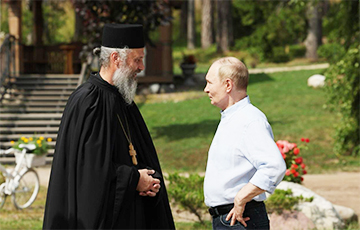
On Friday, Vladimir Putin arrived on his traditional summer visit to Valaam Island in Lake Ladoga (Karelia). Since his first election in 2000, the president has traveled here almost every year. It was from Valaam on Friday that Putin did what had been expected of him since Monday - he responded to Donald Trump's ultimatum promising to impose sanctions if the Kremlin did not start negotiating peace with Ukraine by August 8. Both his frequent trips to Valaam and his use of the Valaam Stavropegial Monastery as a venue for the press conference do not seem accidental. It was at Valaam that the president, back in the 1990s, may have learned the power of religion, having fled here from criminal prosecution. About it write Roman Badanin and Mikhail Rubin in the book "The Tsar in his own right", writes "Agency".
A journalist interlocutor who knew Putin from his work in St. Petersburg said that after Anatoly Sobchak lost the 1996 election, the Prosecutor General's Office headed by Yuri Skuratov began investigating a case of irregularities in the St. Petersburg mayor's office. A team of Moscow investigators landed in the northern capital. Fearing trouble with the law, Putin temporarily left his hometown for Valaam Island, the source said.
One of Russia's most famous Orthodox male monasteries, located on the island since at least the 15th century, was in a deplorable state in the 1990s. The monks shared the island with the families of exiled disabled veterans of World War II, whom the Soviet authorities evicted from major cities so that they would not spoil the prosperous picture of communist life. It was in the monastery in July 1996 that Putin, who escaped from St. Petersburg, settled down for a few days, according to an interlocutor of the book's authors.
The journalists admit that this story may well be apocryphal: it literally copies legends about ancient tsars who miraculously escaped in church monasteries (for example, Peter the Great in the 17th century took refuge from the rebellious Streltsy in the Trinity-St. Sergius Monastery). However, much does suggest that Putin has had a very close, almost mystical connection with Valaam ever since, Badanin and Rubin write.
Putin's annual trips to Valaam occur around the same time of year that he supposedly escaped in a cell from investigators. The monastery even built a special skete for the president, a place where Putin stays during his visits. Here in 2008 they opened a church in honor of the Old Russian prince Vladimir and the martyr Lyudmila of Bohemia. Parishioners quickly realized that the temple was actually dedicated to Vladimir Putin and his wife Lyudmila, the book says.
Putin's friends bought up huge tracts of land near the Karelian town of Lakhdenpokhya, opposite the island of Valaam. That's also where Putin stayed during his visits to the monastery. Finally, it was in the Valaam monastery that Monk Methodius (in the world - Venko Petkov), especially revered by Putin and his entourage, served since the 90s. He became famous for the fact that in 2012, when Putin had just returned to the presidency and on a joyful visit to Valaam once again, he rushed to kiss the hand of the Russian ruler. Putin then pulled his hand away, but did not stop honoring Methodius. When the monk died of covid in 2021, Putin came to his grave.
According to the book, Putin's escape to the Valaam Monastery could have been organized by Roman Tsepov (born Beilenson), a former security official who set up a private security firm in St. Petersburg called Baltic Escort. It was Tsepov who organized security for Putin, who was not entitled to state security; Tsepov was also the intermediary in communication between the president and St. Petersburg's criminal masterminds, Badanin and Rubin wrote. In 2004, Tsepov died a gruesome death: after visiting his acquaintances at the FSB and the St. Petersburg Interior Ministry, he was diagnosed with poisoning by a substance that caused symptoms of radiation sickness.

Bank's name: Bank Millennium S.A.
Address: ul. Stanislawa Zaryna, 2A, 02-593, Warszawa
IBAN: PL97116022020000000216711123
SWIFT: BIGBPLPW
Name of the account holder: Fundacja “KARTA ‘97”
Purpose/title of payment: Donation for statuary aims
You can contact us by the e-mail charter97@gmail.com