

Drone Attacks Could Force Russia To Cut Oil Production
- 16.09.2025, 16:51
- 2,898
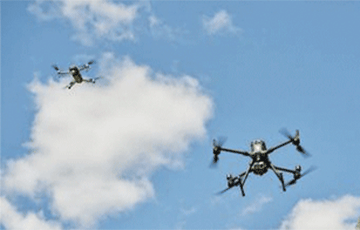
Storage facilities are overflowing and infrastructure is on fire from AFU strikes.
Russia, which accounts for about 9 percent of global oil production, may be forced to cut crude output after Ukrainian drone attacks on key oil infrastructure, Reuters reported, citing three industry sources.
One of them said such a scenario was becoming real after drones hit the Baltic ports of Ust-Luga and Primorsk in recent weeks, as well as several other major refineries - Kinef in Leningrad, Russia's largest oil refinery in the world, was hit by a drone attack on the Baltic port of Ust-Luga and Primorsk in the past week It also warned that it could impose restrictions on receiving crude from the fields if attacks on the infrastructure continue.
Last week, a major Baltic port of Primorsk was damaged by Ukrainian drone attacks for the first time since the war began. Its capacity is about 1 million barrels per day, which is more than 10% of Russia's total oil production.
According to industry sources, two oil tankers, Kusto and Cai Yun, were damaged in the attack. Primorsk only partially resumed operations on Saturday after the disruption.
Russian oil export capacity was already limited as another Russian Baltic port, Ust-Luga, has yet to fully restore its capacity after a drone attack on the oil pipeline leading to it in August. According to industry sources, the port is half-loaded this month. Unlike Saudi Arabia, however, it does not have significant oil storage capacity.
As part of the OPEC+ agreement, which controls about 40 percent of global oil production, Russia's production quota will increase to 9.449 million bpd in September from 9.344 million bpd in August, excluding the compensation plan.
Analysts at US banks JP Morgan and Goldman Sachs believe that instead of increasing production, Russia will be forced to cut it.
"Russia's ability to increase oil production is now at risk due to limited storage capacity," JP Morgan explains.
"Russian oil companies have about 96.8 million barrels of storage capacity at oilfields and refineries, but their spare capacity is limited, as most of it is used in day-to-day operations," the banks' analysts wrote.
"Refinery outages could also negatively affect oil production due to full storage facilities amid lower refinery utilization, while crude storage and export capacity is limited," Goldman Sachs analysts agreed. However, in their opinion, as a result of these difficulties, Russia may reduce oil production insignificantly, as Asian buyers continue to signal their readiness to import Russian oil.

Bank's name: Bank Millennium S.A.
Address: ul. Stanislawa Zaryna, 2A, 02-593, Warszawa
IBAN: PL97116022020000000216711123
SWIFT: BIGBPLPW
Name of the account holder: Fundacja “KARTA ‘97”
Purpose/title of payment: Donation for statuary aims
You can contact us by the e-mail charter97@gmail.com