Legend Of The Belarusian Resistance
1- 14.01.2026, 17:56
- 2,452
History of the Bison Movement.
On January 14, 2001, at the very beginning of the new millennium, forty young people gathered in Belovezhskaya Pushcha to create a new movement. A movement of people who were no longer willing to tolerate the insane actions of the sick dictator and his entourage. A movement of people who wanted to live in an independent, strong and free Belarus. This is how Zubr - the brightest, most mass and strongest youth organization in the recent history of Belarus - emerged, writes Telegram channel "Basta!".
"We deny violence. Our way is non-violent resistance to the regime. We do not divide the citizens of Belarus into our own and strangers. We are equal before each other, and each of us can influence decision-making. We know that only through personal courage we can achieve victory," said the first leaflets distributed by the "bison".
Non-violence, solidarity and personal courage became the main principles of the new movement. The "bison" were autonomous groups. The movement had no clear hierarchy and no formal leader.
Overnight the walls of dozens of cities in Belarus were covered with "Zubr" inscriptions. Thousands of bright colored stickers appeared on the streets. The public was given a riddle to which no one had a ready answer. But everyone argued and talked about it. Various opinions and speculations were expressed in the newspapers.
A month after the meeting in Belovezhskaya Pushcha, "Zubr" announced a press conference, which was attended by representatives of all Belarusian and foreign mass media accredited in Minsk. An athletic-looking young man came out to the monument to the Belarusian patriot Marat Kazay, read the Memorandum of "Zubr", gave it to the press and left without answering any questions. All newspapers wrote about the unusual press-conference. They were waiting for the well-known and bored politicians to announce the formation of another coalition. The newspapers had already typed up the duty blanks intended to sneer at the new initiative. But everything had to be rewritten - the intrigue continued and no one could still give an unambiguous answer to the question: "What is "Zubr"?
March 6, 2001 the country learned that street actions can look quite different. Report by "Radio Racyja":
"The action of the "Zubr" movement in the center of Minsk lasted only half an hour. Young people lined up along Skaryna Avenue with portraits of politicians who disappeared during the years of Lukashenko's rule.
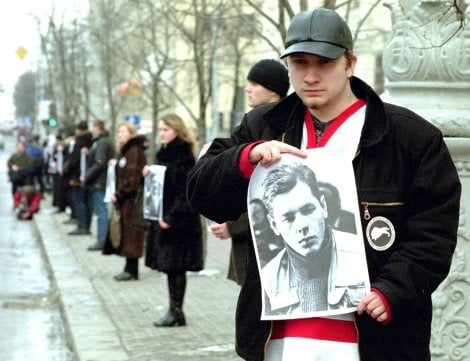
"Bison" shocked everyone present with their action. No one expected that in an instant about a hundred people would stand along the main highway from October Square to Independence Square. The action lasted no more than half an hour and ended as unexpectedly as it began. Not only journalists, but also police officers had no idea of its nature and location.
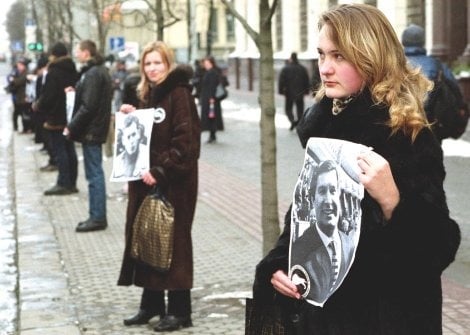
This action clearly contrasts with other opposition events. One can assume that unconventional ways of fighting for democracy will attract a lot of people to the Bison. One can only guess what surprise the members of this movement will prepare next time."
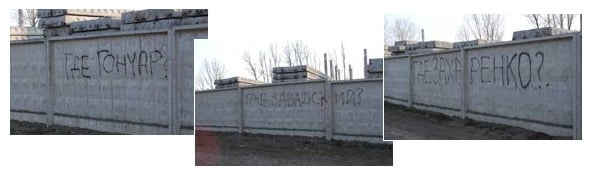
"Where are Lukashenka's disappeared opponents?": this was the first question the "bison" asked the regime. Soon after the March 6 action, thousands of graffiti appeared all over the country. Many of them were done publicly. On a spring afternoon, huge graffiti "Where is Gonchar?", "Where is Zavadsky?", "Where is Zakharenko?", "Where is Krasovsky?" were sprayed in the presence of journalists along Masherov Avenue, along which the dictator traveled daily. The authorities tried to paint over the inscriptions, but the housing and utility companies soon ran out of money for paint. The "bison" had paint.
One of the most striking actions of 2001 was "Final Diagnosis". The "folk-psychological festivities" took place on April 21 in the capital's Gorky Park. The main topic was the diagnosis "Moderately expressed mosaic psychopathy with predominance of features of paranoid and dissociative personality disorder", diagnosed to Alexander Lukashenko by psychiatrist Dmitry Shchigelsky earlier.
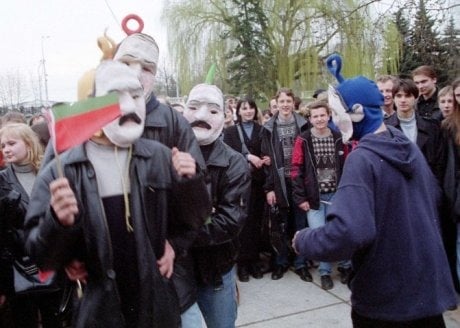
"If you confuse Schopenhauer with Kaltenbrunner, if you prefer to sleep not in your pajamas but in a bulletproof vest, if you see spies everywhere, if you have only skis left of your friends, if you feel that you have gone mad but still occupy the chair of the chief - you will be cured by Dr. Zubr!"," the invitation booklet said.
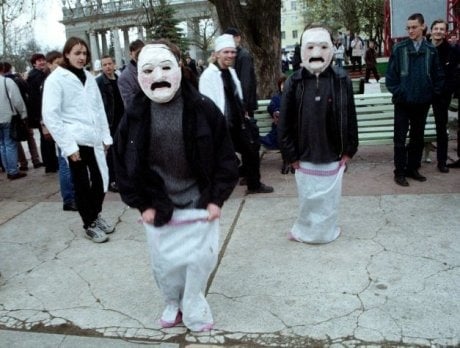
The event was the hit of the year. Never before in Belarus have political events been held as a performance art event. The police, who also encountered such a phenomenon for the first time, were at a loss, not knowing how to react to what was happening. At the time indicated in the leaflets and stickers, rides and impromptu theatrical performances unfolded in different parts of the park. Some "bison", wearing moustache masks, skied on the asphalt, others, wearing white medical coats, chased them, caught them and made a final diagnosis.
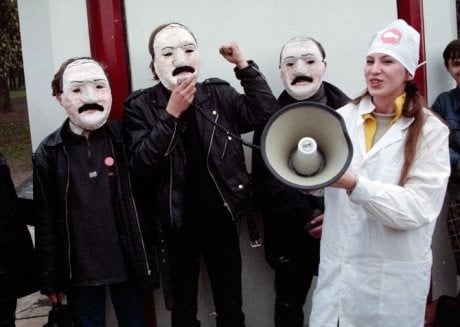
It was possible, wearing a moustache mask, to participate in the contest "Scream-4" - to shout in a megaphone as scary as possible, so that the crowd determined the winner. Also everyone who wanted to try on the mask was offered to play table hockey or, taking a plastic children's stick, to play the dictator's favorite game with the orderlies.
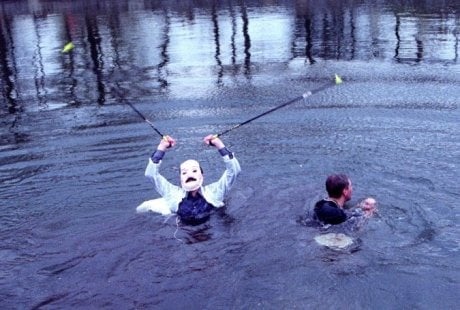
At one moment two mustachioed skiers sprinted across the asphalt and jumped into the cold April water of the Svisloch River, making a ski swim. The police fished out the "crazy dictators" already on the opposite bank.
Mass arrests began only after several "bison" unfolded a stretching banner with the inscription "Let's say no to fools!" and another one read out a short fiery speech into a megaphone.
This action became a catalyst. Across the country, young people pulled out old skis, others found white coats. Hundreds of young people got involved in catching the crazy mustachioed skier.
The main goal of the action was achieved - people stopped being afraid. Any dictatorship creates a so-called "spiral of silence" - when the majority opposing the dictator simply does not believe in its own strength and, moreover, does not know that it is the majority. Watching the mustaches "sliding" on the asphalt, even the policemen laughed. For a long time the regime didn't know how to fight with a new unusual form of youth protest, destroying the fear of possible repressions.
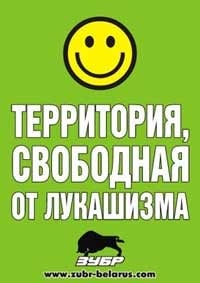
Five months of its existence the rating of "Bison" according to the data of the International Republican Institute of the USA became higher than that of any non-governmental, youth organization, political party, civil initiative of the country. 60% of Belarusians learned about the movement. Among young people this rating was much higher.
The volunteer network of "Zubr" by that time operated in 152 settlements of the country and distributed up to 2 million units of printed materials per week.

Bank's name: Bank Millennium S.A.
Address: ul. Stanislawa Zaryna, 2A, 02-593, Warszawa
IBAN: PL97116022020000000216711123
SWIFT: BIGBPLPW
Name of the account holder: Fundacja “KARTA ‘97”
Purpose/title of payment: Donation for statuary aims
You can contact us by the e-mail charter97@gmail.com