
EU Signs Historic Trade Agreement With South American Countries
1- 18.01.2026, 8:56
- 2,630
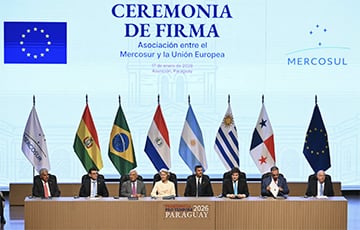
The signing took place in the Paraguayan capital Asuncion.
The EU has concluded a historic free trade agreement with the association of South American countries Mercosur (Mercado Común del Sur - "Common Market of the South"). The signing of the document took place in the Paraguayan capital Asuncion.
It was reported by Euractiv.
The agreement was signed at the Central Bank of Paraguay, the site of the 1991 Treaty of Asuncion, which established the Mercosur bloc between Argentina, Brazil, Paraguay and Uruguay.
The signing on the Mercosur side was attended by Paraguayan President Santiago Peña, Bolivian President Rodrigo Paz, Argentine President Javier Milay and Uruguayan President Yamando Orsi, as well as Panamanian leader Jose Raul Mulino, an associate member of Mercosur.
European Commission chief Ursula von der Leyen said at the signing ceremony that the EU chooses "fair trade over tariffs."
"We choose a productive long-term partnership over isolation and, above all, we intend to deliver real and tangible benefits for our peoples and companies," the official said.
Fon der Leyen also noted the geopolitical importance of the agreement:
"When two regions like ours speak with one voice on global issues, the world listens," the EC chief added.
It should be noted that on January 9, the head of the European Commission Ursula von der Leyen received the "green light" to sign the agreement, the work on which lasted more than 25 years. Most EU states supported the deal despite objections from France and Poland.
Protests against the Mercosur agreement
Farmers' protests against the agreement have been taking place across Europe in recent weeks. They are expected to continue next Tuesday, with some 5,000 farmers and 1,000 tractors expected to gather outside the European Parliament in Strasbourg.
Farmers believe the planned free trade agreement with South American countries will flood the EU market with cheap food.
Importantly, Wednesday's key vote in the European Parliament could cast doubt on the agreement by appealing to the EU Court of Justice.

Bank's name: Bank Millennium S.A.
Address: ul. Stanislawa Zaryna, 2A, 02-593, Warszawa
IBAN: PL97116022020000000216711123
SWIFT: BIGBPLPW
Name of the account holder: Fundacja “KARTA ‘97”
Purpose/title of payment: Donation for statuary aims
You can contact us by the e-mail charter97@gmail.com