
Russia Has Lost 40% Of Oil Refining
4- 7.01.2026, 9:01
- 9,748
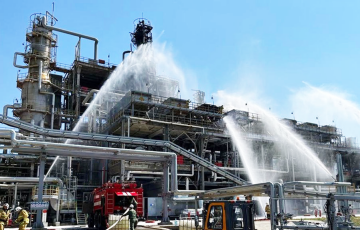
Ukrainian strikes deprive the Kremlin of money for war.
Strikes on Russia's oil refining infrastructure have become one of the key events of 2025 - Ukraine has turned Russia's oil industry into a vulnerability by launching a strategic series of strikes against it. These attacks have already impacted the war and created long-term problems for the Kremlin with fuel, exports and funding for the military.
In November 2025 alone, 41 strikes using both attack drones and ballistic weapons have been launched against legitimate military targets in the occupying country. These are both stationary objects - enterprises of the military-industrial complex, and oil refineries in Russia.
The concentrated Ukrainian strike on oil refining has led to tangible economic consequences for Russia: domestic prices for gasoline and diesel have risen, fuel supply disruptions have occurred, and oil companies have suffered multibillion-dollar losses. At the same time, export flows and budget revenues have fallen, hitting the Kremlin's financial capacity to continue the war.
"The Ukrainian strikes on refineries have done more damage to Russia's economy than many Western sanctions packages. This is a direct blow to the revenues from which the war is financed," said Kirill Budanov, former head of the Ukrainian Defense Ministry's GUR.
The Ukrainian military intelligence agency notes that the strikes on oil infrastructure hit the foundation of the Russian economy, not secondary sectors. The goal is not only a short-term weakening, but also a long-term reduction in Russia's ability to conduct large-scale military campaigns.
"Actually, our strikes have made a greater impression than the effect of the sanctions. It's just such a mathematical truth. We have inflicted by direct action much more damage to the revenues of the Russian Federation than any economic leverage that has been imposed on them so far," Kirill Budanov said.
Oil refining is a critical basis for providing the army with fuel, so a strike on a refinery automatically affects the combat capability of Russian troops. Reduced refining volumes and disruptions in fuel logistics make it difficult to move equipment, limit the intensity of operations and increase the cost of maintaining groups of Russian army troops. And without a stable supply of fuel, it is impossible to conduct offensive operations on the same scale.
Ukrainian command also notes that the choice of targets is made in such a way as to minimize the risk to civilians and focus on military and near-military infrastructure. The focus includes refineries, bases, terminals and facilities directly related to supplying the army and replenishing the military budget.
In the past few months, Ukrainian drones have hit a number of oil refineries in the European part of Russia:
Syzran refinery;
Volgograd refinery;
Saratov refinery;
Ukhta oil refinery;
Samara refinery 1,000 kilometers from Ukraine;
Krasnodar refinery;
Ryazan refinery;
Afip refinery;
Il refinery;
Ufa refinery.
The consequences of these blows can be judged by the statements of the Russian side itself. Thus, the increase of VAT from 20 to 22% is quite indicative. This is evidence that there is no money in the Russian budget to finance active operations in Ukraine.
The Russian budget depends on petrodollars for about a third of its revenues, so the effectiveness of strikes on Russian refineries is more than indicative.
The second point is the budget of the Russian Federation for 2026. What is it indicative of? According to Russian economists, the spending part is increased by 4% of GDP. That's about $1 trillion, which is actually no longer in the budget.
According to the Russian side itself, budget losses from Ukrainian drone strikes and Ukrainian ballistics on oil refineries are estimated at $100 billion.
After the imposition of economic sanctions against Rosneft and Lukoil, as well as successful attacks by Ukrainian weapons on oil refineries and oil terminals, the Russian Federation is forced to sell oil and oil products at a record discount of up to 40%.
It is also indicative that even at such a discount, for example, Indian buyers refused to buy Russian oil. Now we are talking about diversification of supplies, in particular, from Saudi Arabia and other producing countries. The situation is similar with China: their refineries do not risk buying Russian oil even with the record discounts.
The strikes on refineries have affected the military budget of the Russian Federation and the financing of the programs of the participants of the so-called "SWO". Thus, the authorities of the Republic of Sakha (Yakutia) have announced the termination of payments to the participants of the "SWO". They officially state that they have no possibility to pay material support. And this is directly related to the fact that the drones of the Main Directorate of Intelligence of the Ministry of Defense of Ukraine reached the oil refineries on the territory of this subject of the Federation. We are talking about a distance of more than 2 thousand kilometers.
As a result, the Russian Federation was faced with the question: what is the further fate of the oil refineries? Let me remind you that there are no more than 40 of them on the territory of the Russian Federation. And, according to the Russian side's own estimates, about 40% of them have either partially or completely stopped the production cycle.
A very illustrative example is the fate of the Ryazan Oil Refinery, one of the most technologically advanced refineries. Three waves of modernization were carried out there thanks to Western technologies. After the Ukrainian drone strikes, this refinery, which provides fuel and lubricants to Moscow and the Moscow region, announced the shutdown of the production cycle.
At the same time, it provides fuel and lubricants not only to Moscow and the region, but primarily to the Russian army. And this is already a direct problem with logistics for the occupation troops.
Now let's look at the results of a successful attack by Ukrainian Defense Forces marine drones on the oil terminal in Novorossiysk, which provides pumping of about 5% of the world's oil. The consequences for the Russian Federation are simply catastrophic. Moreover, the Russian side stated that after the attack, the oil terminal in question cannot be restored. This is a serious blow to Russia's ability to supply oil to end consumers.
It is also indicative that the actions of the Ukrainian Defense Forces are in unison with U.S. efforts to reduce the possibility of using the shadow fleet. For example, thanks to U.S. diplomatic and economic pressure, Panama and the Bahamas refused to lend their flags to the Russian shadow fleet. As a result, more than 500 "rusty troughs," as Russia itself calls them, have anchored, unable to transport oil and oil products. This is a serious blow to the possibility of replenishing the Russian treasury with petrodollars.
It is very indicative that the year 2025 was a failure for the Russian Federation in the context of its foreign doctrine as a "petrol pumping country". By decision of the State Duma, exports of gasoline and diesel fuel were suspended in order to stabilize the situation inside the country. The Russian Federation was forced to take unpopular measures - to increase imports of gasoline and diesel fuel, buying them from Tatarstan and Belarus.
Dmitry Snegirev, "Focus"

Bank's name: Bank Millennium S.A.
Address: ul. Stanislawa Zaryna, 2A, 02-593, Warszawa
IBAN: PL97116022020000000216711123
SWIFT: BIGBPLPW
Name of the account holder: Fundacja “KARTA ‘97”
Purpose/title of payment: Donation for statuary aims
You can contact us by the e-mail charter97@gmail.com