

Kommersant daily: Lukashenka to be asked to sign agreement on Rapid Response Collective Forces at summit in Bishkek
28- 29.07.2009, 10:58
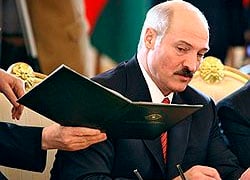
The mass media comment on participation of the Belarusian ruler in an informal CSTO summit.
The Kyrgyz ambassador to Minsk told yesterday that Alyaksandr Lukashenka planned to take part in the summit of the Collective Security Treaty Organization. This news must be pleasant for the Kremlin, which, according to Kommersant daily, began to suspect that Lukashenka may ignore a CSTO summit again that would lead the organization into crisis.
“According to the information we have, the Belarusian side accepted the invitation of the President of Kyrgyzstan to take part in the informal CSTO summit scheduled for July 31–August 1,” ambassador of Kyrgyzstan to Belarus Ishenkul Boldzhurova said at a special press conference in Minsk yesterday. She expressed a hope the Belarusian delegation would be among the first to come to the summit.
This news removes the main intrigue of the forthcoming summit – participation of the Belarusian ruler in it. Alyaksandr Lukashenka boycotted the precious meeting of the CSTO leaders in the middle of June in Moscow due to the “milk war” between Russia and Belarus. Moreover, Minsk declared all decisions taken at the summit in Moscow illegitimate and put in doubt legality of formation of the Rapid Response Collective Forces (RRCF), that according to plans of Moscow would be the core of the organization. As the Belarusian ruler was absent at the summit, Belarus didn’t take the CSTO chairmanship. If Alyaksandr Lukashenka had refused to visit another CSTO summit, the organization could face a political default.
The apprehensions had grounds. In the middle of July, Lukashenka refused to go to Moscow for the Russian President Prize Horse Race, which is considered to be an informal CIS summit. On July 21, Minsk encroached upon the Russian oil transit to Europe and declared the oil pipeline from Russian to the Latvian port Ventspils closed on the territory of Belarus. A day after, Lukashenka set new priorities of the country’s foreign policy: he called the “union state” with Russia an “incomplete project” and said he was ready to develop cooperation with the US.
After that, Moscow began to suspect that Lukashenka was paving the way for ignoring the CSTO summit in Cholpon-Ata (Kyrgyzstan). As Kommersant learnt from the Russian president’s administration last week, “participation of Mr Lukashenka in the summit hasn’t been arranged”. This wasn’t a part of Kremlin’s plans.
Though ambassador Boldzhurova said yesterday that the summit would focus on information security and it wasn’t planned to sign any documents, Russia puts great hopes on the informal meeting. According to a source of Kommersant, close to summit organizing, Russian president Dmitry Medvedev is going to discuss in Cholpon-Ata concrete steps on formation and deployment of the Rapid Reponses Collective Forces. Without these forces the CSTO, claiming a role of an “anti-NATO”, will hardly become a full military and political institution.
Russia tried to reach at least a partial accommodation with Belarus in the current situation. As Kommersant learnt, the Kremlin offered Alyaksandr Lukashenka last week to have an informal meeting before the CSTO summit to settle sensitive questions in the bilateral relations. However, this attempt was unsuccessful. As sources of Kommersant admit, Alyaksandr Lukashenka evaded the invitation of the Kremlin.
So, the yesterday’s statement of the Kyrgyz ambassador promising Lukashenka’s visit to Kyrgyzstan will likely to allow the Kremlin breathe freely. Now Moscow can count that Alyaksandr Lukashenka will take the chairmanship of the CSTO and sign document on the RRCF adopted in Moscow.
But the Belarusian experts think Lukashenka certainly set high price for his unexpected favour, at least he will demand that Russia should transfer another $500-million tranche of the loan.
Besides, the theme of participation in the CSTO summit may become for Minsk a bargaining chip in relations with West, as it was with the recognition of Abkhazia and South Ossetia. In fact, head of the Belarusian Ministry of Foreign Affairs Syarhei Martynau confirmed this yesterday. After a meeting with the EU leaders in Brussels he noticed among other things that Belarus didn’t take a decision on recognition of South Ossetia and Abkhazia so far, but “was considering all aspects of the issue”.