

Pensioner, Holocaust Survivor: This Power Is Worse Than Fascism
35- 8.12.2020, 14:02
- 63,553
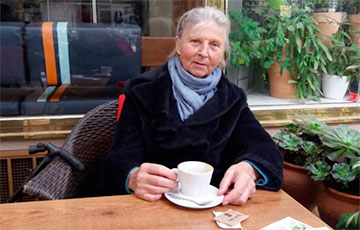
PHOTO FROM FAMILY ARCHIVE
79-year-old Minsker Larysa Sous has made her verdict on the Lukashists.
On December 6, a traditional Sunday march against Aliaksandr Lukashenka was held in Minsk. At least 300 people were detained there. Among the detainees was a 79-year-old resident of Minsk, Larysa Sous. She was held at the police station for more than six hours. An administrative protocol was drawn up against her for participating in an illegal protest action. Now she faces a trial.
As a child, Larysa Sous was a Holocaust survivor. She told Nastoyashcheye Vremya that she usually goes to the March of Pensioners in Minsk, which traditionally takes place on Mondays. However, she usually does not take part in Sunday actions. According to her, she was detained while she was walking, but she witnessed how riot police began to detain the protesters.
- The first thing I will say is that I was less worried than my relatives were. I am already so old that I need not worry, and I think more about them than about myself. About them and about the whole country.
How it happened. I go to all Pensioners’ Marches. I do not go to other marches, because my health does not allow me, my age is taking its toll, I had a surgery not very long ago, but I have to walk a lot, so I walk around my neighbourhood every day for several hours. And on this day - yesterday - I, like every day, just went out for a walk. I walked one big circle - several streets - I already turned into the second circle, approached the new metro station “Kavalskaya Slabada” - this is the corner of Varanianski and Zhukouski streets - and saw people there. I would not say that this was a very large mass of people, but a decent one.
I stood a little, just looked and was about to leave, when suddenly I heard shouting: “They're coming, they're coming!” People began to scatter, and in a minute a sea of riot policemen in black clothes jumped out. There were so many of them, and they had automatic weapons. An elderly person's reaction - you can imagine. People ran into the arch of this corner house - they were behind them. And then I heard shots from there. For an elderly person who has children and grandchildren, who has already lived her life, it was an overwhelming experience, and of course it was impossible for me to just stand there and watch indifferently.
The women stayed, I didn't run either, I remained where I was, I never run at all. I stood there, and when they began to take the tied people out of this arch with their hands behind their backs, I even said to someone nearby: “Look how many people they grabbed, see, there are handcuffs” (I thought so). Then they led more, more people. And, of course, the reaction - all people shouted: “Fascists!” Naturally, this is just too much to bear for a normal person. I think that every woman of my age who has children and grandchildren has probably done the same. I began to shout: “Take me! Why are you taking them? Take me!” They led [people] into the bus - I followed them. And then one of the riot police commanders said: “Take her”. And they took me by the arms into this minibus.
I noticed that they smelled of fresh vodka - they apparently had just drunk. Today I rubbed my hands with vodka - the smell was the same. Not fumes, but vodka. Perhaps they drank and immediately ran out - that's my opinion.
In general, we were thrown into a paddy wagon, few people. There was one woman who came out and shouted, “Where is my husband, where is my son?” She went out with her husband, met her son and saw how the son was attacked. She tried to protect her son, but was immediately seized. And what happened to her husband and son - she did not know. She was screaming all the time.
There was another man with his hands tied behind his back, he was sitting in front of me. These were not handcuffs. Hands were tied tightly with some kind of plastic cord. And he kept asking: “Untie me, I can't sit like that anymore.” I was told that this can only be bitten off - nothing else would work. And he had a torn jacket and a completely swollen eye. It was literally, probably, in a few minutes - his eye got swollen. It is clear why this happened: of course, this man was beaten. There was someone else, but I did not see what was in front. And about five or six riot policemen were sitting in this minibus.
Then they drove us - I don't know where they took us - and they threw us into a big bus, where there were a lot of people, this bus was almost full. And they all were brought together to the Kastrychnitski district police station. They took us somewhere down to the ground floor in the assembly hall, seated us. And there were already many people, and among them were people who had been beaten. Most were unbeaten, apparently, they were taken just for numbers, but some of them were beaten. A guy was sitting in front of me, he said that they fired at him with these weapons, probably rubber bullets. The shot went tangentially near his ear, he says: “Everything was on fire, just one centimeter and everything would have been blown away.” And the lower thigh was shot. For more than four hours, as he was there, blood was dripping on the floor all the time. He was sitting in front of me, I saw that his blood was dripping.
They finally realized that I was old. There, they collected data for everyone: the year of birth, where they work, specialty. And they saw that in a few months I would turn 80, that I was a person with the second degree of disability. Probably, after all, it played a role. Since everyone was rewritten, we heard that people were saying. There was a young guy - a maxillofacial surgeon at a children's hospital. There was another doctor who was [a student of] a Chinese postgraduate school. Almost all of them had higher education. There were no scum, no drunkards. There was one drunk man who was apparently caught by accident. He could see what was going on there, he could say something, I suppose. He was the only person who was drunk, one among all the people. But they apparently needed to fulfill some plan, so they grabbed him too.
When I walked, walked - I was not ready for this, because I was just walking. It was they who grabbed me like everyone else. But it's another matter, I go to marches, and there they do not touch pensioners. Didn't touch, at least. If they arrest me - well, let it be so. What should I do? It’s the same for everyone.
Sometimes they tell me: “You are a heroine.” And it seems to me that I am doing what every person at my age should do, there is absolutely no courage or heroism here. This is a normal reaction to the lawlessness, to the terror that is now taking place in the country. How else? Only to act peacefully like this. Well, they can jail me - so what? I am 80 years old, well, if I die - so what? Nothing wrong. I’m worried for myself - just for the youth. They also live differently. They do not want to live like this, the world is already another, completely different place.
And these guys do not want to understand that the world is different, they all want to live under the old order. [Like in the song:]
“My dear country is huge, how freely one breathes here!” We believe that this is the case. And then, when I read Solzhenitsyn, when I read many more such books, I [saw] everything in a different way. Any person who wants to know, who reads, will surely understand everything, and will know how to do the right thing. What is good and what is bad.
From the first days of the [Second World] War, my mother had to flee to the village on foot, with me and my brother - he was four and a half years old , when the war had just begun, when they started bombing Minsk. They walked, when they arrived - there were already Germans. A few weeks or a month later, there was an order for all Jews to gather in the ghetto - not far from there. My mother was Jewish. The whole village knew about it. Mom took us and wanted to go to the ghetto with the children, so as not to endanger my father's brother's family. But they caught up with her on the way, and said that they would keep the children, asked her not to leave, told that she would keep us while she was alive. And so she raised us throughout the war, and the whole village knew this, and not a single person betrayed us. What does this prove? This suggests that Belarusians are such people. Not a single person betrayed, although there was a reward, they could be shot for hiding us.
My dad fought with the Nazis, was wounded at Stalingrad. And when after the war we already lived in Minsk with the whole family, I remember well that another house was attached to our house - this is on Leningradskaya Street. The captured Germans worked there. And my dad, despite the fact that his family had suffered so many bad things during the war, he fed these poor Germans. This suggests that Belarusians are such people.
Where do these people come from now? Are they really born by Belarusians? I can't even believe it, I can't imagine. I sometimes think about it at night. How could this happen? To run - just like a safari - chase people, shoot them point-blank. Where does this come from? Do they have mothers? Would it be that if the mother found out what he was doing, would she recognize him as a son? I think not. This cannot be so. This is worse than fascism. It is worse to destroy your own people this way. I have the right to my opinion.