

Experts Name Countries, Through Which Russia Circumvents Sanctions
9- 6.02.2024, 14:35
- 10,518
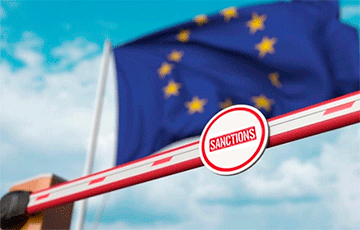
Belarus is among them.
Why are sanctions against Russia imposed by the West circumvented? What role does Lukashenka's regime play in this? Which European countries have turned out to be the leaders in violating the restrictive measures?
Experts from the Norwegian Helsinki Committee in co-operation with the Corisk risk analysis company, the Wikborg Rein law firm and the European Rud Pedersen consulting agency answer these questions in their report.
The experts handed over the report to the European Belarus civil campaign, which translated it from English into Russian. The Charter97.org website has studied the report and collected the most interesting facts.
The full version of the report can be read here.
The authors of the report believe that the Russian Federation is able to continue the war in Ukraine largely thanks to Western technologies, which it receives bypassing sanctions. Experts cite data that Turkey and Kazakhstan are key gateways for the flow of sanctioned goods to Russia.
"Even more surprisingly, a large number of military goods are sent from Europe to Russia directly," the paper says.
Sources of particularly large direct shipments of sanctioned goods include several Western countries, namely: Poland, Germany and Lithuania, with the latter partially supplying sanctioned goods via Belarus.
Analysts say there is a risk that the Western sanctions coalition could "splinter and grow tired".
"It is the harmonisation of compliance that is crucial. The EU, the UK and the US play a leading role in this work," the experts say.
The authors of the report emphasise the special role of Lukashenka's regime in circumventing anti-Russian sanctions.
"Although sanctions against Belarus have been strengthened, aligned to some extent with sanctions against Russia, and the last sanctions were imposed in August 2023, there are still differences between the sanctions regimes.
Our analysis shows that Belarus remains a gateway for transporting some sanctioned military goods from Western countries to Russia," the report said.
Many sanctioned goods end up in Russia via Eurasian Economic Union countries.
"The EU should consider expanding the current licensing regime for military and dual-use goods to include a much larger group of goods necessary for military operations, including digital components. Such restrictions could significantly impede Russia's access to some key technologies," the experts conclude.
The authors of the report see the introduction of a quota regime for trading with EAEU member states and some other states that can supply sanctioned goods to Russia as one of the solutions to the problem.