


The Scam Of The Century
4- 15.10.2025, 16:15
- 9,400
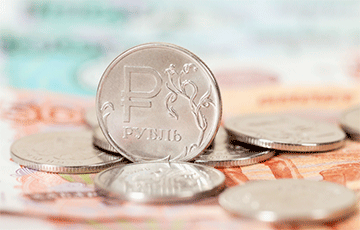
How else can you rip off the Russians.
On November 1, the Russian authorities will begin another experiment on their own citizens. The experiment, which symbolizes the unconscionable abolition of the previous principles of relations between the authorities and citizens.
Lately, however, there have been doubts about the date - November 1; the date - but not the intent.
And the intent of the experiment on citizens is to increase the so-called recycling fee to astronomical values: from a few hundred thousand to more than 4 million rubles. Even the Russian people, seemingly accustomed to everything, have launched very active protests - which is not surprising: the utilization fee has turned into a "scam of the century" without exaggeration, having started its history just over ten years ago.
Milestones of a sorrowful journey
In 2012, in the turmoil of Russia's accession to the WTO, automakers (AvtoVAZ, to be exact) lobbied the government to introduce a non-customs levy that discriminated against imported cars. This levy was linked to ecology, to which it never had and has nothing to do with, and set a not too onerous rate: 26 thousand - 110 thousand rubles.
Of course, the "partners" quite quickly figured out the cunning plan, and the WTO began the process to stop discrimination - but the Kremlin reacted to it in 2014 in the most original way possible: agreeing with the principle, it chose not to abandon the financial invention, but to extend it to all cars, including domestic ones. Since AvtoVAZ received subsidies, the recycling fee did not become critical for the domestic automobile industry.
For some time, in parallel with the recycling fee, there was a government program that stimulated the abandonment of the long use of environmentally inefficient cars and the purchase of new ones. Payments for the trade-in of junk cars reached 300 thousand rubles and exceeded the scrappage fee by 3-5 times. This program was ordered to live long in 2019, and the appetites of "environmentalists" began to grow faster and faster. I should add: until 2019, the increase in the levy was balanced, albeit only to some extent, by a reduction in customs duties on imported cars for legal entities, but then these conventions were discarded.
By the early 2020s, a situation had developed in which the levy turned out to be nothing more than a type of federal tax, and from 2020 it exceeded 100 thousand rubles for any new cars for the first time, which for some cars then amounted to a quarter of the cost. The rate of the scrappage fee continued to rise, and by the fall of 2024 it reached 556 thousand for new cars with an engine capacity of 1-2 liters and 1.1 million for the same used cars.
By this point, the irrational nature of the fee became quite evident, as in most cases of organized imports through dealers, it began to exceed the price of the car set by the exporter.
What recycling really looks like
The signs of a scam - although the nature of the program seems obvious and as if it does not need much proof - are particularly impressive if we consider two aspects of it.
First, there is an irresistible desire to compare it with counterparts in countries more concerned about environmental problems than Russia. And then we will see that in most of them there is nothing like this, and where the payment is present, it is maintained at an extremely low level - compared to Russia. In the Netherlands, for example, when buying a new car, you pay a fee of 22.5 euros, there is also a fee for the disposal of batteries, from 8 to 25 euros depending on their capacity and weight, which is quite understandable, given their environmental hazard.
In Germany, where the legislation is notable for its reasonableness and honest approach, manufacturers are obliged to accept old cars from owners and dispose of them for free. De facto, this means that this amount is included in the price of the car - except for export deliveries. There are also fees for the recycling of electric car batteries, as the damage from their uncontrolled destruction in landfills can be quite significant.
It should be emphasized that in general, the industry of recycling used cars is quite profitable in the world and without any recycling fees: in the U.S., for example, recyclers buy junk cars at prices ranging from 115 to 650 dollars per car and make a profit on the reuse of spare parts and the sale of scrap metal.
In the same Germany, up to 95% of cars are either dismantled at thousands of authorized sites, or modernized with the participation of manufacturers - the export of such used cars exceeds ... 1 million units per year.
In Russia, I note, there is no licensing of such activities at all, and if a car owner wants to dispose of his car - usually in order to legally terminate its ownership and get rid of the need to pay transport tax - he can apply to any company that has a license to recycle metal scrap metal What is particularly interesting: if you are going to recycle a car, in the technical passport of which there is no mark on the previously paid recycling fee, the basic rate of payment for this work was in 2024. ... 20 thousand rubles - or 30-200 times less than the amount that the state is going to extort from the buyer of a new car next year.
Secondly, there is an irresistible desire to understand what the funds collected for more than ten years are spent on. Even if we pay attention, for example, to the statistics of 2024 (1.57 million new cars were sold in the country last year and 395 thousand used cars were imported, with the average amount of the fee in the first case - 556 thousand, and in the second - 1.28 million rubles), we will get a revenue of at least 1.1 trillion rubles, which goes directly to the federal budget. If in 2026 the fees will be raised to the planned - and in addition to a simple increase in tariffs there will be a significant complication of the calculation of the payment, now will be taken into account not only the volume of the engine, but also the power, and the growth of the fee will not stop until 2030, - additional revenues may amount to about 700 billion rubles.
These funds have nothing to do with environmental programs, all expenditures on them from the federal treasury under the article "Environmental Protection" are planned for 2025. In the amount of 914.3 billion rubles, nor to road construction, for this there are other fees from motorists - from transport tax, still adjusted for the "luxury tax", under which falls more than 500 models of cars, to excise taxes on motor fuel and tolls on the system "Platon", nor to road safety.
Worse than drunkenness
In other words, we are talking exclusively about an undiversified fiscal tool that the government uses at will and which becomes one of the serious sources of tax revenues, while it is provided by just one social group - motorists. I would even say that this levy has become the most significant "selective" tax in the country, because even the excise tax on alcoholic beverages in 2024 turned out to be ... 8 times less than the "utilization levy"!
This means, among other things, that the "progressivity" of income tax in Russia is much more significant than the authorities claim, and that motorists have become the most seriously taxed group of the taxable population.
The only response so far is that people are trying to adapt to the changing situation (from August 2024 to August 2025, car imports by individuals rose from 36% of new car imports to 72%, taking trade into the "gray" zone), but the authorities are responding by tightening the rules more and more. This incessant race has led to the fact that in 2024 the average ruble value of a new car in Russia has increased 10 times compared to 2004, from 305 thousand to 3.12 million rubles, and in 2026 may increase by another 30-60%. According to calculations of automobile experts, the price of Toyota Camry with a 2.5 liter engine after the New Year will reach 6.5 million rubles, and Toyota Land Cruiser 300 will cost 13.3 million rubles, it is respectively 2.6 and 2.3 times more expensive than today these models cost in American car dealerships. Why so? - It is easy to explain: there is a huge amount of money at stake - Russian motorists will pay for one-sixth of the country's military expenditures in 2026 only through the scrappage tax, and if gasoline taxes are taken into account, even more than a quarter! What space for those who want to expand the list of Russians under personal sanctions!
The relationship between the Russian authorities and motorists has gone through several phases in recent decades. In the 2000s, the Russian government, taking advantage of the country's non-participation in the WTO, implemented a brilliant strategy to attract foreign automobile concerns, which opened large assembly plants and became investors in the largest Russian car factories, rapidly increasing the number (from 990,000 in 2002 to 1.97 million in 2012) and, most importantly, the quality of cars produced - by 2012, two-thirds of the output were cars of European and American car companies. The Kremlin talked about Russia's inevitable transformation into Europe's largest automobile market, but by 2024 its own production had fallen to 756,000 units, sometimes in very primitive equipment, and a significant part of new sales, as before, came from imports, mostly Chinese.
In the new conditions, motorization is seen not as a means of improving the quality of life of the population, but solely as a tool to replenish the treasury (recycling fee) or support "domestic manufacturers" (limitation of the range of cars for the domestic market). Direct taxes - like personal income tax - were preferred to be withheld from wages "preventively", without "stressing" citizens with tax returns and various additional tax payments at the end of the year.
But the stagnation of the 2010s, and then military realities forced a change of approach - first through the introduction of progressive personal income tax in 2021 and 2025, and in parallel - through the growth of the tax base,
This is a very important change in Russian politics, and it demonstrates a complete loss of fear of the only type of protest that has manifested itself in the country over the years: a protest caused by an attack on the rights of certain social groups, which is explicit and has serious material consequences. We can recall several such cases, from the "monetization of benefits" to attempts to ban the operation of right-hand-drive cars. Apparently, the Kremlin has stopped seeing the shore: the silence of Russian society is telling, and it is ready to tolerate almost anything the authorities can think of.
The "opposition" could speak for society, but its leaders are not concerned with what is happening in the country, and it is much more boring than the discussion of the nuances of the different versions of the book by Alexei Navalny.
If so, the "utilization" scam of the century will clearly not be the last...
Vladislav Inozemtsev, The Moscow Times.

Bank's name: Bank Millennium S.A.
Address: ul. Stanislawa Zaryna, 2A, 02-593, Warszawa
IBAN: PL97116022020000000216711123
SWIFT: BIGBPLPW
Name of the account holder: Fundacja “KARTA ‘97”
Purpose/title of payment: Donation for statuary aims
You can contact us by the e-mail charter97@gmail.com