

"There Are Three Obvious Reasons Why Trump Gave Putin A 'spanking'"
8- 24.10.2025, 9:35
- 8,812
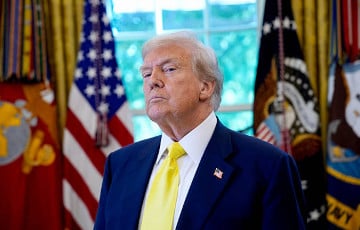
And began to finally put pressure on Russia.
US President Donald Trump announced the cancellation of the summit with Vladimir Putin in Budapest, explaining it was the "wrong moment" and lack of perspective. He added that Putin was willing to negotiate on Ukraine but was making maximalist demands. "We don't want him to have everything," the White House head explained his position.
With this background, Washington has moved to open pressure. Trump announced tough sanctions against Russian energy companies, and the US Senate approved three bills at once: on the use of frozen Russian assets in favor of Ukraine, recognizing Russia as a sponsor of terrorism and punishing China for supporting Moscow. "I hope the sanctions will make Putin smarter," Trump said on the occasion.
Europe, meanwhile, is synchronizing: adopting the 19th sanctions package and discussing a €140 billion "reparation loan" for Ukraine. Ukraine's allies are preparing truce options that could please Trump. Behind the closed doors of European capitals, a 12-point plan to end the war is taking shape - a document that should both stop Russian aggression and please the American president.
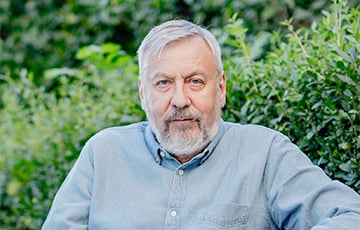
With his thoughts on these issues in an exclusive interview for OBOZ.UA shared diplomat, Ambassador Extraordinary and Plenipotentiary of Ukraine, Ukraine's representative to the EU in 2008-2010 Andriy Veselovsky.
- Well, let's start with the meeting that never took place in Budapest. The question is first of all, why did Trump decide to do so?"
- There are several explanations. One is the role of US Secretary of State Marco Rubio. He had a conversation with Russian Foreign Minister Lavrov, after which he reported on its content and, more importantly, its tone. And that tone was telling. Rubio joined this with quotes from Putin's press secretary Peskov, who of course doesn't speak without his master's permission. And all of this together created a negative impression. There are also statements by Deputy Foreign Minister Ryabkov, who is not just a diplomat, but a man who has been dealing with strategic, including nuclear issues with the United States for twenty years. And all of this, put together, could have landed on Trump's desk.
The second element: a growing wave of criticism of Trump's actions in relations with Russia in the American media. You know, when the "that trashy, treasonous, undignified" New York Times writes about you, in Trump's own words, that's one thing. When the even more "vile" CNN is another. But when the Washington Times, the Wall Street Journal - that is, the mouthpieces of big capital - write about it, when NBC, which he supposedly loves, and not ABC get involved, all this already creates a chorus that drowns out even the "joy of victory" that he ascribed to himself in the Middle East.
And that's when Trump realizes that it's simply not the right time to be chatting with Putin in Budapest. Because people from NATO are coming, reminding him: we are a military alliance, it's dangerous now, the Russians can make serious advances if we relax. Ukraine should not be "saved", but should be given a shoulder to lean on - in a real, mature way. And all of this may have played a role. But I think there is another point. Trump has a meeting with Chinese leader Si Jinping in a week's time. And to that meeting, the American president has to go strong. And he will be strong when he publicly slaps Putin. And that public slap is what we saw. It all came together. That's why Trump says, "Stop screwing with me." And now that Putin is also going to "deceive him in front of the whole world", he decides - no, enough. And cancels the meeting.
- Is this really a slap in the face for Putin? And is it really the loss of a big opportunity for him?"
- Undeniably. And most importantly, Trump hasn't changed his fundamental idea of "trying to buy Russia." That hasn't gone anywhere. It all stays down, in his logic. He's just looking for the best bargaining position. But it is now that he is giving Putin a public slap in the face. Because the whole world has already been talking about Trump's over-reliance on the Kremlin. After that "Alaska" everyone said: you are dependent on him. He came to you, "ate, washed your feet, left dirty water, and you were left with nothing." Then Trump has not yet boarded the plane, to fly home, and all the media are already reporting that he lost. And so this picture of dependency is shattered by one public gesture. Trump says, "No, he's not going to have me. I'm going to have him." And when he adds: "I'm not giving him everything," it's not just about Ukraine. It's about the geopolitical game in general.
- Regarding the consequences after the repeal. Donald Trump said the US Treasury Department is imposing sanctions on Russia's largest oil companies Rosneft and Lukoil and urged Moscow to immediately agree to a ceasefire.
"I hope the sanctions will make Putin smarter," Donald Trump said of the sanctions imposed on Russia. The new U.S. sanctions against Russian Federation will be among the toughest ever imposed, U.S. Treasury Secretary Bessent said. In your opinion, so to what extent can these sanctions make Putin "smarter"?"
- These predictions only confirm: all this has primarily an anti-Chinese direction, not purely anti-Russian. As far as India is concerned, we are not talking about "complete withdrawal" there. There is an English term phasing out, i.e. gradual withdrawal. Not cutting down - not "cutting off". It means that nothing will happen tomorrow. The process will take months, not weeks. Gradual reduction of purchases is what it is. That is why it is wrong to say that "today sanctions are imposed, and tomorrow Russian tankers will not know where to put their oil". Someone will still buy this oil, perhaps in smaller volumes, but they will buy it.
Another question is whether China will refuse? Absolutely not. Moreover - it will increase purchases, but lower the price. Will this make Putin smarter? Yes, but not right now. That is, no change in the paradigm of war against Ukraine, Europe, and part of the rest of the world is visible yet. Are there any signs that the Kremlin has begun to think differently? No. There are only reports that Russian generals have already determined the dates for the "capture" of Kupyansk and Pokrovsk. And if they have, they will go for it at any cost.
This means that the danger is growing. They can redeploy forces from other parts of the front. After all, in the same way Putin now needs a show of force before the Xi Jinping and Trump summit. He wants to show himself "indestructible." So we have the hottest phase of all the hot phases. And there is no sign that Putin has changed his mind.
- And this "practice nuclear strikes," this demonstrative launch of the Yars missile, this demonstrative activity of the nuclear triad - is this "I'm not afraid of anything and will continue on"?
- These tests were conducted demonstratively in response to the tests conducted in NATO countries. There, however, not in three environments - water, land, air - but only in one. But the very fact - it was a response.
In addition, these maneuvers are timed to coincide with the meeting in Southeast Asia. This is the second "climax" for the PRC. The first was on Sept. 3, at the celebration of China's victory in World War II - then it was about a purely military demonstration. And now it is an economic and financial one. China is now seeking to show its primacy in the Indo-Pacific region, if not the world. And Putin is thus demonstrating his "value" to Xi Jinping. Because what Xi has in his arsenal today is not what Putin has in the nuclear sphere. Yes, maybe it will appear in 5-10 years, but not now. It's as if Putin is saying, "You can't agree with Trump among yourselves? I'm here. And I'm not a third party. I am an equal. Without me, this world will not be stable." That's actually the point of this demonstration of the nuclear triad.
- What about the authorization for strikes? The Wall Street Journal reported that the U.S. had lifted restrictions on Ukraine's use of Western long-range missiles. But Trump just hours later claimed it was a fake: they said nothing had been lifted, no authorization had been given. What was it even?"
- It's a game. A very clever one. The newspaper wrote: "The restrictions have been lifted." But the missiles used are European - those Storm Shadow missiles. Trump, on the other hand, is telling the truth: "We didn't take anything off." Because indeed it was not the US that filmed, but the Europeans. However, there is a nuance: these missiles cannot be used without an American "nod."
- There are American components there.
- Exactly. But these missiles were not delivered to Ukraine "yesterday". They have been lying in warehouses for months. And now there was that "nod". One. Then the Treasury Secretary's announcement of sanctions. Two. And Trump's own reaction. Three. It's another "triad," if you will, only politically executed. And the Wall Street Journal is right when it writes about it. And Trump is also right when he says he didn't take anything off. Because technically there was nothing to remove.
- Now regarding Europe. Yesterday the summit of EU leaders in Brussels, today in London "coalition of the willing". The 19th package of sanctions has been adopted. The issue of using frozen Russian assets to fund aid to Ukraine is going hard, but still steadily. So, can we expect any major decisions in the near future?
- Before the EU summit it was clear: the main issue will be precisely the use of frozen Russian assets in the Belgian Euroclear. This is the most important and most complicated issue on the agenda. If now there was a clear signal from the Americans that they support this idea, it would significantly affect the positions of those countries that still have doubts. Among them are Belgium, France, perhaps a little bit of Austria. The Germans have already agreed, which is very important. The Netherlands seem to agree as well. But these two or three capitals are still hesitating. For our part, we must remain persistent, but not cross the line. Europeans are our partners, not our pets whom we can order around. The right tone is now more important than the right words.
- Has Europe finally come to that line - the decision to use frozen Russian money? Just a year ago, even the thought of it caused them shock. There were plenty of "why not" arguments - from the risk to financial stability to legal obstacles. And now? Are they running out of money or have they just realized that the war will last longer than they thought?
- Both. All countries in Europe are in debt. Some are catastrophic, like France. And at the same time, both left-wing and right-wing populist movements are growing. They both shout: "Spend the money on us!" or "Throw out immigrants!" The only paradox is that they do not want to work instead of immigrants. So, the internal political situation in Europe is such that it is risky to allocate large funds to Ukraine openly.
The logic is simple: either we pay our own pensioners or Ukrainian ones. And this is not a question of one politician - it is a question of millions of voters. So if money is needed, it should be taken where it does not hurt our own electorate, for example, in Russia. Because their own citizens are not ready to pay, they are "not ripe". By the way, even the Poles, who have always been Ukraine's most ardent friends, have now become the most cautious. They are least willing to give money, least willing to participate in new aid programs. They are busy digging up graves and rewriting history. Yes, the question of memory is important, but the question of the future is even more important. That is why today, if to simplify: either Ukraine will remain and together with it Poland and Europe, or there will be neither Ukraine, nor Poland, nor Europe.
- NATO Secretary General Rutte had a meeting with Trump the day before. He brought to the White House the 12-point plan that is now being hotly debated - with a cease-fire but also a gradual lifting of sanctions on Moscow, that is, with "proposals by and for Trump" and potential peacemaker laurels for him.
- Exactly. That's the very same plan. You see, they reduced the previous one, the "Middle East" one, from 20 points to 12. But the main difference is not the quantity. In the Middle East plan, there was no answer to the simple question, "Who will do it?" The 12-point plan does. It explicitly says: NATO does everything, NATO controls, NATO coordinates. In that plan, Hamas and the IDF were on their own, while here there is a force, a structure and a control mechanism.
- But how viable is this plan at all? I mean, NATO is a red line for Putin there. Or is it just a diplomatic move to show that Putin "said no again"?"
- Both. Because when they say "NATO," it doesn't mean that tomorrow everyone from Cyprus to Iceland will pack up their armored personnel carriers and march on Pskov. We are talking about a coalition of the willing. NATO gives logistics, intelligence, financial and organizational support. But not everyone fights together, but those who are ready. This, by the way, is perfect for Trump. Because not by his hands, not by his soldiers. It's important to him that "others do the work and the laurels go to him." And that's why Europe is playing into this willingly. They offer him to become "chief of security" - simultaneously in Ukraine, in the Middle East. That is - a global warden for stability. And then the "noobel" will come.
All in all, this is essentially about the alliance taking responsibility for Ukraine's security. Not for Ukraine's war with Russia, but specifically for its security. How? By giving weapons, giving money, giving insurance guarantees. And if the front line remains as it is now, it is NATO in this new form that will guarantee that no one else will cross it.

Bank's name: Bank Millennium S.A.
Address: ul. Stanislawa Zaryna, 2A, 02-593, Warszawa
IBAN: PL97116022020000000216711123
SWIFT: BIGBPLPW
Name of the account holder: Fundacja “KARTA ‘97”
Purpose/title of payment: Donation for statuary aims
You can contact us by the e-mail charter97@gmail.com