

Putin's Ukrainian Failure
1- 21.11.2025, 11:42
- 24,972
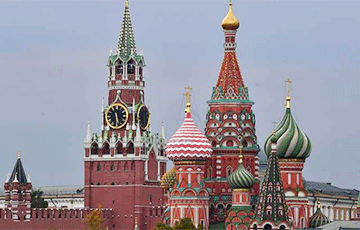
For the Kremlin, all of this is extremely bad news.
The full-scale invasion launched by Vladimir Putin nearly four years ago is often characterized as "unprovoked," although it is hard to call it entirely unexpected. On the contrary, the large-scale invasion of 2022 was just the latest in a growing escalation of Russian aggression designed to keep Ukraine in the Kremlin's orbit and prevent it from returning to the community of European powers.
In the early years of Putin's rule, this strategy was expressed primarily in crude interference in Ukraine's domestic politics. After the 2014 Revolution of Dignity, the Russian autocrat shifted to a much harsher combination of military pressure and political control. But when even outright aggression failed to dislodge Kiev from the European path, Putin decided to "close the Ukrainian question" in the most radical way possible - by launching the largest European invasion since World War II.
Today, with the start of the fifth year of the war just around the corner, there is little to indicate that such heavy-handed tactics will be successful. Russia has occupied about a fifth of Ukraine's territory, but in the remaining four-fifths of the country, attitudes toward Moscow have become sharply hostile and the desire for Europe is firmer than ever. For the vast majority of Ukrainians, the invasions of 2014 and 2022 were watershed moments that profoundly altered notions of national identity and permanently severed previous ties with Russia.
This transformation of Ukraine's geopolitical orientation is mirrored by equally marked internal changes: the country's center of gravity is shifting decisively from east to west. In the first decade of independence, Ukraine's political and economic life was defined by the industrial east: major cities such as Donetsk, Kharkiv, Dnipro, and Zaporizhzhya served as key strongholds for the billionaire oligarch clans that shaped the national agenda and maintained a high level of Russian influence throughout the country. At the time, the colorful but far more modest cities of Central and Western Ukraine had neither sufficient capital nor resources to compete with them.
The first sign of a major shift in this dynamic was the Orange Revolution of 2004, when unprecedented protests erupted across the country against an attempt to rig the presidential election, an operation orchestrated by pro-Russian political forces firmly entrenched in the east. This popular uprising was a clear and unequivocal rejection of the idea that Ukraine was supposedly inextricably linked to Russia. A decade later, the onset of Russian military aggression has only rapidly accelerated modern Ukraine's historic turn to the West.
After 2014, the traditional centers of Russian influence in eastern Ukraine - Donetsk and Lugansk - found themselves under occupation and effectively disappeared from the country's political map. The full-scale invasion made the situation even worse. Much of Donbas has been destroyed and depopulated, and the once-dominant eastern metropolitan areas are on the front lines, turned into fortified outposts with uncertain prospects under relentless Russian attacks.
Western Ukraine, on the other hand, is undergoing a real transformation. Cities in the region are growing dynamically thanks to an influx of businesses and families fleeing war. Lviv is the most striking example of this process. Since 2022, the population of the largest city in Western Ukraine has increased by about a quarter and approached one million. The Lviv real estate market has confidently overtaken major eastern centers and, in fact, equaled the capital. In terms of the number of new companies and investments Lviv is now second only to Kiev.
The political and diplomatic influence of Lviv is growing just as rapidly. Many embassies based in Kiev moved partially to Lviv in 2022 and continue to maintain offices there. Over the past three years, the city has hosted a number of high-level international events, including presidential summits and EU ministerial meetings. Lviv's rise in influence has been so marked that it has given rise to rumors of jealousy within the Kiev establishment: some believe that the possible reopening of Lviv International Airport is being deliberately delayed to prevent further eclipse of the capital.
Whatever the outcome of the war, the reversal of Ukraine's national center of influence toward the western regions is unlikely to ever be reversed. In addition to the powerful compulsory impetus created by the ongoing Russian invasion, the development of western Ukraine is also driven by the factor of Ukraine's aspirations for EU integration. Over the past decade, Ukraine has achieved visa-free travel with the EU and has been granted official candidate status. This is transforming the investment climate in the western regions bordering the four EU member states.
Large infrastructure projects are already strengthening western Ukraine's status as the country's most attractive region and its "gateway" to the EU. Earlier this year, the country broke ground on a 22-kilometer railroad line with European standard gauge from the EU border to Uzhgorod, and construction of a much larger Euro gauge line that will connect Lviv to the Polish border is due to begin in 2026. As Ukraine's accession process to the EU gathers momentum, these logistical links will only become stronger.
It is still unclear when exactly Ukraine will become a full-fledged member of the European Union, but there is a growing sense of confidence in the country that the once distant dream of membership is finally becoming achievable. For western Ukraine in particular, joining the EU will be the completion of a historic journey - from imperial outpost on the fringes of Soviet space to economic engine at the heart of the world's largest single market.
For Vladimir Putin, all of this is extremely bad news. His obsession with Ukraine reflects a fear that consolidating a democratic, European and truly independent neighboring country could be the catalyst for the next phase of Russia's long retreat from the imperial past that began nearly four decades ago with the fall of the Berlin Wall.
With each year of Putin's rule, his desire to prevent Ukraine's geopolitical retreat has only grown stronger, as has his willingness to disregard Russia's immediate interests for the sake of his anti-Ukrainian "crusade." But now it is increasingly clear: Putin's invasion has failed, undermining centuries of Russian influence and strengthening Ukraine's desire for the European integration it so desperately opposed.
If Putin fails to completely destroy Ukrainian statehood and the very idea of a Ukrainian nation, it should be clear to him that postwar Ukraine is bound to become part of the Western world and remain implacably hostile to Russia. Unwilling to recognize this catastrophic outcome, he will seek to continue the war indefinitely. Putin realizes that if he stops now and agrees to a compromise peace, he will go down in Russian history as the man who lost Ukraine.
Peter Dickinson, Atlantic Council

Bank's name: Bank Millennium S.A.
Address: ul. Stanislawa Zaryna, 2A, 02-593, Warszawa
IBAN: PL97116022020000000216711123
SWIFT: BIGBPLPW
Name of the account holder: Fundacja “KARTA ‘97”
Purpose/title of payment: Donation for statuary aims
You can contact us by the e-mail charter97@gmail.com