


Forbes: "Daggers" Plow Fields To The Ukrainian Anthem
1- 21.11.2025, 13:04
- 11,158
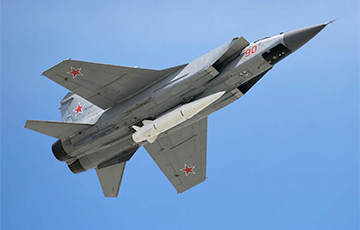
How the AFU diverted Russian missiles from their targets.
Russian hypersonic Kinzhals have recently started crashing into empty Ukrainian fields instead of hitting targets. The defense forces suppress enemy missiles with the technique of "spoofing", sending false data.
The Ukrainian methods of fighting Russian Kh-47M2 "Kinzhal" aeroballistic missiles are written by the Forbes. The journalists noted that according to the FT from August to September their interception rate by US Patriot anti-aircraft missile systems dropped from 37% to 6% due to Russian munitions modifications, but the AFU forces the Kinzhals to descend at speeds of over Mach 5 and miss, striking deserted areas.
Members of Ukraine's Night Watch unit told reporters that they have now suppressed at least 21 Kinzhals with the Lima electronic warfare system using the "spoofing" technique, and the shooting down of two more missiles is awaiting confirmation.
Russian manufacturers report that the Kinzhal has a 10-meter "circular probable error," meaning it should hit within 10 meters of a given point half of the time. The authors of the article note, however, that a Russian milblogger on November 10 published satellite images of funnels showing misses of up to 144 meters.
The journalists explained that the Dagger's guidance system relies on satellite navigation, which uses Russia's own GLONASS satellite group instead of the U.S. GPS. This navigation can be confused by external signals. Photos of the Dagger wreckage provided by the Night Guardian confirm this vulnerability.
"The missile fell without an explosion, which can only be accomplished with the help of electronic warfare," the Ukrainian military said.
The journalists noted that the suppressed missile has a multi-element Kometa satellite navigation receiver with several antenna elements to eliminate interference, which are also installed on drones like the Shahed.
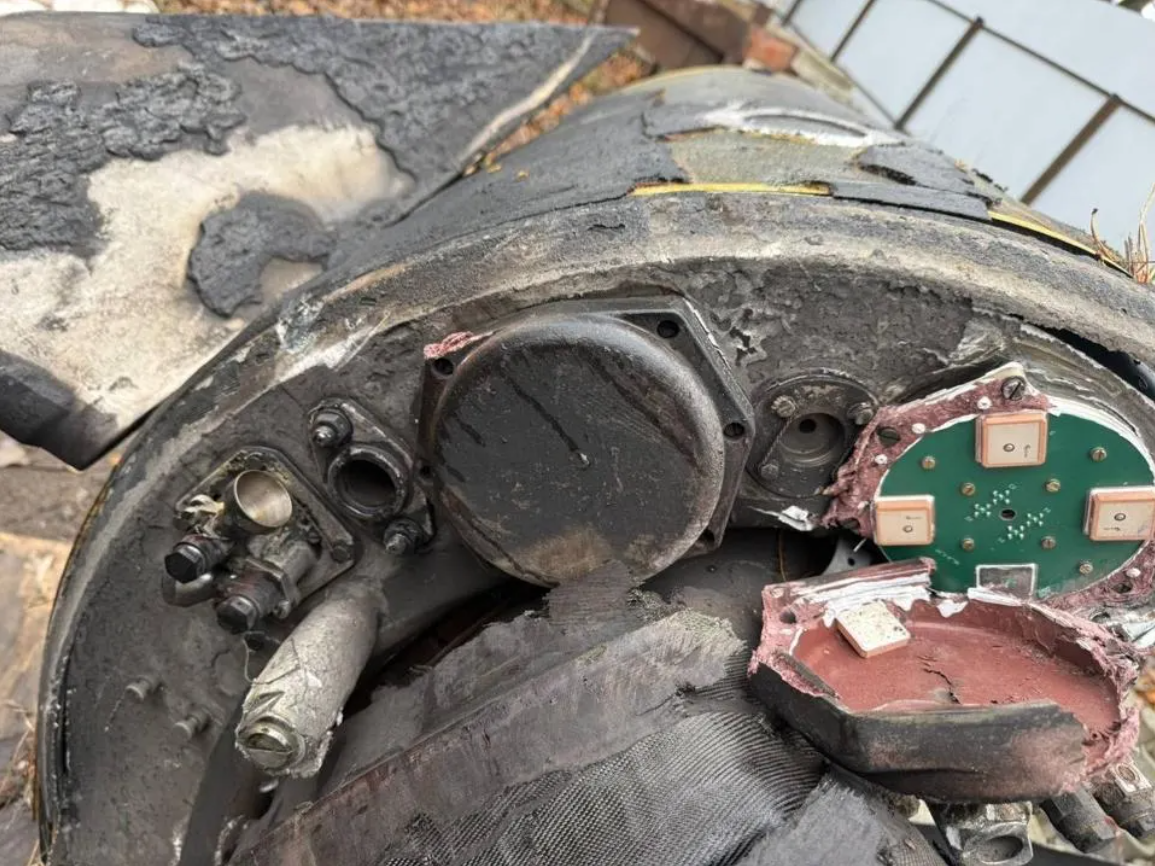
How Dagger missiles are diverted from their target
The authors of the piece explained that the Kometa uses controlled pattern reception antennas (CPRA) to block jamming signals, but the spoofing technique used by the AFU is more insidious. Instead of blocking satellite data, the Ukrainian military sends fake signals - this confuses the receiver, and it transmits incorrect coordinates. The victim is unaware that he or she has been attacked.
"We create a wide navigation ban zone and transmit a specific signal in binary format. In certain flight modes, this causes severe anomalies in one of the missile's channels, causing the autopilot to attempt to stabilize, effectively ignoring other sensors," explained the Nightguard fighters.
Military systems can detect that the navigation is showing false readings, but the root of the problem cannot be determined.
"At that point, the navigation loop is effectively 'blind' and there is nothing left to correct the error," the military said.
If the missile does not detect the false signal, it can be driven far away from its intended target. The Night Guard said the Dagger in the Zhytomyr region managed to deflect it 200 kilometers away from the airfield the Russians were aiming at.
The Night Guard uses a digital version of the Ukrainian anthem for the false signal, according to journalists, "purely for style."
The "spoofing" is a temporary solution, however: American companies such as CMC Electronics are already working on technologies to detect it, and the Russians are probably doing the same.
The journalists noted that Russian President Vladimir Putin once called the Kh-47M2 an "ideal weapon" that could defeat any Western air defense system, and now the Kinzhals worth millions of rubles continue to plow farmland to the sound of the Ukrainian anthem.

Bank's name: Bank Millennium S.A.
Address: ul. Stanislawa Zaryna, 2A, 02-593, Warszawa
IBAN: PL97116022020000000216711123
SWIFT: BIGBPLPW
Name of the account holder: Fundacja “KARTA ‘97”
Purpose/title of payment: Donation for statuary aims
You can contact us by the e-mail charter97@gmail.com