

Media: Russian Draft Peace Plan Contained A Clause Targeting A Key Kremlin Ally
3- 27.11.2025, 14:25
- 10,408
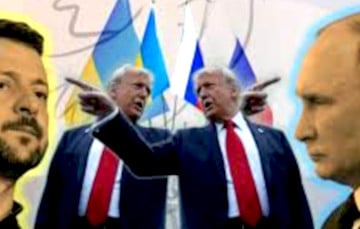
Moscow is ready to betray him.
Trump's scandalous 28-point "peace plan," passed off as a US initiative, according to media reports, was in fact a wish list of Moscow's wishes that no one had agreed upon with either Washington or Kiev. Many of the plan's controversial terms originated in the Kremlin almost a year ago, and one of the points is directed against Russia's key ally China, The Insider wrote, citing sources.
According to the publication, a number of key provisions of the plan, which leaked to the press on Nov. 18, are actually borrowed from an earlier draft written by Kremlin negotiator Kirill Dmitriev shortly after Trump returned to the White House in late January 2025, including:
de facto U.S. recognition of Russian-occupied Crimea, LNR and DNR (which is seen as a concession on Moscow's part compared to the more binding de jure recognition of these territories);
freezing territorial status along the current line of contact in the Zaporizhzhya and Kherson regions;
phasing out sanctions on Russia;
admission of Ukraine to the European Union;
unconditional denial of Ukraine's admission to NATO;
prohibition of the presence of Western peacekeepers or NATO contingents in Ukraine;
a scheme whereby the U.S. profits from frozen Russian assets held by the EU while investing in post-war Ukraine, and an invitation for the U.S. to invest in Russia.
The most striking similarity concerns the last paragraph:
"$100 billion of frozen Russian assets are directed to a U.S.-led effort to rebuild and invest in Ukraine," the 28-point plan reads. - The U.S. would receive 50 percent of the profits from the venture. Europe adds $100 billion to increase the amount of investment available to rebuild Ukraine. Frozen European funds are unfrozen."
"The oligarchs will still be able to get their profits from investments in Ukraine," explained the Russian source who showed The Insider the first version of the document. In other words, assets would not be lost, but simply redirected into future business projects to enrich billionaires close to Putin.
It is claimed that the Russian concept also contained two "baits" directly aimed at the Trump administration, which is known for its strictly business-oriented approach. Both of these proposals were quite remarkable, but only one of them made it into the plan leaked to the US media.
The first was that the US would be able to invest in Russia's post-war economy, which is expected to be "severely underfunded and in need of investment" due to its full military transition following a full-scale invasion in February 2022. This, the source explained, would usher in "a new... era for U.S. investment in Russia similar to the 1990s."
The 28-point plan reflects this proposal as follows: "The balance of frozen Russian funds would be directed to a separate U.S.-Russian investment structure that would pursue joint projects in specific areas. This fund would aim to strengthen relations and expand common interests to create a powerful incentive to prevent future conflicts."
The second proposal revealed in the original plan is completely absent from the Whitkoff-Kushner-Dmitriev version. The Insider's source summarized it as, "We would be willing to trade China for the U.S.," adding that Russian elites are "infuriated by China's growing role in the civilian economy - it is exploiting the gaps left by the withdrawal of Western investors."
Bearing in mind the well-known great-power rivalry between Washington and Beijing, the proposal was to create a coalition of opponents of the rising Asian superpower, characterized by the source as "a kind of new Christian coalition."
This was apparently intended to address an argument popular in MAGA circles for not supporting Ukraine: that the US should focus its military and diplomatic efforts on countering China's rise as a global superpower. This clause was probably deleted because Russia did not want to even hint that it would ever break with its most important strategic ally.

Bank's name: Bank Millennium S.A.
Address: ul. Stanislawa Zaryna, 2A, 02-593, Warszawa
IBAN: PL97116022020000000216711123
SWIFT: BIGBPLPW
Name of the account holder: Fundacja “KARTA ‘97”
Purpose/title of payment: Donation for statuary aims
You can contact us by the e-mail charter97@gmail.com