Yauhen Afnagel: In Iran Today There Is A Real Revolution
13- 9.01.2026, 23:48
- 15,734
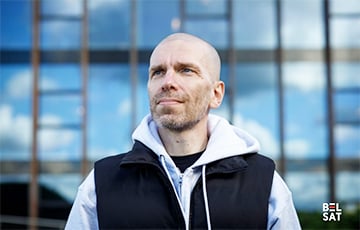
Photo: belsat
What does it take to defeat a dictator?
Taking control of cities and highways, the security forces moving to the side of the people, a nationwide strike, strong leaders. What are the secrets of "small victories" of the protesters in Iran and what can they lead to? Answers to these questions - in the interview of the coordinator of the civil campaign "European Belarus" Yauhen Afnagel Malanka Media. The website Charter97.org cites a transcript of the conversation.
- The trigger for renewed mass protests in Iran was the collapse of the national currency. For comparison I will specify for our viewers that before the ayatollahs came to power in the late 70s, the US dollar was worth 70 rials. Now it's about one million 400 for one dollar. Plus the official inflation rate reached 43% in December. That's not Belarusian inflation, of course, it's much higher. So, do you think, with the protests growing in intensity, with Trump's threat, do you think there's any chance for Iranians to finally bring down this religious dictatorial regime? Let me remind you that there are rumors that Rahbar Khameini has already packed a suitcase and is ready to fly to where? To Moscow?
- Naturally, to Moscow, there is nowhere else. The protests in Iran are very encouraging. We can see that in just 10 days they have literally covered dozens of settlements, the capital and major cities. Iran still has a fairly strong army and a consolidated dictatorship, but given that the protesters are acting professionally and decisively, they are making some new progress every day, two cities are under their control, administrative buildings and police stations are occupied in many cities, and there are weapons. We can look at the situation with cautious optimism, but for now it is uncertain.
- There have been several waves of protests in Iran over the past 3-4 years. The penultimate one was already a protest caused with the murder of a woman for wearing the hijab incorrectly. Now it is an economic protest in the first place. It turns out that economic protest, which is more intense now, is still a more effective form of protest?
- Indeed, the trigger was the economy and the depreciation of the rial against the backdrop of sanctions and the economic crisis. But we should not forget many other contradictions within Iranian society. About 35-40% of the country's population is made up of national minorities - Kurds, Azeris, Lurds, Baluchis. If we look at the cities that are covered by the protests, we see that most of them are concentrated in the west of the country, along the border with Iraq. The Kurdish and Azeri minorities are actively participating in the protests.
The economy was the trigger, but we can already see that just a couple of days later, already on New Year's Eve, January 1, the protests were under political slogans. And one of the slogans was the demand for the return of the monarchy. You just have to look at all these reasons in a complex. We don't know yet which of them will be decisive.
- Now some part of both the army and the police is already moving to the side of the protesters, because two cities are already occupied by the protesters, these are Abdanan and Malekshahi, they are small cities, but it turns out then that some of the police simply moved to the side of the protesters, and the army simply ran away?
- Not only in these cities, but in other cities there were cases when the police moved to the side of the people. The army moves to the side of the people when it sees decisive action, when it sees that this is really, as the leaders of the protests in Iran say, a decisive, final battle. It's important for the military to realize that there is a chance of victory. In such a situation, the army does come over to the side of the people. But I emphasize, this happens only when the people act decisively, when the people are confident, when the people win victories every day. The army will not take the side of the weak.
- Here we are already now running into parallels with our protests in 2020. Is it possible to compare them in any way? Is it even correct to compare with Iran now, with the actions of the army? Because as I recall, a fair number of both the military and the police in 2020 wanted to side with the protesters. Remember those videos of burning uniforms, tearing up their tickets and the military and their own police ID?"
- Some number of the military crossed over to the side of the people, more wanted to cross over. We met with the security forces in the summer of 2020, we met with the military. Conversations very often ended with the fact that they did not see any center that is ready for decisive action, ready to win and take power into their own hands.
The situation was very good for this, a huge number of people took to the streets in Belarus. As a percentage of the entire population, probably, nowhere in Eastern Europe for the last 50-70 years such a number of people have not come out on the streets. The situation was unique. But, unfortunately, the military, like many other people, did not see the will to win in the headquarters of the presidential candidate.
With regard to the first half of your question, it is naturally correct to compare, because revolutions in all countries follow more or less the same scenario. It's some kind of trigger, economy, rigged elections, defeat in a war. People take to the streets, there are more of them. But then there are bound to be other actions. Not necessarily violent ones. In 2020 we wanted a peaceful revolution, after all. But nonviolent resistance implies daily protest. Non-violent resistance means occupying buildings. Nonviolent resistance means taking control of key highways, railroads. Non-violent resistance implies a nationwide strike. These are prerequisites for the victory of a peaceful revolution. We see all of this in Iran. And most importantly, we see that the symbolic leader of the protest - the son of the last Shah Reza Pahlavi - called for a nationwide strike even in the early days. He expressed strong support for the protesters without any reservations. Every day, while abroad, he kept his finger on the pulse of the country and did not just support the protesters ex post facto, but called for concrete action. For example, even today I saw on social media Pahlavi calling for a nationwide protest on January 8 and 9.
Unfortunately, we didn't have that in 2020. The headquarters of Svetlana Tikhanovskaya instead of calling precisely for decisive action, to some extent dampened the protests. There were even calls not to take to the streets. This is the root difference. In my opinion, these calls played a negative role in us not meeting our 2020 goals.
Also, another important point. Protests should be done in the city center. Revolutions are made in capital cities. Revolutions are made in the center of capitals. And in 2020, you remember that during the most massive actions, people gathered in the center of the city, but then they left the city, they went, let alone not to the outskirts, but to the periphery.
That's not how revolutions are made, that's not how non-violent resistance works. In the example of Iran, we see how it should work, how it can work. And we see that it leads to success, even though the dictatorship in Iran is stronger and more brutal than in Belarus.
- Yes, I remember very well August 16, when everyone was ready, when this huge crowd - not only in Minsk, I myself am from Hrodna - there was a huge number of people in Hrodna. But that's it, we split up and started rioting again the next Sunday. This, of course, was like a blow to the head.
- I remember this action on August 16, I was there. I remember the sea of people, I remember the pride in everyone's eyes that there are so many of us. I remember the determination of people, but I also remember their disappointment when the action ended.
- Most of the people from the Stela went then - we just see these images - to the avenue, to Independence Square, and in response to the calls of some people to some action, they referred to the fact that "we were not told about it in the TV channels, they told us that we should disperse". A large number of people had disappointment in their eyes that their expectations were not met.
- I agree with you. I also remember just then the broadcast of Alexander Glebovich Nevzorov and his phrase "peaceful protest is the best form of submission"...
- Peaceful protest does not exclude occupation of buildings, peaceful protest does not exclude blocking the highway, peaceful protest does not exclude strikes. I will remind the history of 2001, when there were also elections, when the Zubr movement played a big role in the protests, when Zubr activists without violence seized the building on Oktyabrskaya Square, which (let's say for one night, one day) was the headquarters of the revolution. It was a peaceful protest.
- It was such a creative peaceful protest. I was little too, but I remember it from my childhood. What do you think are such reasons for Crown Prince Reza Pahlavi's popularity? Because he is outside of Iran. We have a great number of leaders and leaders of Belarusian demsils outside Belarus, too. But because... I, for example, watched today's video from the protests, slogans, and protesters chanting "Iran is ready! Command, Prince! This is the final battle! Pahlavi will return!" But it is hard to imagine that if, let's say, protests start again in Belarus, perhaps because of the collapse of the Belarusian ruble or some other triggers and force majeure, Belarusians will not come out there with slogans "Tikhanovskaya will return". It's impossible to imagine such a thing, I think so.
- I'm sure that the Belarusians will not come out with slogans "Tikhanovskaya will return. But in Belarus there have appeared and there are many leaders who can lead the protests. And I will emphasize, the protests in Iran are decentralized after all. I don't think that Reza Pihlevi enjoys the support of the absolute majority of Iranians. Rather, he's a symbol that at this stage suits everybody. Of course, there is a very large portion of supporters of the monarchy who want it restored, but I'm not sure they are the majority. But as a symbol of protest, Reza Pahlavi is behaving very responsibly and professionally, as a patriot of his country. He didn't just support the protests, he initiated them to some extent. Perhaps it was this behavior that resonated in people's hearts.
- Returning to our 2020 protests: if something were to happen, and we would win in 2020. Let's imagine Lukashenko flew to Voronezh or somewhere in Muscat, like the capital of Oman. What would Putin do then? He would obviously have introduced troops. At that time there was still a mythology about the Russian army, Putin himself, and Russia's power in general.
- You know, it seems to me that this is quite a widespread myth, spread by Lukashenko's supporters: if something happens, Putin will lead troops. You know, like in school they used to say, "You touch me, I'll call my big brother and he'll kick your ass." Russia can't even handle Ukraine right now, it's been storming the district center for a year with all its boasted might. Russia is not as strong as they scare it.
The second point: if democratic forces win in Belarus - I emphasize, I'm talking about 2020, not about today, when there is a war, when Russia is absolutely an enemy - at that time it would be possible to negotiate with Russia with respect for our national interests, from a position of strength. In any case, war is a last resort.
Ukraine in the first few months of the war was able to repel the attack and survive this most difficult phase, and now is successfully, heroically fighting for its independence. If you're fighting alone against Russia, naturally it's hard. But we have Europe behind us. Russia's GDP is 10 times less than the total GDP of the EU countries, without Great Britain, without the United States, without the rest of the Western world. If Europe will be on the side of independent Belarus and independent Ukraine not only in words, but also with real support, no Russia will be afraid of us. If Europe strengthens its support for Ukraine, Ukraine will win the war. If we face a situation when after the victory of democratic forces in Belarus we will have a conflict with Russia, with the support of Europe we will win this war.

Bank's name: Bank Millennium S.A.
Address: ul. Stanislawa Zaryna, 2A, 02-593, Warszawa
IBAN: PL97116022020000000216711123
SWIFT: BIGBPLPW
Name of the account holder: Fundacja “KARTA ‘97”
Purpose/title of payment: Donation for statuary aims
You can contact us by the e-mail charter97@gmail.com