

"Sarmat" Or "Voevoda": What Exploded At Russia's Newest Nuclear Base
12- 29.11.2025, 12:30
- 23,472
The main leads have been announced.
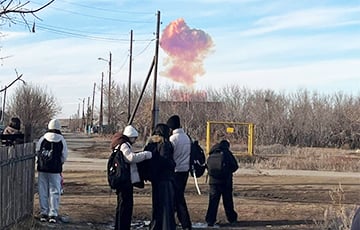
In Russia's Orenburg region, an explosion occurred at the Dombarovsky Strategic Missile Forces base in the Yasny settlement of Yasniy, where the newest Avangard complexes are deployed. Eyewitnesses told local media that a cloud of purple smoke rose into the sky after the incident. The cause could have been a missile launch accident, writes The Insider.
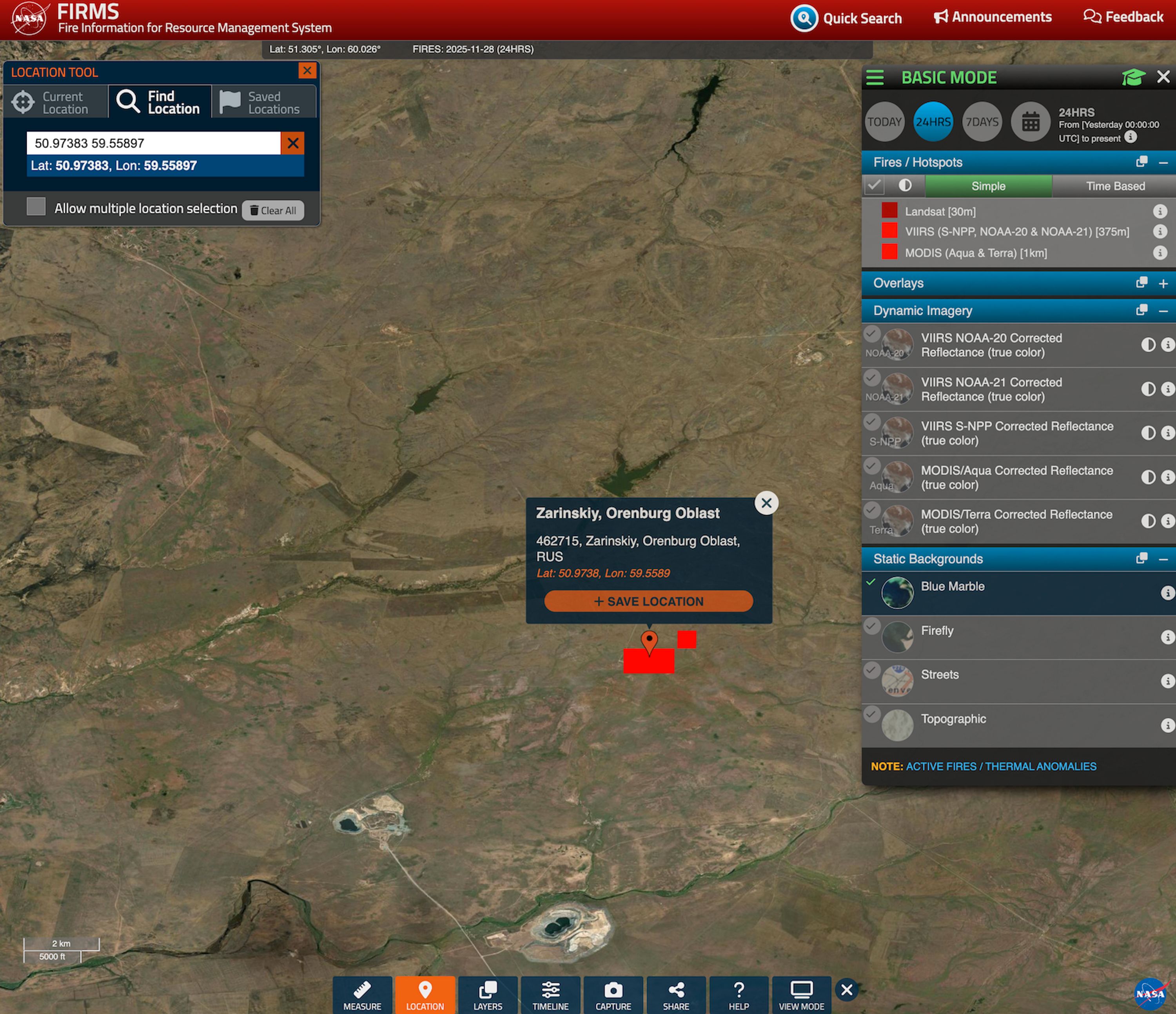
The NASA FIRMS fire mapping service shows a fire near the test site.
The Yasny Cosmodrome is one of Russia's key facilities from which intercontinental nuclear-capable missiles can be launched. In 2023, it began rearming here for the Avangard complex, which Vladimir Putin called a system that would "nullify" U.S. missile defense. The base was also used for launches of Dnepr carrier rockets.
Avangard is a Russian hypersonic special-purpose combat unit that is mounted on intercontinental ballistic missiles (ICBMs) and, according to the official version, is capable of hitting targets at intercontinental distances, moving in the atmosphere at very high speed and maneuvering in course and altitude.
Voevoda
The Russian channel MilitaryRussia.Ru writes that "a missile was launched, which ended unsuccessfully." According to the channel, the missile in question is presumably the R-36M2 Voyevoda missile.
If the R-36M2 Voyevoda did explode, the purple smoke could be extremely toxic, missile launch analyst Georgy Trishkin explained to The Insider. According to him, there could have been a release of diazote tetraoxide, which is used in this rocket. Commonly called amyl in Russia, it is used as an oxidizer with hydrazine. It is a self-flammable vapor that is stored at room temperature and burns on contact with each other.
Diazot tetraoxide is a toxic and extremely dangerous chemical. When it comes in contact with air, it partially breaks down into the brownish-brown gas NO₂. That's why clouds when diazote tetraoxide is released are usually red-brown or purple-brown.
"Sarmat" and UR-100 with the "Avangard"
Theoretically could perform a test launch of another missile, which can be made from the shaft launcher (hereinafter - SHPU) missiles "Voevoda", writes MilitaryRussia.Ru. For example, the 15A28 Sarmat ICBM.
In 2018, the fifth launch of a UR-100 launch vehicle with an Avangard unit and payload was carried out from a converted Voyevoda missile silo at the same base. In 2022, it was reported about plans to launch the UR-100H with the Avangard unit from the Yasnoye test site.
After the publication of this material, a video with the fall and subsequent explosion of the rocket appeared. After that, several experts began to lean that it seems to be a Sarmat missile.
Pavel Podvig, a researcher at the UN Institute for Disarmament Studies, explained to The Insider that it is difficult to assume anything yet, it is clear only that it is a liquid-propellant missile.
"We know that last year the Sarmat mine in Plesetsk exploded. Perhaps that's why they could have decided to test it at the Dombarovsky base. (...) It would be strange if it was an SS-18/R-36M - it hasn't been launched for more than a decade and probably won't be again. Even if it is the missile on which the Avangard is mounted, the malfunction was in the missile, not the payload."
Norwegian military analyst Tor Are Iversen noted in a comment to The Insider that there are two reliable sources claiming the launch was from the SS-18/R-36M silo. If true, it certainly couldn't have been an Avangard missile.
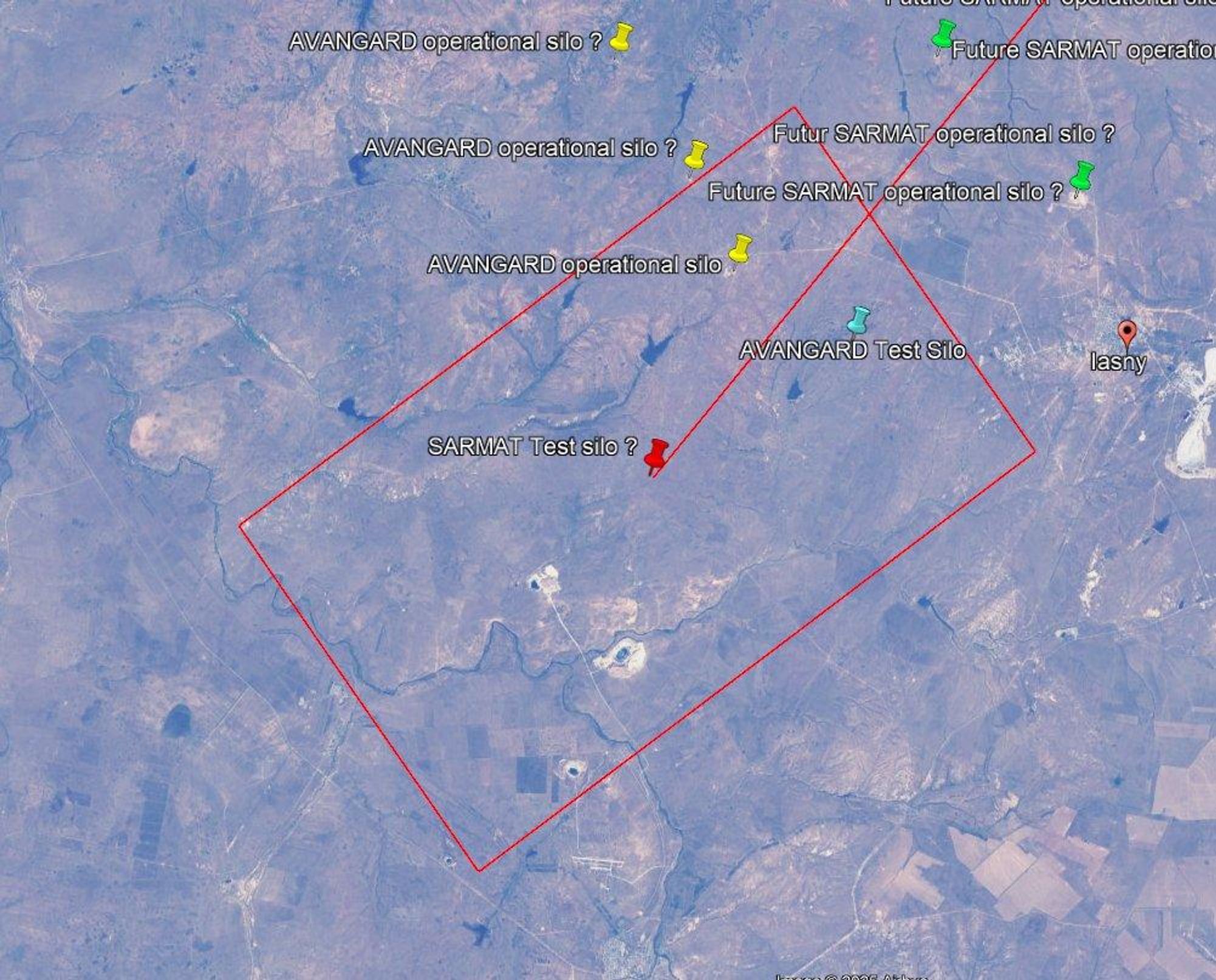
"I'm not familiar with every single mine at this range, so I'm inclined to trust these two sources - especially since they're saying the same thing. The other possible option is Sarmat, but it would require a mine reconstruction to launch. Until today, I believed that it had not yet been carried out in this position area. Nevertheless, there are signs of recent construction work, although there is not enough evidence to draw definitive conclusions.
The color of the smoke clearly points to a liquid-propellant rocket - and all the possible options for Dombarovsky are among them. As for the cause of the accident, in my opinion, the first stage worked properly and took the missile out of the silo, but shortly afterwards there was a failure of the engine and/or control and navigation systems."
A missile expert at the French research center Fondation pour la Recherche Stratégique Etienne Marcuse told The Insider that although the type of missile has not been officially confirmed, it was a Sarmat with a high probability. NOTAMs (notices to pilots) for the launch standby period have been published in recent days, covering the area between Dombarovsky and the Kura test site in Kamchatka. Last time this area was used for launches of the Avangard hypersonic planning block.
An analysis of the NOTAMs shows, however, that the launch area was designed not for the silo used for the Avangard tests, but for a different one - a recently modernized one. Work on it began in the spring of 2025, after the ice melted. After the complete demise of the Sarmat silo in Plesetsk in September 2024, the main hypothesis was to continue testing from future missile deployment positions. Work was already underway in Uzhur and Dombarovsky. Given that Dombarovsky was previously used for Avangard tests and is further away from the Kura test site (which is preferable for intercontinental tests), the probability of choosing this particular site was higher.
"Of course, we cannot completely rule out the possibility of testing Avangard, but the urgent modernization of the mine, if there is already a suitable one for it, looks unlikely. But such a step is logical for the continuation of the Sarmat program. It is important to remember that the Strategic Missile Forces are in dire need of Sarmat certification, as the program is already several years behind schedule. Meanwhile, the R-36M2 (SS-18), which it is supposed to replace, has been in operation beyond its extended service life since 2016."

Bank's name: Bank Millennium S.A.
Address: ul. Stanislawa Zaryna, 2A, 02-593, Warszawa
IBAN: PL97116022020000000216711123
SWIFT: BIGBPLPW
Name of the account holder: Fundacja “KARTA ‘97”
Purpose/title of payment: Donation for statuary aims
You can contact us by the e-mail charter97@gmail.com