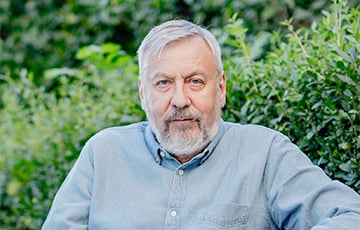


Yauhen Afnagel: We See Who Is The Real Leader Of Belarus
3- 16.09.2025, 12:14
- 13,290
The West should clearly articulate its demands to Lukashenko.
Coordinator of "European Belarus" Yauhen Afnagel gave a great interview to "Radio Racyja". The site Charter97.org publishes its full text:
- Very glad to see you alive, healthy, with a clear look, strong as always, with a smile. How do you feel?
- I feel fine, the way a free man in a free European country should feel. Unfortunately, not yet in my own, not in Belarus, but all in due time.
- I saw videos and photos from the trial, from the day of the announcement of the verdict to a whole group, which included you. You met it with a smile, too. Did you expect that you would have to serve all five years?
- I realized that this figure (first of all, not five, but seven years was the term) meant nothing. The release of political prisoners does not depend on their formal term. If political prisoners are fought for in freedom - in Belarus, abroad, politicians, journalists, people, then they come out earlier.
If this does not happen, they come out later, they may not come out at all. Political prisoners, I saw and always knew, were fought for. It saved a lot of people. Because the pressure started immediately. As soon as there was less attention on freedom - the pressure increased. As soon as there was more attention - the pressure went down. They understood that. So I didn't just hope, I knew that I would get out earlier.
- But from our side, from the outside world, sometimes it seemed the other way around. There is such a popular opinion that the more attention to a political prisoner, the more pressure he can be under.
- This is an absolute lie, absolute nonsense. This lie was spread by the authorities, special services. Somewhere they even tried to support it. They said: "Tell your relatives to talk less about you and you will be fine. Tell them not to write about you, and you'll be fine. Some people fell for it, believed it. At first they were really given some "pluses", and then - more pressure, more repression and so on. So this is an absolute lie. It is not true.
Evil does not like to be publicized, to be talked about. Evil is created in darkness. As soon as light appears, evil simply disappears. Therefore, I would like to thank the independent media, all those who wrote about political prisoners, who continue to write, because we cannot forget. Thousands of our brothers and sisters remain there.
- Is the number of political prisoners you are talking about much higher than the human rights activists say? Because, unfortunately, many relatives are afraid to talk about their loved ones who are in prison. Many of them are simply unknown. I have met such people: they were detained, but they have no relatives who could report them. Some have no contacts, some are afraid. There are many more political prisoners for various reasons. Even among those with whom I communicated and met - well if half of them were on the lists, maybe even less.
- Regarding the incommunicado regime: were you in it? Were your contacts and correspondence restricted? There was not much information about you.
- At a certain time, about the same time as everyone else, I was completely cut off from correspondence with everyone except my wife and mother. When I was transferred to a "covered" prison, even this was not the case: for a month and a half I had no communication at all. Then, when they started talking about it on the outside, my wife said that the letters were not coming, and my mother too. Eventually the letters started coming. Here's a simple example.
- Do you know psychological or physical violence?
- No.
- Is the rest of the story similar: punitive isolation, working in an industrial zone?
- I spent most of my sentence in a "covered" prison. You sit in a small cell, there's very little space. No visits, no handoffs, one phone call a month. They take you out for an hour for a walk. I was in the colony for less than five months, less than six months. I spent most of my time in Mogilev prison No. 4 - it's a "covered" prison.
- Did they get anything from you? Pardon, testimony against others?
- Even at the very beginning I made it clear that I would not be asked for pardon. They understood that it was pointless.
- Reading František Alyakhnović's "In the GPU's Curtains", I remember that the worst dream in prison is when you dream that you are free, and then you wake up and realize that it was a dream. Now you do not experience something like that, that it may not yet be fully real?
- Such dreams were, and quite often. And very realistic ones. Most often I dreamt about Vilnius: Ostrya Brama, Gedimin's tower. When we were approaching Vilnius, I remembered it. I thought: "I saw it in my dream, I will wake up now, it will be unpleasant...". But even in a dream to see Vilnius, the free world - it was amazing.
Yes, then again a sharp contrast: just seen Vilnius - and here you are already in Mogilev, in a cell, dim light. But it was a kind of journey, a virtual walk to freedom.
- The day of liberation - how unexpected was it?
- It was an ambivalent feeling. We didn't know where it was going. We were just being taken to a KGB detention center. It could have been a release or a new criminal case. Only when we found ourselves together in one cell with Statkevich, Viniarski, Voynich, Dedek, Matskevich, and others, we realized that it was most likely a release. Before that everything was very unclear. There were many cases when the term was coming to an end and a new case was opened.
- This is another technique to break a person.
- Of course.
- Did you see Mikalai Statkevich breaking down the doors of the bus to stay in Belarus?
- I rather heard, but also saw, of course. I saw Nikolai when he went to Belarus.
- How do you assess this step?
- This is the step of a real leader. We see who is a real leader of Belarus. A man who sacrificed himself, who had a choice, who was well aware of the consequences. And he made this choice - he returned to the country. Before that, Nikolai was a symbol of resistance, but he has become a symbol even stronger than before. A symbol that is much stronger than Lukashenko and his entourage.
- Those people who were with you in the cage, at the last court hearing during the trial, what is their fate?
- Two of them are here now. Pavel Seviarynets remains in Belarus, in Grodno, in a "covered" prison. Irina Schasnaya is already at liberty, Pavel Yukhnevich is at liberty. Dmitry "Gray Cat" Kozlov is within reach, somewhere here in Vilnius.
- Can we hope to see those who remained in Belarus, at large?
- We know we will see them. Not that we hope - we know it. We will fight for them, as I hope all our supporters do.
- The liberation was accompanied by forced deportation of our own citizens. How do you feel about that?"
- First of all, I call it what it is. It's not just deportation. Deportation is when you, with documents, passport, are expelled from a foreign country. And this is deprivation of citizenship. You have to understand that this is the first time since the Soviet Union that deprivation of citizenship has been used in Europe. This is a much harsher measure than deportation from a foreign country.
This issue should be raised at a serious international level. If someone negotiates with Lukashenko, it is necessary to clearly formulate the conditions: release, lifting of sanctions and so on. But is there any point of such negotiations at all if we are punished even more severely? For many of my friends this is a greater punishment than prison - deprivation of the homeland. Our homeland will not be taken away from us, but we have been deprived of citizenship.
- But let's hope that we will see each other in a free Belarus.

Bank's name: Bank Millennium S.A.
Address: ul. Stanislawa Zaryna, 2A, 02-593, Warszawa
IBAN: PL97116022020000000216711123
SWIFT: BIGBPLPW
Name of the account holder: Fundacja “KARTA ‘97”
Purpose/title of payment: Donation for statuary aims
You can contact us by the e-mail charter97@gmail.com