
Lukashenko As Kashpirovsky
- Alexander Klaskovsky
- 18.11.2026, 12:00
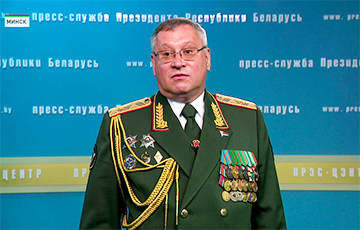
Will General Muraveyko's cows now march in formation?
His career over the past month and a half has taken two stunning turns. At the end of September, this career military officer was unexpectedly transferred from his post as Chief of the General Staff to the position of deputy head of Lukashenko’s administration. He hadn’t even had time to settle into this new role when he was sent off to turn around a chronically underdeveloped region.
A dashing warrior was sent to the countryside
The president explained the September appointment of Pavel Muraveiko to his administration as follows:
“As president and commander-in-chief of the Armed Forces, it is very important for me to have several—if you will—alternative perspectives on the situation within our security forces.”
Experts at the time put forward a range of profound theories: ranging from the assumption that Alexander Lukashenko does not fully trust Defense Minister Viktor Khrenin, to the hypothesis that Moscow had promoted its own protégé in preparation for an attack against NATO.
Now all these theories are up in the air. Either the leader no longer wanted alternative perspectives on what is happening within the security forces, or Muravyeko simply happened to be at hand when the question of filling an unpopular position arose. For the record: Alexander Rogozhnik stepped down as head of the Vitebsk Region last month, reportedly due to illness.
Lukashenko has repeatedly chastised the region’s leadership for poor performance. At a meeting last October, it was stated that the situation there was “deplorable” and “worse than anywhere else.” In February of this year, the president commented on the region as follows: “We’re not going to carry them on our shoulders. If you want to live and work—start pulling your weight.”
Why isn’t the Vitebsk region excelling? This is partly due to its harsher climate and particularly acute demographic problems. What else? Perhaps the region has just had bad luck with its leaders? But let’s be honest: who appointed and replaced them? Does this mean the regime’s leader has chronically made poor choices in his appointees?
Lukashenko himself is convinced that “the problem in the Vitebsk region is discipline. We need to introduce military-style discipline when it comes to following technical regulations.”
This is precisely how the president explained today why he chose General Muraveiko, who became famous three years ago for threatening Lithuania that he would cut through a certain “vital” corridor (presumably the Suwalki Corridor).
At the same time, Lukashenko emphasized:
“Of course, agriculture will be the main focus of your work.”
As we can see, the bond between the army and the countryside is growing stronger. The Commander-in-Chief sends negligent farmers to “Khrenin’s” training camps, while soldiers—including generals—are thrown into battles for harvests, milk yields, and livestock weight gains.
Lukashenko in the role of Kashpirovsky
Lukashenko chose not to explain why Muraveyko was so hastily removed from the administration. Instead, he spent a long time convincing the newly appointed regional head (and probably himself as well) that today’s personnel decision was a success from every angle.
“Why, out of all the candidates, am I offering you this job: you are a systematic person with a military mindset, accustomed to setting goals and demanding their fulfillment,” the leader noted.
Then he added thoughtfully: “You know, there are no bad people in the General Staff—they’re all sharp-witted.” At this point, the author of these lines recalled a famous line from *The Good Soldier Švejk*: “Everything was going well until the General Staff got involved.”
Finally, Lukashenko recalled recent events at which the situation in the Vitebsk Region had been discussed: “I was watching you while you were in the hall, and I sensed that you had truly internalized this sense of responsibility. I know that this future work arouses in you not just interest—but a real passion.”
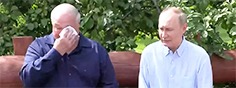
It all felt very much like a session of suggestion. One might assume that Mr. Muraveiko was simply stunned by this new, dizzying career turn, and the regime’s leader, in the style of Kashpirovsky (those of you who are older will remember), was instilling in his subordinate the belief that he was ready for an unexpected mission, had “embraced” it, and was even gripped by excitement.
Why Does the Ruler Like Those Who Know How to Click Their Heels
Today’s appointment could be chalked up to the autocrat’s high-handedness, which no one dares to challenge. But it seems that, to quote a line from *Hamlet*, there is a method to this madness.
In Lukashenko’s lexicon, perhaps the most frequently used word is “discipline.” He is convinced that virtually all economic woes stem from a lack of it.
In his view, the security forces serve as the model of discipline. That is why the ruler so often appoints people who have worn military rank insignia for many years to key civilian posts.
It is worth recalling that the heads of his administration were generals Viktor Sheyman, Gennady Nevyglaz, and Igor Sergeenko. And Vladimir Makei, who headed this agency from 2008 to 2012, was a reserve colonel despite his civilian public image.
Furthermore, Colonel Sergei Kovalchuk, a graduate of the Artillery School and a former employee of the Presidential Security Service, has served as Minister of Sports since 2018. Lieutenant General of Police and former Minister of Internal Affairs Yuri Karaev has been appointed head of the Grodno Region.
Roman Golovchenko, who was once prime minister, now heads the National Bank. Although he is not a career military officer, he worked in the military-industrial complex for a long time.
The list goes on. The local power structure also includes quite a few former members of the Ministry of Internal Affairs, the KGB, and other law enforcement agencies.
Lukashenko’s approach to personnel stems from the nature of a harsh authoritarian regime, whose leader values unquestioning obedience above all else. So those who know how to click their heels and fawn over their superiors are in favor.
However, in Muraveiko’s case, we’re talking more about a high-risk position. Today, he promised to implement “military-style management” in the Vitebsk region. Will it help?
The modern economy is too complex to solve its problems by imposing barracks-style discipline. But Lukashenko is a firm believer in the omnipotence of administrative-command methods. This largely explains the nature of his personnel policy—relying on individuals from the security apparatus.
Will General Muraveiko’s cows now march in formation?
Alexander Klaskovsky, “Pozirk”

Bank's name: Bank Millennium S.A.
Address: ul. Stanislawa Zaryna, 2A, 02-593, Warszawa
IBAN: PL97116022020000000216711123
SWIFT: BIGBPLPW
Name of the account holder: Fundacja “KARTA ‘97”
Purpose/title of payment: Donation for statuary aims
You can contact us by the e-mail charter97@gmail.com