

Russia Has Lost Nearly Half Of Its Fuel Production In Three Weeks
1- 18.11.2026, 19:31
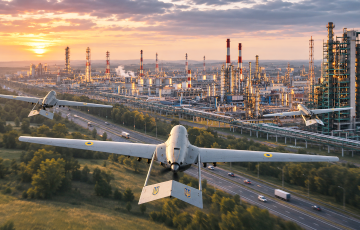
Results of the Ukrainian Armed Forces' strikes on the oil refinery.
The increasing frequency of unmanned aerial vehicle (UAV) attacks on Russian oil refineries in November led to disruptions or shutdowns at 15 of 35 major refineries, reducing their total processing capacity by 45% compared to the end of October. This was reported by The Moscow Times.
Drone strikes resumed on October 30 after a two-week lull, during which refining capacity had recovered, exceeding 700,000 metric tons per day.
Over the course of 20 days of nearly daily drone strikes, refining volumes at Russian refineries fell to approximately 400,000 metric tons per day, sources told Reuters.
The total nominal capacity of Russian refineries that have been attacked from late October to the present is about 500,000 metric tons per day — roughly half of the total nominal capacity for primary refining, which is estimated at 930,000 metric tons per day.
At the same time, sources note that, given the gradual reduction in refineries’ operating capacity, average refining in November remains above 500,000 metric tons per day—which is approximately 5–10% lower than the figures for September and October. Among those affected by the attacks are major Russian refineries in Ryazan, Yaroslavl, the Northwestern Federal District, and the Volga region.
Current refining levels—about 2.7 million barrels per day—are even lower than at the peak of the fuel crisis this summer, when they dropped to 3.3 million barrels per day, notes Sergey Vakulenko, a senior research fellow at the Carnegie Berlin Center for Russia and Eurasia.
“This means that gasoline production is currently at about 60–65% of what the market consumed in November in previous years,” — writes Vakulenko. Even taking into account fuel purchases from abroad, the shortage could amount to 25–30% of consumption, he estimates.
According to Vakulenko, lines at gas stations are likely to resume in the very near future. “In the summer, they didn’t start appearing until mid-June, two months after the attacks began,” the expert notes.
According to data from the U.S. think tank Rand Corp, three of the refineries attacked by the Ukrainian Armed Forces have completely halted production: “Norsi” in the Nizhny Novgorod region, “Yanos” in Yaroslavl, and Rosneft’s Novokuybyshevsk Refinery. The Ryazan Oil Refinery, which supplies Moscow and the Moscow region, among others, also lost 90% of its capacity.
Russia’s largest oil refinery, the Omsk Oil Refinery, which was hit by an airstrike on November 11, lost half of its refining capacity; the Volgograd Oil Refinery lost the same amount. The “Kinef” plant near Leningrad, Russia’s second-largest, is operating at only one-third of its capacity, according to Rand data.
Vakulenko does not rule out that the refineries where this wave of attacks began could resume operations in the coming days: in the past, repairs typically lasted from one week to one month. “But what’s fundamentally new compared to what happened before is how quickly Ukraine was able to inflict such extensive damage and the fact that there’s no sign of it stopping yet,” the expert emphasizes.

Bank's name: Bank Millennium S.A.
Address: ul. Stanislawa Zaryna, 2A, 02-593, Warszawa
IBAN: PL97116022020000000216711123
SWIFT: BIGBPLPW
Name of the account holder: Fundacja “KARTA ‘97”
Purpose/title of payment: Donation for statuary aims
You can contact us by the e-mail charter97@gmail.com