

Air Defense Forces Didn't Fire A Single Shot: How Ukraine Destroyed The Crimean Bridge
- 19.11.2026, 9:11

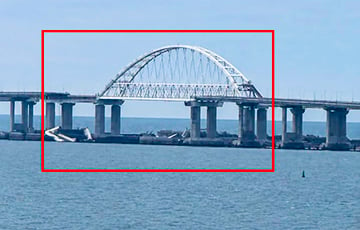
Photo: fakty.com.ua
The operation was brilliantly planned.
During the final attack on the Crimean Bridge, the occupiers’ air defense did not fire a single shot—it had been destroyed in advance over the course of three months. Four FP-5 “Flamingo” missiles struck the bridge span at once, each with a warhead weighing one metric ton. This was stated by military expert Oleg Zhdanov in an interview "Glavred".
According to him, the bridge was brought down not only by “Flamingo” missiles, but also by “Neptune” missiles and many other Ukrainian weapons.
How the occupiers’ air defense in Crimea was breached
Zhdanov emphasized that the Ukrainian military first identified a weak spot in the bridge. Then, over the course of three months leading up to the final attack, they neutralized the aggressor country’s air defense systems in Crimea, particularly in Kerch. Operation “Crimea Off” was led by Madyar (Robert Brovdi).
According to the expert, the result is visible in footage from Ukrainian drones and missiles approaching sections of the bridge.
“There wasn’t a single shot fired by the air defense system—no missiles were launched, and no anti-aircraft machine guns fired tracer rounds. In other words, the air defense system was completely disabled,” Zhdanov said.
The expert called the operation brilliantly planned and speculated on exactly how the attack might have been carried out.
“Most likely, anti-radar missiles were used to blind the enemy’s remaining air defense systems. Drones most likely drew the fire of anti-aircraft missile systems and mobile fire units. Meanwhile, the missiles simply headed for their targets, breaking through the ‘gaps’ in the air defense system,” he explained
Why the Crimean Bridge’s span couldn’t withstand the strike
According to Zhdanov, four “Flamingo” missiles, each with a one-metric-ton warhead, struck the span—a fact confirmed by videos released by the Russians themselves. Furthermore, the arch had already been critically damaged by a previous attack on the bridge.
The expert noted that even Russian specialists acknowledged that the arch had tilted 15 degrees due to damage to its stiffeners and foundation, meaning that even a severe storm could have caused it to collapse.
“That’s why we could very well have brought down the Crimean Bridge using our own forces and resources,” Zhdanov emphasized.
Why Ukraine Didn’t Strike the Bridge Earlier
Zhdanov cited the Telegram channel “Oko Gora,” whose author wrote that Ukraine was ready to destroy the bridge as early as January 2026—the operation in question had allegedly already been planned and prepared.
“But, as the channel’s author wrote, war is, among other things, about agreements. As long as the Russians didn’t touch our bridges, we didn’t touch the Crimean Bridge. As soon as they began striking our bridges, we showed them that this game can be played by two,” the expert said.
Will the Russians be able to restore the Crimean Bridge?
Military expert Alexander Kovalenko described the strike on the Kerch Bridge as a masterful operation in a column for “Glavred.” In his opinion, repeated or more powerful strikes could render the bridge permanently inoperable.
“The destruction of the arch structure is inevitable, and this automatically renders the bridge inoperable,” Kovalenko emphasized.
The expert considers winter to be another ally of the Defense Forces, as it will prevent the occupiers from quickly repairing the bridge.
“Weather conditions during lulls between strikes will not allow for full-scale repair work,” he explained.
How Ukraine Manages to Penetrate Russia’s Layered Air Defense System
Military officer and military analyst Oleksandr Musienko explained on “Channel 24” that Ukraine is breaking through Russia’s layered air defense system thanks to a combination of various weapons.
“We’re talking about combined operations: missiles and drones,” he noted.
The analyst also highlighted the increased effectiveness of Ukrainian missiles.
“We’ve seen an increase in the effective number of ‘Neptune’ missile deployments and their effectiveness,” Musienko said.
According to him, the technical specifications of the “Flamingo” are also changing: the missile is becoming less vulnerable and capable of inflicting more significant damage.

Bank's name: Bank Millennium S.A.
Address: ul. Stanislawa Zaryna, 2A, 02-593, Warszawa
IBAN: PL97116022020000000216711123
SWIFT: BIGBPLPW
Name of the account holder: Fundacja “KARTA ‘97”
Purpose/title of payment: Donation for statuary aims
You can contact us by the e-mail charter97@gmail.com