

"The Collapse Of The Crimean Bridge's Arch Brought The Russian Federation To A Standstill For A Long Time"
- 19.11.2026, 15:13
An expert revealed the extent of the consequences.
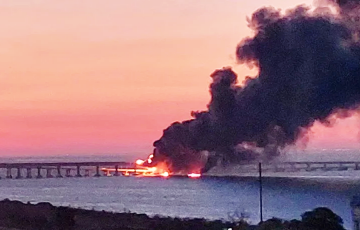
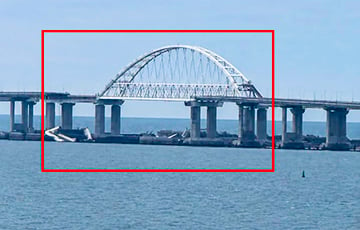
After the Kerch Bridge was damaged, an arch that fell into the water blocked the shipping channel of the Kerch-Yenikale Canal—this blocked navigation for a long time and prevented the reinforcement of the Russian Federation’s Black Sea Fleet.
This was reported during a televised marathon by Captain 1st Rank (Reserve), Deputy Chief of Staff of the Ukrainian Navy from 2004 to 2020 Andriy Ryzhenko, reports UNIAN.
According to Ryzhenko, the four vessels spotted near the scene are assessing the situation caused by the collapse of the 6,000-metric-ton arch. After all, following the collapse, the structure became deformed, blocking the passage of ships and damaging more than 200 meters of the bridge span.
“Special equipment is required to clear, lift, and cut up this metal structure. It is possible that underwater explosions will simply be used to cut through this structure. Incidentally, this is what happened in the port of Berdyansk after the Security Forces struck the amphibious assault ship “Saratov” in 2022—they (the Russians—UNIAN) dismantled it underwater using explosives,” Ryzhenko said.
He emphasized that the “Saratov’s” displacement was half that of the Crimean Bridge’s arch. The fact that specific work is underway at the site where the arch fell—that the remains of the structure are being raised from the depths—will be evident, in particular, by the presence of lifting cranes. As the military official explained, it is simply impossible to lift such a structure without these mechanisms. Pontoons and other specialized equipment are also required.
“There is a great deal of work to be done there (by the occupiers—UNIAN). I think it will take at least several months to clear this channel. Perhaps even longer. It will take more than a year to install the arch, which needs to be manufactured and then assembled on site,” Ryzhenko speculated.
According to him, the latest damage to the Crimean Bridge will halt shipping and road traffic for quite some time.
As the expert emphasized, this means there will be no shipping, and there will be significant restrictions on entry into the Sea of Azov via the Kerch-Yenikale Canal, where the maximum draft of a vessel must not exceed 7 meters.
“That’s assuming the canal is clear. But those conditions don’t exist right now because it’s blocked—there are debris from the collapsed structure there—that’s the first point. Second, and equally important from the perspective of a potential buildup of military capabilities, Russia will not be able to redeploy small and medium-sized ships to the Black Sea from the Baltic Sea or from Russia’s northern regions via the Volga-Don canal system,” Ryzhenko emphasized.
Previously, the Russians had already redeployed combat units in this manner, specifically “Raptor”-class boats, and BK-16 landing craft, which “were in action” from the very first day of the large-scale invasion of Ukraine, having traveled from the Baltic Sea through the Volga-Don Canal system, Ryzhenko recalled.
He added that the Caspian Sea currently hosts “Kalibr” cruise missile carriers, amphibious ships, and other vessels—which could also potentially be transferred to the Black Sea via the Sea of Azov:
“In other words, blocking the Kerch-Yenikale Canal rules out that possibility.”

Bank's name: Bank Millennium S.A.
Address: ul. Stanislawa Zaryna, 2A, 02-593, Warszawa
IBAN: PL97116022020000000216711123
SWIFT: BIGBPLPW
Name of the account holder: Fundacja “KARTA ‘97”
Purpose/title of payment: Donation for statuary aims
You can contact us by the e-mail charter97@gmail.com