

Up To 300,000 Russian Troops Could Find Themselves Trapped In The "Crimean Cauldron"
2- 22.11.2026, 12:41
- 1,084
Significant consequences of the attacks on the Kerch Bridge.
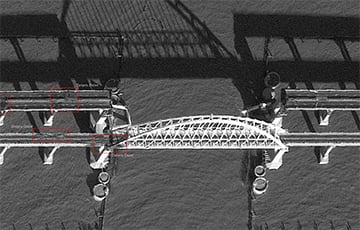
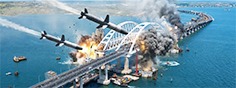
Following new strikes on the Crimean Bridge Russian occupiers faced difficulties using the crossing, particularly its railway section. Damage to the bridge and Ukrainian strikes on overland supply routes could significantly complicate efforts to resupply the Russian force in southern Ukraine.
Military expert and Ukrainian Armed Forces Reserve Colonel Roman Svitán stated in an exclusive interview for “Channel 24”, assessed the consequences of the attack and explained why up to 300,000 Russian troops could be at risk of being operationally encircled.
Russia may miss the opportunity to restore the Crimean Bridge
— The General Staff of the Armed Forces of Ukraine reported that Ukrainian “Neptune” missiles damaged the railroad tracks of the Crimean Bridge. Trump also stated that Putin was angry at Zelenskyy because of the attack. How serious is the damage to the bridge, will the Russians be able to repair it, and how will this affect Putin’s reputation?
— And how might this affect his reputation? If Putin is asked where the bridge girder went, he’ll have no choice but to say it sank. He’s already an expert at giving answers like that. Remember the submarine “Kursk”? When he was asked what had happened, he replied, “It sank.”
The situation with the Kerch Bridge is roughly the same right now. At least one girder supporting the bridge spans over the main shipping channel ended up in the water. Now the Russians will have to retrieve it from there, essentially piece by piece, just as the Kursk submarine was raised back then. But the question arises: will they even be able to organize this operation?
Will our Defense Forces—which continue to keep the Kerch Bridge under fire control—allow the Russians to repair the bridge? The “Neptune” strikes have clearly demonstrated that we still have this capability. This is the so-called window of opportunity, and it remains open to this day.
Russian air defense currently has no idea where to obtain additional anti-aircraft missile systems and radar systems to increase the density of defense in the area of the crossing. And if they cannot provide cover for the bridge itself, they cannot fully protect the repair crews either. At the same time, work is needed not only to restore road and rail traffic but also to clear the shipping channel.
By my estimate, thousands of vessels from the Volga-Don Group are currently blocked north of the Kerch Strait. They cannot navigate this route normally, which means daily economic losses. Vessel downtime, restrictions on port operations, and reduced cargo-shipping capacity—all of this creates additional problems for Russia.
We’re talking about losses in the millions every day. And this is no longer just a matter of military logistics, but also of the economy. The Russian leadership will have to find ways to restore the passage of ships as soon as possible, but doing so under the constant threat of new strikes will be very difficult.
At the same time, I believe that the Ukrainian military will continue working on the bridge structures. If further strikes are successful, the Russians could lose the second arch of the bridge over the fairway as well. Then the problems with using the crossing will become even more serious.
Take note of the weapons being used. The “Luch” Design Bureau has once again demonstrated the capabilities of Ukrainian-made weapons. In my assessment, “Palyanitsa” missiles were used to destroy the bridge span, while “Neptune” missiles struck the railroad tracks.
The Russians will not be able to make full use of the railroad crossing at this time. And I think that in the coming nights, a significant number of forces and resources will be deployed there to permanently disable this arch, including the railway crossing.
Preparations for this operation lasted nearly a month. During that time, the Defense Forces worked to weaken Russian air defense, destroy radar stations, and neutralize electronic warfare systems covering the Kerch sector. It was a comprehensive preparation, the results of which we are now seeing.
I believe the Ukrainian military will continue to exploit this window of opportunity. The Russians will have to simultaneously seek ways to defend themselves, attempt to repair damaged structures, and ensure the passage of ships. Doing all this under Ukrainian fire control will be very difficult.
The Kerch Bridge will no longer be fully operational. And we’ll have to wait and see how Putin responds to this. Right now, this is a serious problem for him, because further strikes could bring the matter to a head.
It is precisely the possibility of continued Ukrainian attacks that makes the prospects for a quick resumption of traffic across the bridge so uncertain. Russia may try to repair the bridge, but it will have to take into account that Ukrainian weapons remain capable of striking this target.
Up to 300,000 occupiers could find themselves operationally surrounded
— Can we say that Crimea is turning into an island for the Russians? What will happen to supplies for the military and the civilian population, and does the current situation create opportunities for Ukraine to intensify its operations in the south and de-occupy the peninsula?
— We’ve been discussing how this might happen for several years now. Crimea itself is a kind of tactical geographical cauldron, as it is wedged between two seas. And if the main supply routes are cut off, it becomes possible to severely limit the supply of Russian troops on the peninsula.
To the east, the route from Taman via the Kerch Bridge is currently damaged. As for the northern direction, in my assessment, it is under fire control by Ukrainian weapons systems. The section from Berdyansk to Melitopol is particularly important, where the depth of the relevant zone is approximately 100 km.
This distance allows for direct control of drones and monitoring of the transport routes the Russians are using to resupply their forces. If these routes are constantly under attack, it becomes significantly more difficult to maintain a steady flow of military supplies. And this applies not only to Crimea.
A strike on the Kerch Bridge and control of the land corridor cut off supplies from Russian territory not only to Crimea but also to the enemy’s Crimea-Kherson force. This also partially applies to the Zaporizhzhia group, which is located west and northwest of Melitopol.
Right now, it is very difficult for the Russians to organize a full-scale supply of military equipment, ammunition, and other resources needed to conduct both offensive and defensive operations. Imagine a route stretching approximately 500 kilometers from Rostov to Oleshky or Vasylivka via Tokmak. This route is constantly under threat from Ukrainian strikes.
Consequently, there are problems with delivering supplies in the necessary quantities—especially when it comes to a large military force that requires enormous amounts of fuel, food, ammunition, and military equipment on a daily basis. The more intense the fighting, the greater the strain on the entire supply system.
In my estimation, the Crimea-Kherson force—which may be at risk of operational encirclement—consists of approximately 250,000–300,000 Russian troops. This is a very large number of people who must be constantly supplied with everything they need. Moreover, during offensive operations, the consumption of ammunition and other resources can be three to four times higher than during defensive operations.
About 250,000–300,000 Russian troops may now find themselves under the threat of operational encirclement. And 300,000 people need to be fed, supplied with ammunition, and provided with everything else. And in an offensive mode, they use three to four times more resources than in a defensive one.
Therefore, it is very important for us to increase the pressure on this force. The damage to the Kerch Bridge and the increased difficulty of movement along the land corridor create the conditions for the further expulsion of Russian troops from the southern occupied territories. And I am referring specifically to the Crimea-Kherson direction, not just the peninsula.
Right now, in my view, Ukraine’s military and political leadership must make it clear in all international forums that we are not talking about a ceasefire or relinquishing the occupied territories. The goal must remain the withdrawal of Russian troops from Ukrainian territory to the internationally recognized borders of 1991.
If the operational encirclement intensifies, the Russian military will have to decide how to extricate itself from this situation. We have been saying for several years now that it would be better for the kafirs to leave Ukrainian territory on their own while they still have the chance.
Otherwise, after a while, they simply won’t be able to escape the encirclement. Their only option will be to cross the Kerch Strait on some kind of inflatable craft toward Taman. That’s why it’s better to leave our occupied territories sooner rather than later.
I have also spoken repeatedly about the historical ties between the Kuban and other neighboring regions and Ukraine. I believe that a significant Ukrainian linguistic and cultural heritage has been preserved in these territories, particularly local dialects and the so-called “boltovnya.” And I have my own vision for their future, although this is already a matter of much broader historical and political processes.
But right now, the main military objective is to deprive the Russian forces of the ability to reliably resupply their troops in the occupied south. Strikes on the Kerch Bridge and control of transport routes create the conditions for this, and we must take advantage of them.

Bank's name: Bank Millennium S.A.
Address: ul. Stanislawa Zaryna, 2A, 02-593, Warszawa
IBAN: PL97116022020000000216711123
SWIFT: BIGBPLPW
Name of the account holder: Fundacja “KARTA ‘97”
Purpose/title of payment: Donation for statuary aims
You can contact us by the e-mail charter97@gmail.com