


What Are Lukashenka's Punishers Doing In Kazakhstan?
8- 11.01.2022, 9:36
- 15,260
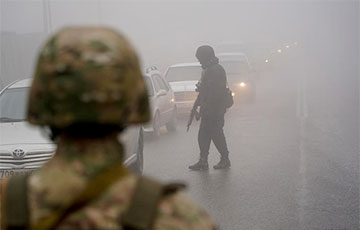
A factor that increases the likelihood of an attack on them is named.
Belarusian servicemen are taking part in the operation in Kazakhstan as part of the “peacekeeping forces” of the CSTO. Experts believe that the soldiers from Belarus are just a screen for the Russian contingent, dw.com reports.
The “collective peacekeeping forces” of the Collective Security Treaty Organization, which were sent to Kazakhstan, as it is said, “for a limited time period to stabilize and normalize the situation,” also include Belarusian servicemen. A contingent from Belarus arrived in Kazakhstan on January 7 and “began to fulfill the assigned tasks,” the Ministry of Defense of the Republic of Belarus reports.
For the Belarusian military, this is the first experience in the history of independent Belarus of participating in operations of this scale. Who exactly from Belarus was sent to Kazakhstan and how does the Belarusian public react to this?
The exact number of Belarusian military in Kazakhstan is unknown
According to Belarusian Defense Minister Viktar Khrenin, a “peacekeeping company” from the 103rd airborne Vitsebsk brigade of special operations forces has been sent to Kazakhstan to participate in resolving the crisis situation. This brigade is staffed only with contract servicemen - it has always been in the reserve of the CSTO military forces and regularly participated in the organization's exercises.
The exact number of Belarusian soldiers who were sent to Kazakhstan is unknown, only the total number of the CSTO mission was reported - 2,030 servicemen and 250 pieces of equipment. “In total, the Belarusian contingent in the CSTO reserve is about 500 people - this is the SOBR of the Internal Troops and the aforementioned 103rd Special Forces brigade. Apparently, now only a company has been sent to Kazakhstan - this is about 100 people, but if necessary, they can send more military men,” explains independent military analyst Yahor Lebiadok.
The Belarusian military has previously participated in peacekeeping operations abroad, although not on this scale. “At the OSCE mission on the contact line in the Donbas, from 2 to 7 Belarusian military personnel are participating on a rotational basis, our contingent was also in Lebanon - mostly doctors,” Lebiadok says.
In general, the military analyst draws attention to legal inconsistencies: it was the “peacekeeping forces” that were formally sent to Kazakhstan, although the CSTO has the Collective Rapid Reaction Force (CRRF) at its disposal. “The peacekeeping mission presupposes the presence of two conflicting parties and their consent to the operation. And the CRRF is just designed to fight terrorism, which is what President Tokayev is talking about. But there is a PR moment - send the CRRF and it will look like suppression of a popular uprising, aggression and occupation. And the peacekeepers give the CSTO the image of a kind organization that helps.”
Belarusian military guarding the airfield
As the Kazakh authorities stated from the very beginning, the CSTO contingent will not take part in military operations in the country - the military personnel of the CSTO countries “will perform cover and security functions” of state facilities. The Ministry of Defense of Belarus, referring to Colonel Siarhei Krasouski, reported that the Belarusian military were guarding the Zhetygen military airfield.
Analyst Lebiadok also says that the CSTO forces are simply releasing the security forces of Kazakhstan so that they could suppress the protests, that the Belarusian military will not be sent to any serious facilities. “Naturally, the main contingent is the Russian military. I’ll say roughly: no one needs Belarusians, Armenians, Tajiks there, this is just a political screen, they are there “for beauty reasons”. It's just that the Kazakhs have healthy nationalism, and purely Russian troops would be perceived as a direct occupation. Therefore, they made a screen in the form of the CSTO mission.”
But despite the fact that the Belarusian military is only guarding the airfield, risks remain for them. Yahor Lebiadok draws attention to the appearance of the Belarusian military and equipment, which do not have the insignia of the peacekeeping forces and their relationship to the CSTO, although earlier exercises were carried out in special patches and helmets with the inscription “Peace Forces”: "And although our servicemen have signs of belonging to the Armed Forces of Belarus, but even from a relatively close distance they look just like people with weapons and in uniform, which increases the risk of an attack on them”.
In addition, according to Lebiadok, the main risk of the participation of the Belarusian military in Kazakhstan is that the conflict may drag on, and then various militants, Islamists and other radicals may be drawn into the country. However, the Kazakh authorities promised that the CSTO forces would stay in the country for only a week, and on January 10, at the CSTO summit, President Tokayev said that “the CSTO mission turned out to be effective and will be completed in the near future.”
Belarusians do not approve of participation in the CSTO mission in Kazakhstan
The enthusiasm with which Aliaksandr Lukashenka rushed to help “fraternal Kazakhstan” is understandable, given the events in Belarus in 2020 after the presidential elections.
But the Belarusian society reacts negatively to sending military personnel to Kazakhstan, says Andrei Kazakevich, director of the Political Sphere Institute. “According to all polls, since the beginning of the 90s, Belarusians are afraid of war, and do not want our citizens to participate in military operations, much less to interfere in other people's affairs. The foreign policy of Belarus, in the mind of an ordinary Belarusian, is to sell tractors, and not engage in high politics.” ...
On social networks, Belarusians criticize the participation of Belarusians in the CSTO contingent, express solidarity with the protesters in Kazakhstan. Many Belarusians, including opposition leader Anatol Liabedzka, write “forgive us, Kazakhs”, and activist Andrei Tkachou now suggested calling the CSTO “the Cowardly Speakers Treaty Organization”. Representatives of the Belarusian diaspora organized rallies in support of the Kazakh people in some countries.
However, in general, the public opinion of Belarusians will depend on the communication of the authorities and the approaches of alternative political forces, says political scientist Kazakevich. “The question is whether the democratic forces will be able to show that this is still a problem, that there can be serious consequences in the form of victims. It is also necessary to talk about political consequences - it is not clear how the situation in Kazakhstan will develop, it may turn out that instead of gratitude Minsk will receive something different from the Kazakh authorities,” Kazakevich sums up.