
Russian Director Sokurov Criticized Putin To His Face
21- 12.12.2025, 16:53
- 32,420
Video Fact.
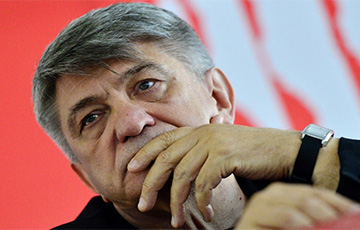
Famous Russian director Alexander Sokurov spoke to Putin at a meeting of the Council for the Development of Civil Society and Human Rights. He raised the topic of "foreign agents," problems in Russian universities, rising tariffs and censorship, according to Nova Gazeta Europe.
At the time of his speech, Sokurov just noted that it is customary for the Council to avoid political issues that require public discussion.
After that, the director touched on the topic of education in Russia. Sokurov said that he had recently returned from Italy, where he had visited several universities, and had gotten an encouraging impression of the student environment. He admitted that Europe has difficulties in the educational sphere, but noted that the situation in Russia is no better: "Many of my acquaintances, whose children are to enter higher education, look at some figures with alarm. For example, the fact that children of military personnel who are at the front receive all the advantages when entering higher education. Politically, I understand this move. But from the point of view of the quality of education, it seems to me that some kind of balance has to be struck here, because the number of budgetary places has been decisively reduced."
He noted that it is becoming impossible to pay 200, or even 400 thousand rubles a year for education. Sokurov emphasized that talented and intelligent children have fewer and fewer chances to get free higher education.
In response, Putin said that education abroad is still more expensive, and the decision to give benefits to the children of participants in the so-called "SWO" was correct.
Sokurov told Putin that in today's Russia there is no culture of political discussion and that the pressure of censorship affects, among other things, the work of creative artists.
"We did not and do not know how to have political discussions with young people, with older schoolchildren, with students. The country is afraid of these discussions. The absence of the procedure of political discussions, the absence of the procedure of open discussion of the processes that take place in the country, the absence of discussion of a serious opposition mood causes, in my opinion, a very serious blow to the fates of many talented people," the director emphasized.
The authorities constantly pressurize the employees of various creative spheres, including cinema, literature and even the book trade, Sokurov noted. Because of this, according to the director, many people cannot realize their ideas and simply lose the opportunity to work in their profession: "Very often these people are not explained why they are treated harshly and uncompromisingly. They tell me, for example, when closing my movie: 'Go to your president, discuss.' (Trying to find out) what, what is the reason for banning the screening of the movie? Without explaining the reasons."
Sokurov recalls that in the USSR at least explained the reasons for bans. At the same time, he emphasized that attempts by one state or another to suppress art have never stood the test of time.
"The state needs art. It is wrong that the state attacks its citizen," Sokurov emphasized.
According to him, "in many art schools, people's heads are down" because they are forbidden everything: "Try to shoot 'Ballad of a Soldier' today (a 1959 film by Grigory Chukhrai). Immediately the movie will be banned, and what will happen to this author - also unknown. Whether he will continue to get the opportunity to work or not (also not clear). This is a fundamentally important situation. We need to change the atmosphere, the relationship between the state and the artistic environment and young people. If we do not change this character of work with young people, we will not go far. It will be an absolute dead end, a regression of the entire state system."
Putin responded by telling Sokurov that the state has always had a complicated relationship with art, and suggested that "Ballad of a Soldier" would also be released today because of the theme of love for the Motherland and mothers.
He also promised Sokurov to discuss bans on the director's works in person, that is, bypassing the Ministry of Culture's decisions on the lack of a certificate allowing the director's films to be shown legally in Russia. "I'll call you, we'll talk," Putin said and called Sokurov's bans in Russia "strange."
"I draw your attention to the fact that you are a member of the Presidential Human Rights Council, so no discrimination against you is allowed. At least at this level. But if there are any restrictions and you see them, tell me," Putin added.
The next day Sokurov told reporters that he now hopes to meet with Putin, but fears the consequences of his speech. In his opinion, it might not have pleased someone in the "bureaucratic environment," the head of Channel One, Konstantin Ernst, and the Ministry of Culture as a whole.
"They must have looked with great alarm at the fact that the president listened to this conversation at all and basically accepted this alarm," the director suggested.

Bank's name: Bank Millennium S.A.
Address: ul. Stanislawa Zaryna, 2A, 02-593, Warszawa
IBAN: PL97116022020000000216711123
SWIFT: BIGBPLPW
Name of the account holder: Fundacja “KARTA ‘97”
Purpose/title of payment: Donation for statuary aims
You can contact us by the e-mail charter97@gmail.com