

Alexei Melnik: Losses Of Russians Are Colossal
12- 20.08.2025, 20:15
- 31,126
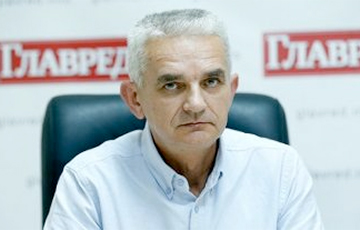
Photo: Glavred
The summer offensive is turning into a "conveyor belt of death" for the Russian army.
The Russian army's advance has slowed to a minimum over the summer: breakthroughs are blocked by Ukrainian defenses, and Russian casualties are growing.
What is happening on the front now? About it Charter97.org talked to military expert, co-director of foreign policy and international security programs of the Razumkov Center in Kiev Alexei Melnyk.
- Strategically, the situation in the theater of hostilities has not changed dramatically, and this has been fixed for at least the last three months. The intensity of fighting since the beginning of the spring-summer campaign remains very high - about 180 combat clashes every day. For understanding: in June there were on average 184, in July - 186, and in August - 178. That is, there is a slight decrease, but it is not radical. Rather, we can talk about stabilization. This is a sign that the resources of the Russian Federation are running out, and it is not possible to increase the pace of the offensive.
In the last two months, the Russians have occupied about 500 square kilometers every month. At first glance, that's a lot of territory. But if we stretch it along the front of a thousand kilometers, it comes out to only 500 meters per month.
As for the losses of the Russian army, they remain colossal. On average - about 1,000 people a day. The Russians actively used the tactics of micro-attack groups: earlier they sent 5-10 people, now they send 2-5, hoping to infiltrate the Ukrainian defense unnoticed. But the level of losses remained enormous.
Recently, I personally communicated with the soldiers of the 24th separate mechanized brigade, who have been holding the defense of Chasov Yar for over a year. At a closed event, they told me that the ratio of losses on this section of the front is one to thirty: for every Ukrainian soldier killed, 30 Russians are killed. These are real figures, confirmed by the military, without the slightest sense to embellish them.
Factually, Russia is simply "throwing meat" on the positions of the AFU. Soldiers describe that groups come one after another, two or three people each, they are destroyed, and in half an hour new ones appear. This is a veritable conveyor belt of death - the price of Russia's "creeping offensive" tactics.
- Have the talks between Putin and Trump had any effect on the situation on the front?"
- There is no sign of an immediate effect on the battlefield and there can be none. Earlier, Trump insisted on an unconditional truce - without discussing terms. Zelensky was forced to agree. However, after the meeting in Alaska, Trump suddenly changed the emphasis. Putin actually outsmarted him, shifting the focus from a ceasefire to preparing a comprehensive peace treaty.
So the diplomatic track is going his way, but Russia continues to fight. This allows Putin to avoid the risk of tough steps from the U.S. - sanctions, duties and other measures. As a result, the ceasefire has been postponed, and this has no effect on the front.
- What is happening now near Pokrovskoye and in Sumy region, where the AFU is successfully counterattacking?"
- There was a breakthrough by Russian troops near Pokrovskoye, but a successful counterattack by the AFU followed. Obviously, the AFU has problems with a shortage of forces and means, but this is not news: from the very beginning Ukraine has been fighting an enemy that is numerically and technically superior.
That Russian breakthrough was timed to coincide with the Alaska summit. The Kremlin wanted to repeat the scenario of Minsk-1 and Minsk-2, when Ukrainian troops were encircled before the talks, these being Debaltsevo and Ilovaisk. But this time the plan failed. The Russians were unable to bring the main forces there and build on their success. Ukrainian reserves eliminated the bulge, and the threat was neutralized.
This showed that for all the numerical advantages, Russia's capabilities are not unlimited. On the threshold of the end of the summer campaign, Russia was still unable to achieve a strategic breakthrough on the front.
As for the Sumy direction, the situation there has stabilized. Moreover, in Putin's recent statements we no longer hear threats to "seize Sumy". It seems that publicly the Kremlin has abandoned this idea. Ukrainian forces have regained control over a number of populated areas and are maintaining a bridgehead in the Kursk region.

Bank's name: Bank Millennium S.A.
Address: ul. Stanislawa Zaryna, 2A, 02-593, Warszawa
IBAN: PL97116022020000000216711123
SWIFT: BIGBPLPW
Name of the account holder: Fundacja “KARTA ‘97”
Purpose/title of payment: Donation for statuary aims
You can contact us by the e-mail charter97@gmail.com