
There Are Three Objectives Behind The Ukrainian Armed Forces' Strikes Against Russia
1- 16.11.2026, 10:31
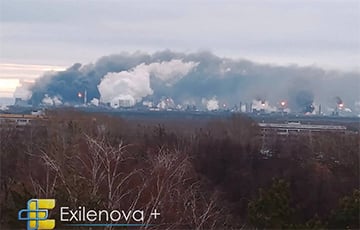
Ukraine has already achieved success in this operation.
Ukraine's new strikes on targets in Russia on the night of November 15 intensified the countercampaign of long-range strikes, which is focused on three types of targets: petrochemical infrastructure, military-industrial complex facilities, and missile production and launch sites. This is reported by the Institute for the Study of War (ISW).
Analysts are referring to the destruction of “Nizhnekamskneftekhim,” the only ELOU-AVT-7 primary refining unit at the “TAIF-NK” oil refinery and the “Monolith” military-industrial complex in Trubchevsk, Bryansk Oblast. The General Staff of the Armed Forces of Ukraine announced these strikes on November 15. In addition, the ISW notes a number of other recent attacks.
According to experts, the strikes on the Nizhnekamsk Petrochemical Complex and “TAIF-NK” are part of two separate but complementary efforts by Ukraine. The first objective is to weaken Russia’s ability to finance the war through oil exports. The second is to prevent Moscow from supplying its army with fuel and petrochemical products, particularly synthetic rubbers and plastics, which are used in nearly all military equipment.
The strikes on the “Monolith” plant, the Akhtubinsk airfield, and the Tsimbulova drone port—located approximately 173 km from the international border— which the ISW classifies as the third prong of the countercampaign—undermining the capabilities of the Russian Air Force and the Russian Federation’s missile launch capabilities.
“The ability of Ukrainian forces to successfully carry out strikes aimed at weakening Russian capabilities in the petrochemical, military-industrial, and missile production sectors, as well as its missile launch capabilities, is an integral part of Ukraine’s ability to mitigate the effects of Russia’s increasingly destructive and deadly campaign of long-range strikes [against Ukraine itself],” the institute emphasizes. According to them, such a countercampaign is necessary to compensate for Ukraine’s weakened air defense and limited capabilities to intercept aerial targets, as Russian forces continue to strike Ukraine’s energy infrastructure and major cities with drones and missiles.
Separately, the ISW notes the growing and increasingly sustained ability of the Ukrainian Armed Forces to strike Russian missile production facilities, launch sites, and various types of strike platforms themselves. For example, the “Monolith” plant in the Bryansk region, according to available data, produces components for helicopters from which Russia launches the “Dan-T” and “Banderol” small winged missiles, as well as various guided and unguided munitions.
Ukrainian strikes on oil infrastructure are also having a noticeable impact on Russia’s domestic fuel market, prompting the authorities to impose new restrictions on fuel sales. According to a Reuters report from November 10, during the week of November 8–15, the attacks disrupted operations at nine of Russia’s 35 largest oil refineries and reduced oil refining by approximately 30%, to 200,000 metric tons per day. The Ukrainian Ministry of Defense reported on November 15 that, following November 9, restrictions on fuel sales began to be reinstated at Rosneft gas stations, and were recently introduced as well in the Zabaykalsky and Krasnoyarsk regions, Karelia, Buryatia, and the Novosibirsk, Arkhangelsk, and Penza regions.
According to the ISW, the reintroduction of restrictions indicates that Ukrainian strikes are having significant collateral effects and could once again lead to large-scale disruptions in the Russian petrochemical sector, similar to those seen in the summer of 2026.

Bank's name: Bank Millennium S.A.
Address: ul. Stanislawa Zaryna, 2A, 02-593, Warszawa
IBAN: PL97116022020000000216711123
SWIFT: BIGBPLPW
Name of the account holder: Fundacja “KARTA ‘97”
Purpose/title of payment: Donation for statuary aims
You can contact us by the e-mail charter97@gmail.com