

"Better To Run While The Bridge Is Still Standing"
- 22.11.2026, 13:11

After all, no one knows when he'll finally be "taken down."
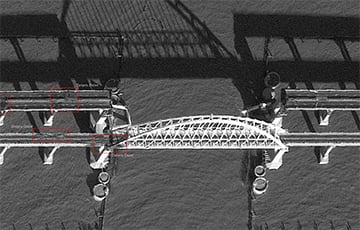
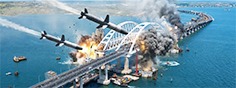
The Telegram channel "Letters to My Daughter" following a series of Ukrainian strikes on the Crimean Bridge shared some sound advice with Russians, drawn from the depths of centuries:
— The Greeks said that the great Persian king Xerxes brought an army of nearly two million men with him to conquer Greece. They were exaggerating, of course.
Out of fear, they might have counted as many as twenty million. But the king’s army was still quite sizeable. The Greeks certainly didn’t have that many.
And, of course, with such a large army, the king faced many logistical problems. And the main problem was how to transport this army from Asia to Europe.
He could have taken the obvious route: transporting them in batches by ship. In Xerxes’s position, anyone would have done that.
But Xerxes was no ordinary man. He was the great king of the great Persian Empire. He didn’t want to transport them in batches. He wanted them all at once. And so the king ordered a bridge to be built across the Hellespont. I would even say “The Bridge” with a capital “B.”
Because by the standards of the time, it was a magnificent engineering feat, one and a half kilometers long. Before King Xerxes, no one had ever built a bridge across the sea. Therefore, in addition to its purely practical use, the bridge was also meant to demonstrate the king’s grandeur.
Admittedly, the king’s first attempt didn’t go entirely as planned. A storm scattered the ships on which the bridge stood. But the king resolved the issue. He executed the builders and ordered the sea to be flogged for showing him disrespect. So, the second version of the bridge was built as intended.
Well, as you know, the king’s conquest of Greece didn’t quite go as planned. First, King Leonidas and his 300 Spartans gave him a hard time, and then the Athenian general Themistocles lured the king’s fleet into a trap near the island of Salamis.
And after the naval battle off the island of Salamis, the king was left without a fleet befitting his greatness. And the king was faced with a dilemma: how should he proceed?
On the one hand, he still had a great army, one that would be enough to conquer all of Greece. On the other hand, without a fleet, the king no longer felt as secure as he once did.
And just as he was deep in these agonizing thoughts, a secret envoy from the strategos Themistocles arrived before the king. Themistocles informed the king that the emboldened Greeks intended to send their fleet to the Hellespont to burn the king’s bridge.
Therefore, out of pure respect for the king’s majesty, Themistocles advised the king hurry back across while the bridge still stands.
And I want to say that the king’s sense of majesty proved greater than his courage. Therefore, he immediately took the advice, taking with him—for the sake of the king’s safety—the best part of the army.
The Greeks routed the weaker part of the army at the Battle of Plataea. But this no longer posed any threat to the king’s safety. By that time, the king was safely ensconced in his royal palace. And the Greeks, of course, burned the bridge—but only later, when the king’s army had already left Greece.
So Themistocles’ advice, though it was a military ruse, ultimately proved to be truly useful. It’s better to flee while the bridge is still standing. After all, no one knows when it will finally be destroyed.

Bank's name: Bank Millennium S.A.
Address: ul. Stanislawa Zaryna, 2A, 02-593, Warszawa
IBAN: PL97116022020000000216711123
SWIFT: BIGBPLPW
Name of the account holder: Fundacja “KARTA ‘97”
Purpose/title of payment: Donation for statuary aims
You can contact us by the e-mail charter97@gmail.com