
Scientists Flooded A City From GTA For An Unusual Experiment
- 24.11.2026, 14:25
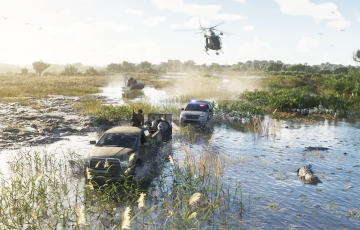
Photo: Rockstar Games
That is how they studied the effects of rising sea levels.
Researchers turned to the sensational video game Grand Theft Auto to study sea-level rise in real-life Los Angeles.
Grand Theft Auto (GTA) fans from around the world have finally seen the release of the new video game—GTA VI. The recent release generated $3.8 billion in just one day, making it the biggest launch in the entertainment industry’s history. Clearly, this world holds a special place in the hearts of a huge number of people. Among them are scientists, according to IFLScience.
The researchers used the landscape from GTA V, released in 2013, as a basis and then flooded Los Santos—a fictional version of Los Angeles where the game’s events take place.
Climate modeling is a crucial tool for preparing for the future, as scientists warn of further temperature rises and changes in Earth’s climate.
How Scientists Flooded Los Santos
What will the world look like in a decade? According to the authors of a new study, their work lies at the intersection of video games and geography, since Los Santos from GTA V has a specific and well-studied real-world prototype.
This provided the researchers with a unique opportunity. The team simulated floods across the Los Santos area and then compared the results with published data on the vulnerability of real-world Los Angeles. In this way, the researchers were able to verify how geomorphologically realistic the game world is.
The scientists set out to determine how well GTA is suited for modeling sea-level rise scenarios and then to compare how floods spread in the game with how they are projected to unfold in real-life Los Angeles.
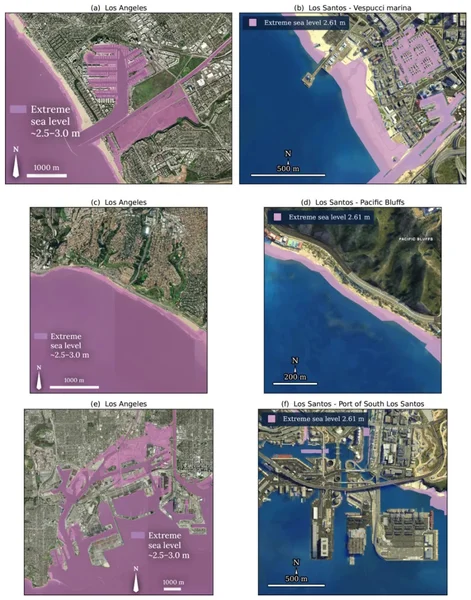
In the first stage, the researchers extracted Los Santos from the game, using 3D terrain modeling to accurately recreate the landscape. They then tested the model under two different climate scenarios taken from the Intergovernmental Panel on Climate Change’s Fifth Assessment Report:
RCP 2.6—a scenario involving emissions reductions;
RCP 8.5—a scenario in which emissions are not reduced.
What the simulation showed
The optimistic scenario shows that by 2300, Los Santos will lose 2.2% of its territory, which will not result in large-scale infrastructure damage.
However, the RCP 8.5 scenario projects that land loss will increase to 5.1%, and sea levels will rise by 5.18 meters. By the year 2500, this scenario poses a serious threat to infrastructure, including wastewater management systems and energy facilities.

Bank's name: Bank Millennium S.A.
Address: ul. Stanislawa Zaryna, 2A, 02-593, Warszawa
IBAN: PL97116022020000000216711123
SWIFT: BIGBPLPW
Name of the account holder: Fundacja “KARTA ‘97”
Purpose/title of payment: Donation for statuary aims
You can contact us by the e-mail charter97@gmail.com