

The Painting "The Coronation Of Mindaugas" Was Discovered By Chance In Vilnius
- 24.11.2026, 17:01
It depicts an event significant to the Grand Duchy of Lithuania that may have taken place in Novogrudok.
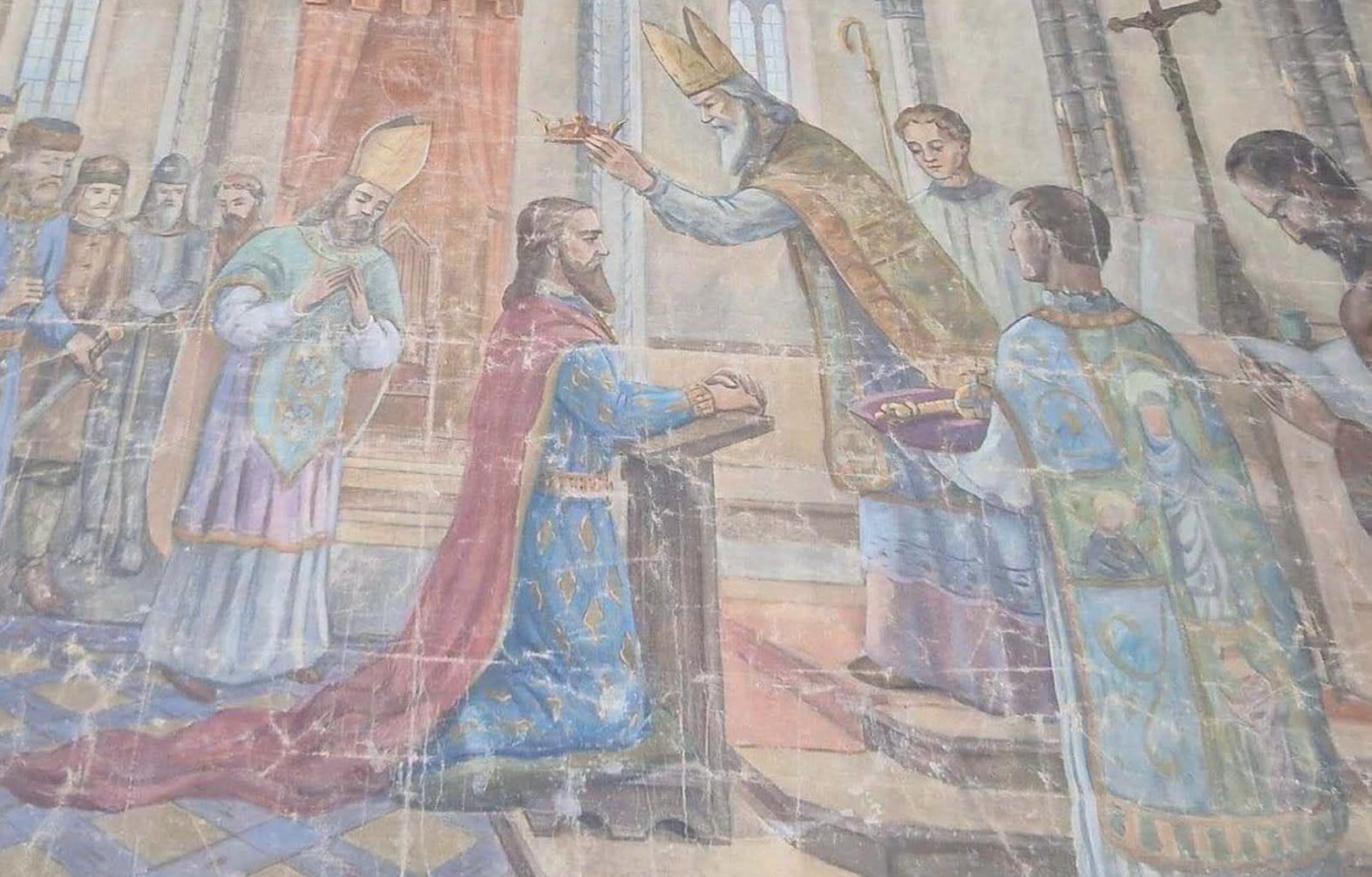
The director of the Lithuanian National Art Museum (LNAM) Arūnas Gelūnas called this discovery a sensation.
““Thanks to some kind people, the painting by Rimtas Kalpokas titled ‘The Coronation of Mindaugas,’ which had been missing since 1939 and once adorned the Lithuanian pavilion at the World’s Fair in the U.S., has just been found,” – he reported on his Facebook account.
The artwork had been left to be discarded near a dumpster on Birutės Street in Vilnius, but two responsible citizens retrieved the painting and handed it over to the Restoration Center at the Lithuanian National Art Museum.
“The Coronation of Mindaugas.” The History of the Painting
The artist painted this canvas in 1939 for the Lithuanian pavilion at the World’s Fair in New York.
At that time, the pavilion’s Hall of Fame featured paintings depicting the most significant events in the history of the Grand Duchy of Lithuania. The exhibition began with the coronation of Lithuania’s first king in 1253. In the center of Kalpokas’s painting, Mindaugas kneels before a bishop who is placing a crown upon his head.
The exact location of Mindaugas’s coronation (in the summer of 1253, traditionally associated with July 6) is not known for certain, as it is not explicitly mentioned in the sources from that period that have survived. Historians have put forward several main theories:
Novogrudok—one of the most popular theories in historiography (based, among other things, on later chronicles and local tradition, including “Mindovg’s Mountain” in Novogrudok).
Kernave—an important center of the Aukštaitian lands; this theory is mentioned by a number of early chroniclers (for example, by Maciej Stryjkowski).
Latava—a hypothesis based on an analysis of Mindovg’s deed of gift from July 1253 (it is supported, in particular, by the historian Tomas Baranauskas).

Bank's name: Bank Millennium S.A.
Address: ul. Stanislawa Zaryna, 2A, 02-593, Warszawa
IBAN: PL97116022020000000216711123
SWIFT: BIGBPLPW
Name of the account holder: Fundacja “KARTA ‘97”
Purpose/title of payment: Donation for statuary aims
You can contact us by the e-mail charter97@gmail.com