


"I Worked For So Many Years, And This Is The Pension I Get."
1- 25.11.2026, 9:59
- 1,032

The Belarusian woman was expecting one payment, but received something completely different.
Anna (name changed) has more than 28 years of total service, of which she spent more than 15 in the military. But when she decided to switch from a disability pension to an old-age pension, her application was denied because she did not have enough years of insurance coverage. She continues to work and currently receives a disability pension of nearly 560 rubles. We’ll take a closer look at why this happened and what options are available in such a situation, writes “Onliner”.
“I was shocked: after all these years, they turned me down”
Anna explains that she served in the military for a long time and left as a reserve officer with the rank of lieutenant. At that time, she was going through a difficult period in her life: a divorce from her husband, health problems, and a long course of treatment. Later, she was granted a Group III disability status and began applying for the corresponding disability pension.
“I was going through a divorce with my husband; against this backdrop, I resigned, fell ill, and was granted disability status. I was bedridden with this illness and wasn’t happy about it,” the woman explains.
When it came time to apply for a disability pension, there were no problems, she clarifies.
“I went around to all my former employers, brought in my salary records—including those from my military service. No one said anything; they calculated everything, and everything was fine.

On June 5 of this year, Anna turned 58. She decided to apply for an old-age pension instead of a disability pension and submitted her application. But her application was denied: she didn’t have enough years of insurance coverage. As a result, she continued to receive her disability pension—which is now nearly 560 rubles.
“I said, ‘How can it not be enough? After all,’ I said, ‘I worked for 17 years, including my maternity leave.’
Anna continues to work at a restaurant: she washes dishes and spends almost all seven hours on her feet—as she says, that’s the longest possible workday given her disability. But, as it turns out, once she reaches retirement age, her work doesn’t count toward her insurance record as long as she’s receiving a disability pension.

Government agencies explained that in order for her insurance record to continue to grow, Anna needs to give up her disability pension and keep working. She is hesitant to do so: she doesn’t know if her health will allow her to continue working.
“You know, maybe I’m working today, but tomorrow I won’t be able to work because of my health. So how can I give up my disability pension?”
Why Was Her Old-Age Pension Denied?
Anna’s application was reviewed by the pension assignment commission of the Partizansky District Administration in Minsk. The minutes state that the woman’s insurance record totals 7 years, 7 months, and 23 days, whereas at least 10 years are required to qualify for an old-age pension in her case.
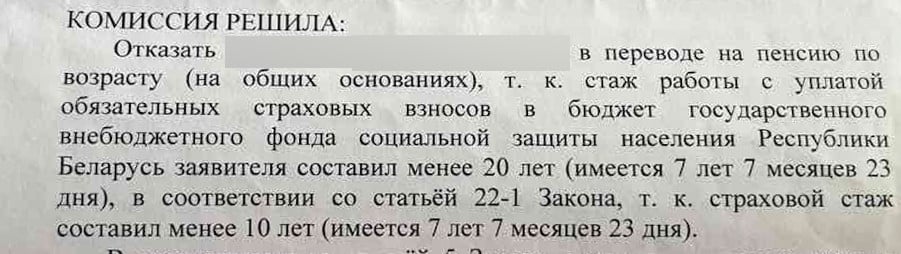
The commission cited Article 22-1 of the Law “On Pension Provision.” According to this provision, a woman who has reached retirement age is eligible for an old-age pension if she has at least 20 years of total service, including at least 10 calendar years of military service, and is not entitled to a military pension. In addition, her insured service must total at least 10 years.
However, Anna did not meet the last condition. The commission’s minutes state that her insurance service record did not include periods of study, parental leave, or periods during which she received unemployment benefits.
In addition, certain periods of employment were counted using an adjustment factor. If the average monthly earnings on which contributions to the Social Insurance Fund were paid were below the established minimum wage, the period worked is counted toward the service record with an adjustment factor. Therefore, only a portion of the full calendar period may be counted.
Why a disability pension was granted but an old-age pension was not
Different requirements apply to these pensions.
To be eligible for a work-related disability pension, several conditions must be met: the person has been assigned disability group I, II, or III; they have a work history during which mandatory insurance contributions were paid to the Social Insurance Fund (the law does not specify a minimum length of the insured period); and they have the required total length of service.

Work history considered when granting a disability pension
The requirements for total work history depend on the person’s age at the time the disability occurred or when they applied for the pension:
Under 20 years of age—no work history is required if the disability occurred while working or engaging in entrepreneurial activity, or after such activities ceased.
Up to 23 years of age—1 year.Aged 23 to 26 — 2 years.
Aged 26 to 31 — 3 years.
Aged 31 to 36 — 5 years.
Ages 36 to 41 — 7 years.
Ages 41 to 46 — 9 years.
Ages 46 to 51 — 11 years.
From age 51 to 56 — 13 years.
From age 56 to 61 — 14 years.
From age 61 onward — 15 years.
Why did she work for more than 20 years but have only 7 years of insurance coverage?
After the denial, Anna appealed to the Committee on Labor, Employment, and Social Protection of the Minsk City Executive Committee. There, they reviewed her pension file and provided a detailed breakdown of how her service record was calculated.
According to the committee’s response, the woman’s total work history is 28 years, 6 months, and 22 days, and her military service is 15 years, 3 months, and 4 days. Her insurance record—which is required to qualify for a labor pension—is 7 years, 7 months, and 23 days.
Why is there such a discrepancy between these figures? The committee explained that Anna’s total work history included years of education, military service, parental leave, and periods during which she received unemployment benefits. However, these periods were not included in her insurance period: during those times, no contributions were paid to the Social Insurance Fund on her behalf.

Regarding military service specifically, the Partizansky District Office of the Social Insurance Fund responded to Anna. They explained that military personnel’s pay is funded from the national budget. Mandatory insurance contributions to the Social Security Fund are not calculated on this pay. Therefore, years of service are taken into account when calculating pensions under the law governing law enforcement agencies.
— The pay of military personnel in the Republic of Belarus, consisting of salaries based on military rank, military rank, and various allowances, is paid from the republican budget and is not subject to mandatory insurance contributions to the fund’s budget. Periods of military service are taken into account when calculating pensions for law enforcement agencies (in accordance with the Law of the Republic of Belarus “On Pension Provision for Military Personnel”).
In addition, information has been confirmed that certain periods were calculated using an adjustment coefficient—specific intervals in 2006, 2017, 2018, 2019, and 2022. According to the committee, the earnings on which contributions were paid during those periods were below the minimum wage. As a result, not all time worked was counted toward the insurance record.
“It is not only the fact that mandatory insurance contributions were paid that matters, but also the amount of income from which they were paid. For certain periods of employment (or other activities) to be fully included in the insurance record, contributions must have been paid on income exceeding the minimum permissible wage level. In other words, the amount of earnings (income) must not be lower than the established minimum wage; otherwise, for the purpose of calculating the pension, the period of employment (or other activity) will be counted toward the total and insurance service not on a calendar basis, but with the application of an adjustment coefficient,”, the experts explained.
What the Ministry of Labor Says
After that, Anna appealed to the Ministry of Labor and Social Protection. They reviewed the situation and concluded that the commission’s decision to deny the old-age pension was justified.
To qualify for an old-age labor pension under general conditions, an insured service record of at least 20 years is required. For women who have served in the military for at least 10 years but are not eligible for a military pension, the requirements are lower: at least 10 years of insurance coverage and 20 years of total work experience.
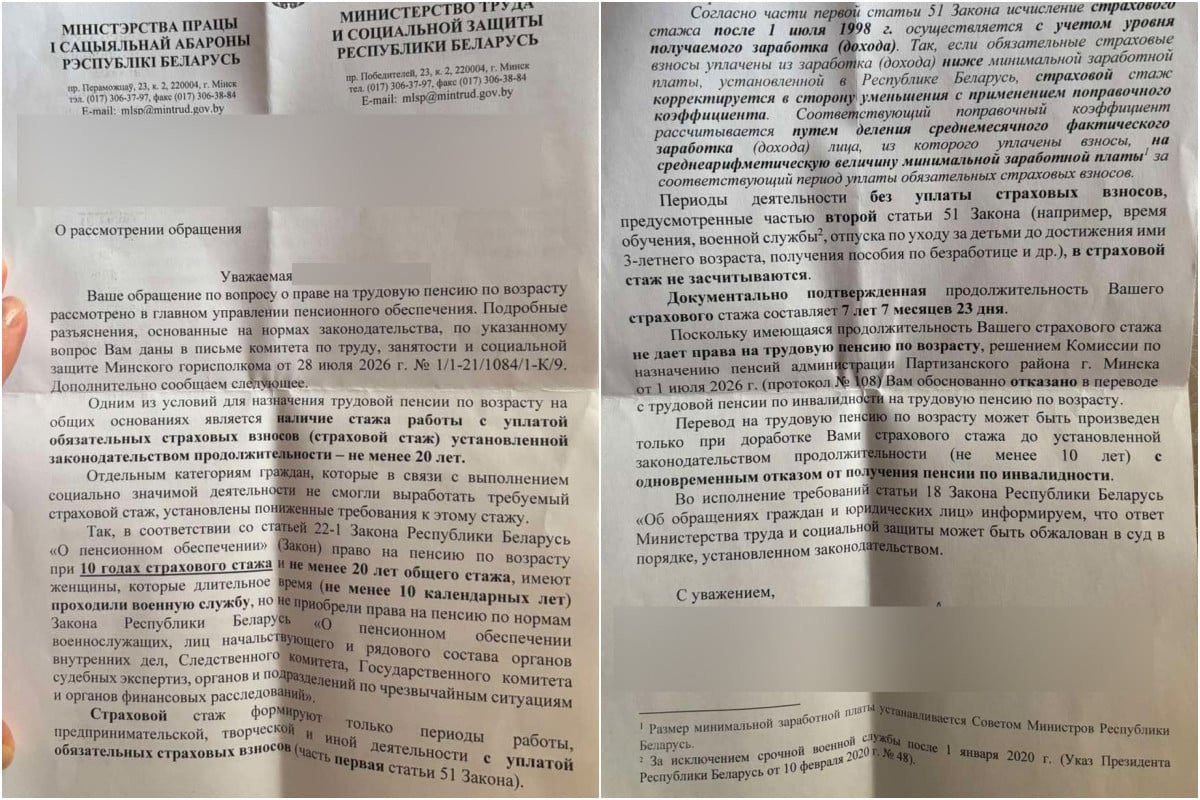
The ministry explained a possible solution to this situation: a woman can receive an old-age pension if she extends her insurance period to 10 years. However, to do so, she will have to forgo her disability pension.
“You may switch to an old-age pension once you have completed the required insurance period as established by law (at least 10 years),” — the response states.
How to Check Your Insurance Period
You can work for years and then discover that you don’t have enough insurance period to qualify for an old-age pension. The fact is that total work experience and insurance period are not the same thing. Only those periods for which mandatory contributions were paid to the FSZN count toward your insurance record. For example, full-time study and parental leave for a child under 3 years of age are not included in the insurance record, although they are counted toward your total work history.
You can check how much insurance service you’ve already accumulated in the “FSZN” mobile app. It displays data from your individual account—essentially, your employment history and insurance contribution record.

In the app, you can see which employers you worked for and during which periods, how much in contributions was calculated for you, and how much was actually paid. Your insurance history is displayed separately by year.
Why check this? For salaried employees, the employer transfers contributions to the FSZN, and the employee themselves doesn’t always know if everything is in order. For example, a certain period of employment may be missing from the statement, or it may turn out that contributions were not paid in full. And if a person worked part-time and earned less than the minimum wage, their insurance record for that period may not be counted in full.
If you notice any discrepancies, you should first contact your employer and ask them to verify the information they submitted. The law allows you to request that the data in your individual personal account be corrected or supplemented. It’s best to sort this out in advance, before it’s time to apply for retirement.
However, the app has a limitation: personalized records have only been kept since January 1, 2003.
If you worked before that, those years will not appear in the app. You’ll need to verify them using your employment record book and other documents. Therefore, the figure in the app does not necessarily represent your entire insurance record, but only the portion that has been recorded in the system since 2003.
Another detail: contribution data is submitted to the Federal Social Insurance Fund quarterly, so data for the most recent months may appear with a delay.

Bank's name: Bank Millennium S.A.
Address: ul. Stanislawa Zaryna, 2A, 02-593, Warszawa
IBAN: PL97116022020000000216711123
SWIFT: BIGBPLPW
Name of the account holder: Fundacja “KARTA ‘97”
Purpose/title of payment: Donation for statuary aims
You can contact us by the e-mail charter97@gmail.com