

The Horde Of Our Time
15- 30.04.2026, 8:38
- 8,800
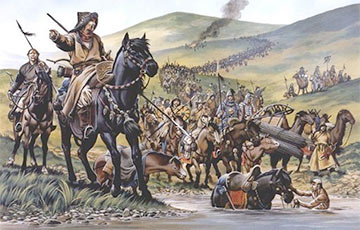
Russia has much more from the Horde than from Byzantium and Rome.
"The past isn't dead. It's not even past." This quote from William Faulkner's book is directly related to the topic of the special project of "Salidarnastsi".
In the previous publication the edition wrote about how the ancestors of Belarusians and Russians went different ways in the times of the Golden Horde.
Today we will continue this theme to tell how the Horde heritage is treated in modern Russia, where, as it turns out, quite a few people are pleased with the idea that the roots of their state grow from such a past.
Well, is it the past? Our neighbors have adopted many traditions of the Horde and carefully carry them through the centuries, thus determining their present and, to a certain extent, future.
In Belarus, no one would think of saying that we are the successors of the Golden Horde. But in Russia, the conversation about it is still going on at various levels.
"This is our homeland, and Russia is the heir of the Golden Horde"
The Tatar philosopher and historian Rafael Khakimov has for many years defended the idea that today's Russia is the direct heir of the Golden Horde.
In 2019, as director of the Shigabutdin Marjani Institute of History of the Academy of Sciences of Tatarstan, he gave a great interview to the portal "Real Time", dedicated to the 750th anniversary of the founding of the Golden Horde. Here are a couple of quotes.
In the Golden Horde, the Russians began to flourish. Russians never fought against the Tatars. Of course, nobody can like an invasion, but Batu-Khan basically just wanted to pass through some lands - he chased the Kipchaks who were going to Hungary.
Yes, they burned some cities, but they were not so many. There was no one to fight there, so this is somewhat exaggerated resistance.
Khakimov admits that the same Batu Khan took food from the Russian principalities. But he also later freed Russian lands from taxes in order to quickly restore the economy and receive more tribute.
The Tatar researcher promotes a version of the Russian-Tatar symbiosis:
Look at the Russian language - how many Tatar words are in it. The Russian Empire emerged as a symbiosis of Russians and Tatars, but with Catherine began Western trends - she began to rewrite history.
Then Karamzin, Klyuchevsky, Solovyov gave history a completely different interpretation, and the annals disappeared somewhere safely under Catherine (evil tongues say that they were burned).
Answering accusations of attempts of Tatars to separate from the Russian Federation, the historian drew a line: "Why should we separate from the Golden Horde? This is our homeland, and Russia is the heir of the Golden Horde."
Jealousy of Turkish encroachment
These theses cannot be written off as the biased opinion of a single historian. One of the Kremlin's chief propagandists, Margarita Simonyan, even uses as her motto: "The Horde is native, evil, yours."
A five-year-old publication in the weekly Zvezda, owned by the media holding of the Russian army, clearly demonstrates what happens when the right to inherit the traditions of the Golden Horde is encroached upon by someone from outside.
It is about Turkish ideologues who "have taken the myth of the Golden Horde heritage of Turkey on full seriousness" - "a myth designed for people who did not learn history well at school".
The author of the publication gives his counterarguments: "Turkey, with the exception of some eastern regions, was never part of the Horde. Even as a vassal".
And concludes that Russia was built not only by Slavs:
Even if we take the campaign of Ivan the Terrible to Kazan, at least one third of his army were Turkic warriors from among the Kasimov Tatars, Nogai and even Kazan Tatars... It would take several pages to list the people who left a bright trace in Russian history and have Turkic roots.
Russia has much more from the Horde than from Byzantium and Rome
The topic was well summarized by Doctor of Historical Sciences Iskander Izmailov in an article for BIZNES Online:
"For a long time, domestic historiography has tried to prove that the Russian state traces its origins to Kievan Rus', but in reality this is a political myth that was developed in the era of Ivan IV, when the ideology of the Moscow kingdom was being created.
In fact, very many military and political realities of this kingdom went back to the Tatar past. And in this sense, the Russian state, and then the Russian Empire is the heir of the Golden Horde.
Only Eurocentric policy, which began with the era of Peter I, interrupted this organic Eurasian development of Russia, forcibly outwardly Europeanized the country, making it a "Potemkin village", where the Russian emperor was and remained the only European.
In this regard, it is thought that the history of Russia has not yet been seriously conceptualized as a holistic process, as a combination of different imperial projects. But in any case, there is much more from the Golden Horde than from Orthodox Byzantium and Catholic Rome."
A word to Vladimir Putin. In 2023, the Kremlin ruler outlined his version of why the Horde is preferable to Europe for Russia:
"Alexander Nevsky traveled to the Horde, bowed to the Horde khans. Among other things, in order to resist the invasion of the West.
The Horde behaved impudently, cruelly. But they did not touch our language, culture, traditions, which was claimed by the Western conquerors. If the culture and traditions of a people are destroyed, the people begin to dissolve as an ethnos. Like snow in late spring."
And with these words, Putin has shown himself to be an extremely incapable student of the same Horde. After all, under his leadership today's Russia does everything that the Kremlin master attributes to the Western conquerors, literally verbatim.
And the Belarusians in more than one generation could make sure of it.

Bank's name: Bank Millennium S.A.
Address: ul. Stanislawa Zaryna, 2A, 02-593, Warszawa
IBAN: PL97116022020000000216711123
SWIFT: BIGBPLPW
Name of the account holder: Fundacja “KARTA ‘97”
Purpose/title of payment: Donation for statuary aims
You can contact us by the e-mail charter97@gmail.com