

Vladimir Fesenko: Some Russian Officials Are Sending Putin A Signal
7- 28.04.2026, 22:37
- 23,520
Will Ukraine be able to stop the war with strikes on refineries?
Ukraine is hitting objects of the Russian "oil industry" almost every day. These include oil refineries and port structure. It is noteworthy that the previous U.S. administration pressured Ukraine not to hit Russian oil infrastructure. What has changed? Will Ukraine be able to stop Russia from hitting refineries? What is behind the public statements of bloggers in the Russian Federation? Why do pro-Kremlin sociologists talk about Putin's falling rating?
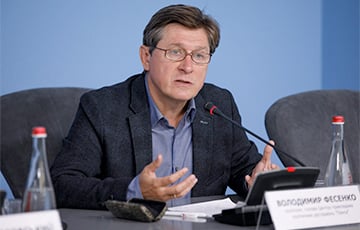
About this and more, Charter97.org talked to a well-known Ukrainian political scientist, head of the Center for Applied Political Research "Penta" Vladimir Fesenko:
- This situation looks like a paradox, although in fact it is quite regular, and these patterns reflect the specifics of the transformation of American policy towards Ukraine. During the administration of Joe Biden we were persistently advised, asked not to carry out strikes on Russian territory. Ukraine listened to this for quite a long period of time, although I note that in the end there was still an active offensive operation in the Kursk region, and there were some precision strikes on Russian territory.
But we often went along with our American partners, there were indeed requests not to hit Russia's oil infrastructure in 2024 (which is the year of the US elections), so that it would not be perceived as, say, a game against Biden, as some kind of, even if not direct, but indirect interference in the US elections, although Ukraine had no intention to interfere in these elections. Moreover, Ukraine's principled position is to maintain bipartisan support for our country in the U.S.
We have never played on the side of Democrats or Republicans. They tried to drag us into this struggle, but we avoided it. But there have been such requests from the U.S. side. On the one hand, in 2024, it was related, of course, to the elections, there were fears that problems with the Russian "oil industry" could affect the price of oil, which was then quite high in the United States. Donald Trump used that to his advantage, but it was a domestic political factor. That is, it was not a desire of the Americans to limit Ukraine in strikes against Russia, but rather the internal political interests of the United States.
Another reason, more serious, which has been in effect since 2022, was related to the fact that in the Biden administration there were fears that if Ukraine began to actively hit targets in the rear of Russia, in particular Moscow, some other significant objects, it could provoke a nuclear attack from Russia.
There were such fears, but practice has shown that they were exaggerated fears. I would not say that there was no such danger at all, there was such a risk. There are publications that say that at the end of 2022, Russia considered such an option, because Russian troops in Ukraine had been defeated, and they were considering the use of tactical nuclear weapons. Then the tough stance of the U.S. and China stopped such a scenario. Nevertheless, the Biden administration feared that if the war suddenly moved into Russian territory, it could trigger retaliation from the Kremlin, especially in the use of tactical nuclear weapons. These are factors that used to work.
- Why did Ukraine listen after all?
- First of all - under the Biden administration we received quite a lot of support. The scale of this support is estimated in the range of 120 to 130 billion dollars. These are both arms deliveries and financial support for Ukraine.
We depended to some extent on arms deliveries to the U.S., and, of course, we showed a partnership attitude. There were restrictions on the use of American weapons, in particular - ATACMS missiles. There was not a complete prohibition that you can't hit Russian territory, it was about American weapons. And then, in 2024, when Russia intensified strikes on Ukraine, and North Korean troops began to operate on the Russian side, then the Americans even agreed that ATACMS missiles could be used in frontline regions.
What about Trump. Why isn't he banning it? It would seem a paradox. Trump is flirting with Putin, negotiating with him, but at the same time the US is acting as a mediator. It would seem that they could also exert pressure on Ukraine, but the U.S. occupies the role of mediator, it should have an appropriate impact on both Ukraine and Russia.
If we demand from Ukraine not to hit Russian infrastructure, a similar demand should be made to Russia. This is an important point, because the Americans under Trump (and Trump himself says so) are in the middle. They observe conditional neutrality, they act as a mediator, they can't make claims and demands to only one side.
In the last two months, there have been unofficial requests not to hit Russia's oil industry. This is related to the war against Iran. The Ukrainian side does not specify who exactly addressed us, but I think that such requests were made by the US and some, perhaps, European leaders.
But there is another factor why Trump does not influence Ukraine, although there is pressure on us in some issues. The fact is that the U.S. is not providing any direct assistance to Ukraine right now. There is no budget support, no free arms supplies. We buy American weapons with European money, so they have no moral right to demand any restrictions from us, because we are not receiving military aid from the US right now. With one exception. That is getting intelligence and satellite information. And this is where, to quote Trump, when he was asked about Russia providing the same information to Iran, he said, and we're providing it to Ukraine. So there is the same parity.
This explains the seemingly paradoxical position of the Trump administration, although in fact it simply reflects the regularities of Trump's own political position and worldview, as well as the new role of the United States in the Russia-Ukraine war. And that role is no longer so much a partner of Ukraine as a mediator.
- Could these strikes actually lead to Putin being forced to stop the war?"
- At this point, the answer is probably not. Serious problems have arisen for residents in both Kursk and Belgorod regions because of the military actions. But Putin doesn't care about that. What matters to him is the war, and that he looks like a winner in this war. And the fact that people in specific regions are suffering because of the war is of little concern to him. This is what concerns the humanitarian factor.
As for ending the war, according to experts, the critical impact of the oil industry on Russia's ability to continue the war has not yet been reached. More than a third of Russia's refineries and Russian oil infrastructure would have to be put out of operation, so that, first of all, this would manifest itself on Russia's domestic market of oil products and create serious problems, including with the supply of both the army and the civilian population. Now, according to different data, it's 18 to 20%. These are point-blank strikes, like the one on Tuapse now.
Secondly, the consequences of the strikes that are carried out are eliminated after some time. The infrastructure is restored, as was the case, for example, with the ports in Ust-Luga, in the Leningrad region, and in some other ports. That is, the effect is temporary. Ukraine does not yet have enough opportunities to, say, through massive strikes on the Russian energy sector to withdraw a large enough number of facilities for a long time.
Unfortunately, there are no such opportunities. Neither does Russia have the ability, let's say, to completely knock out the Ukrainian energy sector and provoke a blackout. Such attempts were made this winter, the risks were huge, but Russia failed to do it.
Do not hope that Russia will be able to stop the war only because of the strikes on the oil sector. This is not the case. Complex strikes are needed here. Not only on the Russian rear, but also sanctions pressure on Russia, its strengthening, first of all on the tanker fleet, on the possibility for Russia to sell oil on global markets, and political pressure. And, of course, active opposition to Russia on the front. The combination of these factors will gradually force Russia to end the war. Oil alone, unfortunately, cannot be such a factor.
- Z-blogger Ilya Remeslo came out of a psychiatric clinic and gave an interview to Ksenia Sobchak. He stated that Putin will be ousted in a palace coup and that certain people at the top are behind it. In Russia, blogger Victoria Boni's statement is still being discussed. What are we dealing with? Is this some kind of Kremlin tower fight? Or a controlled release of discontent by the Kremlin itself?
- As far as Boni and this specific character named Remeslo are concerned, this is more of a steam release. In this way, they can still try to prepare pseudo-oppositionaries for the elections to the State Duma of the Russian Federation, so that the protest moods canalized, directed in the right direction. So that they do not interfere with the victory of United Russia and other controlled parties.
They want to fragment the opposition electorate, those voters who will come to the elections. And push them to vote for a pseudo-oppositionist. As Sobchak herself once played the role of such a pseudo-oppositionary.
Bonya is loyal to Putin. But she displays people's discontent, irritation about the disconnection of mobile Internet, problems with the disconnection of Telegram and so on. So in that sense, it's more of a political technology. Well, and, of course, at the moment it's letting off steam. This is also noticeable.
The struggle of the "towers of the Kremlin" is also taking place, this factor is present. Just those "Kremlin towers" who believe that now there is too much discontent in society have decided to let off steam. That's why, most likely, the political sector of Putin's administration has decided to play Bonya.
So Peskov gave his consent to the on-air communication between Solovyov and Bonya. Here the political technology has already manifested itself. Especially since Sergei Kiriyenko, and the Putin administration in general, have used such technologies before. And now there is a need for them. But as far as the "Kremlin towers" are concerned, indirect signs show that the struggle between them is intensifying.
This concerns the topic of restrictions on the Internet. Perhaps at Putin's suggestion, but these restrictions are being actively dealt with by law enforcement agencies, in particular the FSB, and, of course, the Roskomnadzor service is now acting as a global censor.
On the other hand, it is sort of pulling this discontent down on itself. Also, apparently, the political block of Putin's administration, plus the economic block of the Russian government, are recording the growth of problems, the growth of discontent, and are trying to sound the alarm.
And how? Yes, in my opinion, they are using the information that Putin's ratings are declining as a danger indicator. Many people are surprised that his ratings are probably declining even more than the sociological services have recorded. Another thing is surprising.
This is shown by the VTsIOM, a pocket sociological service of the Putin administration. That is, the Kremlin-controlled sociological service has been recording a decline in Putin's ratings for seven weeks in a row. The paradox is explained simply. The administration's political bloc, which senses danger and growing problems, is trying to signal Putin.
Mol, "Vladimir Vladimirovich, do you see what's happening? Because of these restrictions, the level of trust in you is decreasing. We need to stop these restrictions. Because they are already hitting you personally." This is also an attempt to criticize the actions of law enforcement agencies and Roskomnadzor. The story with Putin's ratings reflects a certain struggle between the different "towers of the Kremlin".

Bank's name: Bank Millennium S.A.
Address: ul. Stanislawa Zaryna, 2A, 02-593, Warszawa
IBAN: PL97116022020000000216711123
SWIFT: BIGBPLPW
Name of the account holder: Fundacja “KARTA ‘97”
Purpose/title of payment: Donation for statuary aims
You can contact us by the e-mail charter97@gmail.com