Lukashenko And The Kremlin's Latest Spectacle
5- Orhan Dragash
- 12.05.2026, 8:24
- 10,394
Ukraine has done what no Western strategy has been able to accomplish.
No intelligence service, no NATO report, and no Western analysis has exposed the real state of today's Russia the way the current May 9 parade in Moscow did. The Kremlin tried to organize a show of force and got something much more like a grotesque. A late-Soviet political reenactment - the kind of ceremony where everyone present realizes that the system is falling apart, but protocol is still observed because no one has had the courage to be the first to stand up and leave the hall.
This is exactly the impression left by Red Square. Not grandeur and power, but the tiredness of a regime that has nothing more to show but the past.
Russia looked like a once aristocratic family that still holds lavish receptions in a house from which the silverware, paintings and grand piano have long since been sold, while the host stubbornly assures the guests that everything is under control and that the "temporary difficulties" will soon be over.
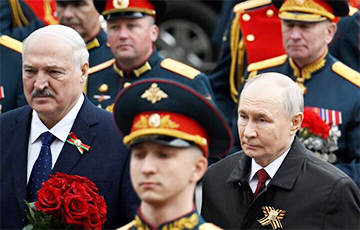
And Vladimir Putin in this performance looked exactly what he is today - an aged authoritarian ruler who, with the war against Ukraine, managed to do what the West could not achieve for decades: to destroy with his own hands the myth of Russia as an unstoppable force. And this is his historical legacy.
Till February 2022, Russia still represented for much of the world a military force around which Europe's security architecture was built. Western analytical assessments, political calculations and military plans had for years been based on the assumption that Moscow had an army capable of conducting rapid and devastating operations against virtually any adversary on the European continent. Fear of Russia was one of the most important instruments of Russian power.
Ukraine destroyed this mechanism more precisely than any sanctions or diplomatic isolation.
The world saw Russian columns destroyed near Kiev. It saw an army that has been waging a grueling war for four years over a few kilometers of territory. It saw a state that buys drones from Iran, ammunition from North Korea and electronic components through Chinese middlemen while trying to portray Europe's geopolitical strength.
This is precisely why the current parade looked so unpleasant for the Kremlin. Because behind all the scenography it became impossible to hide the disproportion between propaganda and reality.
The best symbol of this was a single T-34.
The Kremlin wanted this tank to symbolize the continuity of historical victory and Russian greatness. In reality, however, it looked like a symbol of a state that no longer had enough modern equipment to organize even its own propaganda show without relying on museum exhibits. A war that was supposed to demonstrate Russia's renewed power has led Moscow to have a World War II tank riding through Red Square while modern equipment is being destroyed in Ukrainian fields.
This is not a demonstration of the might of a great power. It is an attempt to hide strategic exhaustion behind historical symbolism.
The view from the stands said almost as much as the military parade itself.
Alexander Lukashenko is a man who long ago stopped running the state and has accepted the role of a political inventory of the Kremlin, a figure who is brought on stage when necessary so that Putin can show that someone else is coming to see him voluntarily.
Robert Fitzo in Moscow looked not like a statesman changing European politics, but like a political smuggler of cheap challenge - loud enough to look "sovereign" at home, but too shallow to be anything more than a useful statistic in the Kremlin's next Putin play.
Thonglun Sisulit is a geopolitical giant from Southeast Asia whose presence served mainly as visual proof that Russia is "not alone." His appearance in Red Square had about as much geopolitical significance as an amateur theater troupe at the Oscars.
Sultan Ibrahim was probably the only person in the stands who looked as if he had come out of diplomatic curiosity - to see with his own eyes what it looks like to see an empire shrinking faster than a wool sweater washed at ninety degrees.
Central Asian leaders Kasym-Jomart Tokayev and Shavkat Mirziyoyev behaved like corporate managers looking for a new investor while checking to see if the old man is still alive.
Milorad Dodik is perhaps the saddest proof of how narrow Putin's political horizon has become. The man who wanted to decide the fate of Europe now accepts and parades ostentatiously next to a politician from one entity in Bosnia and Herzegovina, who holds no public office, as if it were a meeting of great international importance.
And then there are the North Korean statists. For the first time, the soldiers who now effectively serve as the human currency with which Kim Jong-un pays for Russian oil and grain were marching across Moscow's asphalt. Their presence is perhaps the ultimate proof of how degraded the "world's second army" has become - to the point where a nuclear power with imperial ambitions imports human meat from the planet's darkest basement to sustain a war that was supposed to last weeks.
This picture perhaps best describes where Putin's Russia is today.
The former superpower is now showing military cooperation with Kim Jong-un's regime as proof of international influence. A state that for decades tried to convince the world that it represented a civilizational alternative to the West is now militarily dependent on one of the world's poorest and most isolated dictatorships. If someone had told Soviet generals during the Cold War that Moscow would one day display North Korean soldiers in Red Square as a symbol of international support, he would have found himself under KGB surveillance as someone spreading hostile propaganda.
Today, this is the political reality of the Russian Federation.
It is particularly ironic that the current parade actually took place thanks to Kiev's decision not to raise the level of military operations against Moscow on that day. Vladimir Zelensky issued a presidential decree that effectively allowed the central Russian state ceremony to take place without Ukrainian strikes.
It is hard to imagine a more brutal demonstration of a shift in the balance of power.
The state that planned to destroy Ukraine now depends on a Ukrainian decision whether its most important state ceremony will be turned into chaos and panic.
It is here that the full extent of Putin's historic failure becomes apparent.
His goal was not just territorial expansion. The goal was to restore Russia's imperial psychology and bring back a time when Europe tailored its security policy to Moscow out of fear of its power. Instead, the war against Ukraine has had the exact opposite effect.
In the past four years, Ukraine has done what no Western strategy for containing Russia since the end of the Cold War has been able to accomplish. It has shattered the myth on which the Kremlin had built its international influence. Not just militarily, but psychologically and politically. It showed that the Russian army is not an unstoppable force, but a system beset by corruption, poor logistics, faulty calculations and a crude reliance on numbers over quality. It has shown that Russia can be stopped, depleted and humiliated. That is why Ukrainian resistance today has a much broader meaning than simply defending territory. Ukraine was not just defending its own state. It destroyed the political spectacle of Russia on which the Kremlin had spent decades building fear, blackmail and influence in Europe.
And perhaps that is why yesterday Putin moved across Red Square with the marked caution of a man who realizes that he is no longer at the head of a state the world fears, but at the head of a depleted system struggling to survive amid its own false myths. The man who started the war in the belief that he would break Ukraine in a few days now looks like a tired and paranoid old man trying to preserve before the world the illusion of the greatness of a state whose real limits of strength have been shattered precisely in Ukraine.
Four years ago Putin started the war to turn Russia back into a power the world fears. In Red Square, he looked like an aged ruler desperately trying to maintain a show of force while his army is depleted in Ukraine, his economy is crumbling, his allies are turned into political statists, his international reputation is stuck between Tehran and Pyongyang, and the state itself increasingly resembles a tired nuclear power living on Soviet memories and propaganda.
And perhaps this is what is the Kremlin's greatest humiliation. The war that was going to intimidate Europe ended with Ukraine destroying, before the eyes of the world, the myth without which Russia no longer knows how to look like a great power.
The man who wanted to change the borders of the world ended up hosting the saddest gathering ever, where the main attraction turned out to be an old T-34 tank - as lonely as its politics.
And this is the real picture of Russia in 2026: lots of history, no future, and guests who stay only until they bring the bill.
Orhan Dragash, "The Observer"

Bank's name: Bank Millennium S.A.
Address: ul. Stanislawa Zaryna, 2A, 02-593, Warszawa
IBAN: PL97116022020000000216711123
SWIFT: BIGBPLPW
Name of the account holder: Fundacja “KARTA ‘97”
Purpose/title of payment: Donation for statuary aims
You can contact us by the e-mail charter97@gmail.com