
Defeat In Mali: How Russia Is Losing Africa
- 6.05.2026, 17:37
A weakening Putin does not have the strength to support friendly regimes.
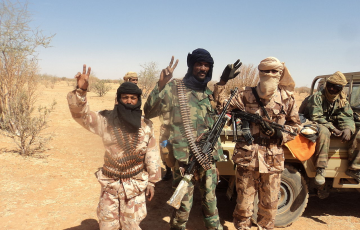
The Tuareg uprising in a distant African country might have gone unnoticed if not for the fact that Russia is the main security sponsor of the Tuareg junta (against which the Tuaregs rebelled), writes UNIAN.
The USSR began ideologically processing the African continent back in the 1960s. Director of the Center for National Sustainability Studies, diplomat and political scientist Oleg Belokolos reminds that the USSR came to Africa with slogans of decolonization and social justice attractive at that time. It provided substantial aid, including erecting factories, building hospitals and schools. And, by the way, the builders, translators and doctors were Ukrainians.
"That is, the USSR seriously invested there. But later the communist ideology of the Soviet model was discredited, because instead of social justice Africans saw totalitarian regimes... Then Russia, having pumped its muscles on high gas and oil prices, tried to enter Africa once again. But it went into Africa from the very beginning. Russia planned to export them and sell them somewhere on world markets," he says.
That's how the Russians entered central Africa, that's how they infiltrated the south, taking advantage of long-standing, still Soviet ties with the African National Congress (ANC)... Russia entered Mali when UN peacekeepers left there and France was unable to provide security.
At the same time, according to Oleg Belokolos, it should be understood that Russia does not provide any assistance to countries in Africa.
"We are talking only about military presence and strengthening the personal power of specific regimes," he reminds.
But after the outbreak of war in Ukraine and with the loss of its bases in Syria, Russia has to spend more and more resources on "putting out fires." That is, if in 2015-2016 Moscow could quietly send troops, equipment and ammunition to Africa, now it has become long and expensive.
"And in this way it is very difficult to organize security in this region," states Belokolos.
It is important to understand: Moscow only covers itself with theses about the presence of Russians in Africa only as private military companies. In reality, all the actions of "private companies" there are inspired at the highest level in the Kremlin.
"Yes, Russia presents the African Corps as Wagner - as a private company. But in fact it is a structural unit of the Russian GRU. Accordingly, these are cadre Russian troops carrying out clear missions," notes the head of the Center for Research on Civil Society Problems Vitaly Kulik.
In the opinion of historian and military expert Mikhail Zhirokhov, Russian "private" military companies have failed in Africa for several reasons.
First, because the Russians, unlike, for example, the French, have no experience of war in Africa.
"They have the experience of Syria, the experience of Donbass, the experience of large-scale war in Ukraine... But this experience does not work in Africa. There are very specific geographical conditions there and specific opponents themselves, with whom it is necessary to fight, not to sit in a base camp, as they, for example, used to do in Chechnya," the expert notes.
Secondly, the Russians came to Africa to "provide security" only in words, in reality they were focused on protecting mineral deposits, including gold.
"So all they did was cover these mines, cover their locations and their convoys that traveled with these minerals... So blocking Russian strongholds was enough for them to simply leave," Zhirokhov believes.
Professor of political science at the Kyiv-Mohyla Academy, scientific advisor to the Ilk Kucheriv Foundation for Democratic Initiatives Alexei Garan points out that, indeed, Russia's primary interest in this region is minerals. That is, the Russians carry out exploration in Africa regarding extracting and exporting natural resources.
The second interest is supporting local dictatorial regimes loyal to the Kremlin, which then, on various international platforms, side with Russia.
And the third is influence on African countries as a whole.
"Since the Cold War, Moscow has viewed Africa as a way to reduce the influence of the West and sow instability in the world. After all, if there is instability in these regions, Europe will be hit by a wave of migration. And this potentially undermines unity in the European Union," he adds.
Alexei Garan says that now it can be seen that the Russian Federation in Africa does have problems. After all, African countries see what the interference of Russian mercenaries leads to (and this leads to destabilization).
"At the same time, I would not be in a hurry to say that Russia has lost its leverage there. Yes, it has lost its economic leverage. After all, the Russians are already ahead of the Chinese. But in fact, Russia's share in trade and investment in Africa is about 1-2%. That is why they are trying to cover this aspect with security aspects.
But he reminds that in terms of security, Ukraine can slightly squeeze Russia in the region.
First of all, the Ukrainian military has always been actively involved in peacekeeping contingents in many African countries, playing a big role in this.
Secondly, now Ukraine has an economic interest in promoting Ukrainian goods to different markets, including defense technologies.
"Our combat experience is of great importance for African countries: for airspace protection, cyber security, border control, etc. may be of interest. And, of course, a new sphere - IT-technologies," the expert believes.
Vitaly Kulik agrees with this opinion: "In the context of recent events in the Strait of Hormuz and the growth of general demand for drones and the ecosystem around them, we may have another promising market. And if we act there in the same way as we do in the Middle East - we offer not only weapons, but also communication. projects, or joint business, we can find partners in Africa as well".
In his opinion, African countries have something to settle accounts with us, even though they are poor. They allocate serious funds for their own security and do not want to deal with bandits.
Another interest of ours in this region is to undermine the Russian military presence anywhere possible and by any means:
"To knock out the Russians means that they cannot be security donors, no one can bet on them. Accordingly, international support for the Russians in exchange for security donations will decline. Banally, even a number of votes in favor of Russia at the UN may disappear. And for us it is a pleasant bonus."
At any rate, Ukraine should have realistic expectations from African countries. They are unlikely to be ready to join economic sanctions against Russia or arms supplies to Ukraine. In humanitarian issues, in particular the return of Ukrainian children kidnapped by the Russians, we can count on understanding.
"African countries do not want the war in Ukraine to spread to the African continent, as the Cold War did in its time. Therefore, we have our own order of work with Africa and I believe that now Ukraine's position in this region is absolutely correct and balanced, - adds Oleg Belokolos. - In particular, we are working together for the return of our children. our food. We used to sell a lot to Russian markets, but now it is no longer relevant."
Russian presence in Africa will not disappear quickly. But as soon as the situation in Mali becomes inevitable for Russia and the Russians are forced to leave, a domino effect may begin. And it is not just a matter of other African dictatorial regimes falling asleep. It is also about the fact that they, having failed to see the prospects of working with Russia, may quickly reorient themselves to more significant players.

Bank's name: Bank Millennium S.A.
Address: ul. Stanislawa Zaryna, 2A, 02-593, Warszawa
IBAN: PL97116022020000000216711123
SWIFT: BIGBPLPW
Name of the account holder: Fundacja “KARTA ‘97”
Purpose/title of payment: Donation for statuary aims
You can contact us by the e-mail charter97@gmail.com