

The Ukrainian Armed Forces' Secret Counteroffensive: What Is Known So Far
14- 14.08.2026, 19:03
- 4,910
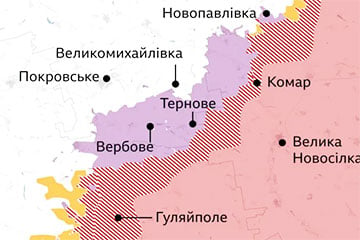
Ukraine has liberated its largest territory since the fall of 2022.
On August 12 , Volodymyr Zelenskyy announced the results of offensive operation, which had been underway at the junction of the Dnipropetrovsk, Zaporizhzhia, and Donetsk regions since January 2026. The Ukrainian army managed to liberate the largest territory since the fall of 2022. The Ukrainian service of the BBC reports on what is known about this.
The first phase of the Ukrainian Armed Forces’ operation in the Oleksandrivka direction began on January 29. At that time, Russian troops, which had invaded the Dnipropetrovsk region in the summer of 2025, were approaching the logistically important settlement of Pokrovskoye (not to be confused with Pokrovsk in the Donetsk region) and its southern outskirts—the village of Oleksandrivka.
At the same time, the Russian army was conducting offensive operations on the flanks, attempting to capture the settlements of Velikomikhailovka and Novopavlovka to the north in the Dnipropetrovsk Oblast, and settlements in the Zaporizhzhia Oblast near Huliaipole to the south.
Had the Russian military succeeded in this plan, they would have been able to break through the defenses of the Ukrainian fortified sector in Orekhov and reach the immediate approaches to Zaporizhzhia from the east.
To thwart the Russian military’s plans, the Ukrainian military command developed and launched a counteroffensive operation in this sector.
The first phase of the operation lasted from late January through April, and the second phase from May 5 through early August.
The operation was carried out by four brigades of Airborne Assault Forces (DShV) and two assault regiments.
What Was Liberated
According to the Commander-in-Chief of the Armed Forces of Ukraine, Major General Mykhailo Drapaty, during the first phase of the offensive operation, an area of 450 square kilometers was liberated, and during the second phase, 490 square kilometers.
Overall, during the offensive, Ukrainian forces took control of 745 square kilometers and cleared approximately 300 square kilometers in the rear of the territory of Russian infiltrated groups, according to Ukrainian authorities.
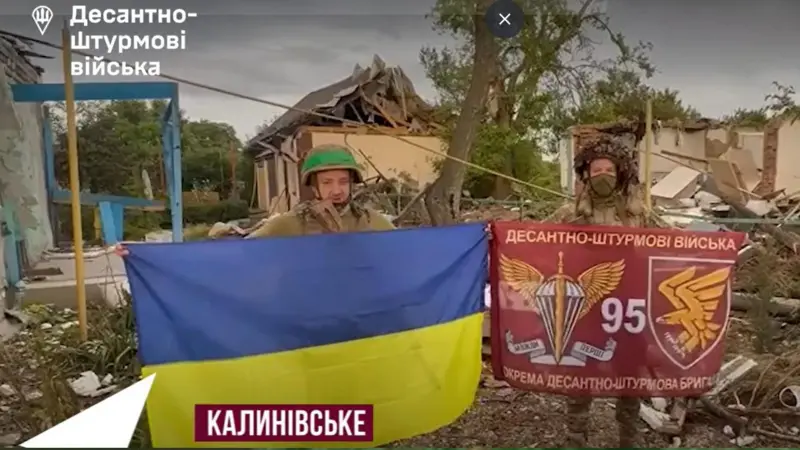
According to the statement, 26 villages were liberated, specifically 12 in the Dnipropetrovsk region (Maliivka, Sichneve, Stepove, Kalynovske, Berezove, Novonikolaivka, Zaporizhzhia, Zlagoda, Privolye, Tsegelne, Ternove, Novogeorgievka), 10 in the Donetsk region (Tolstoye, Novokhatskoye, Zeleny Gai, Krasnaya Zvezda, Poddubne, Mirne, Oleksandrohrad, Hrushevskoe, Yalta, Voskresenka), and four in the Zaporizhzhia region (Rybne, Novohryhorivka, Krasnohorske, Pryvolne).
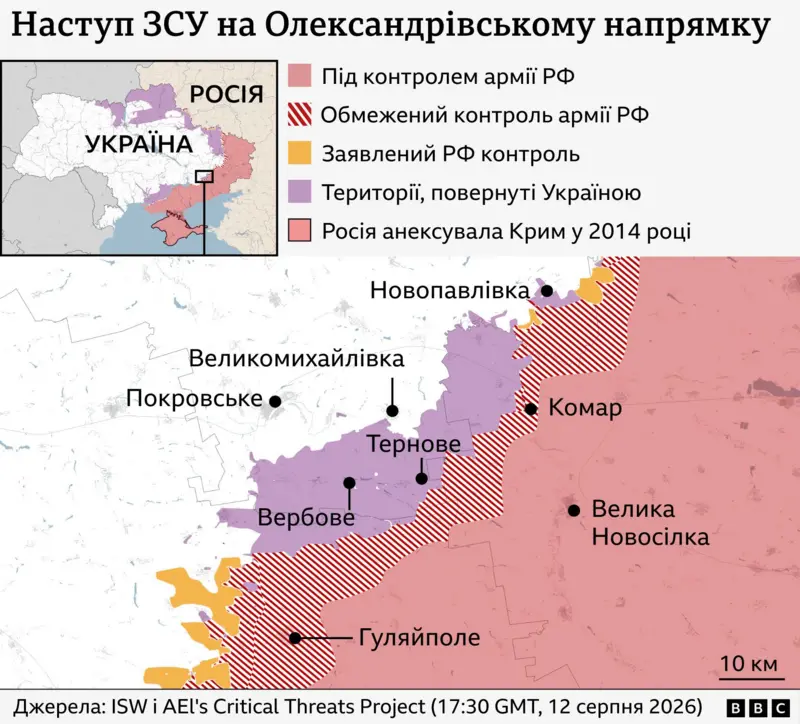
The operation enabled the Ukrainian Defense Forces to drive the enemy out of the Dnipropetrovsk region (no settlements remain under its control, but according to the DeepState map, the Dnipropetrovsk village of Filiya still remains in the “gray zone”).
The Ukrainian military also neutralized the threat of an offensive on Zaporizhzhia along the Donetsk–Zaporizhzhia highway.
The Russian military command has not commented on reports of the success of the Ukrainian Armed Forces’ offensive in the Oleksandrivka direction. However, it should be noted that the Russian Ministry of Defense continued to report its “advances” in the Dnipropetrovsk region throughout the spring and summer.
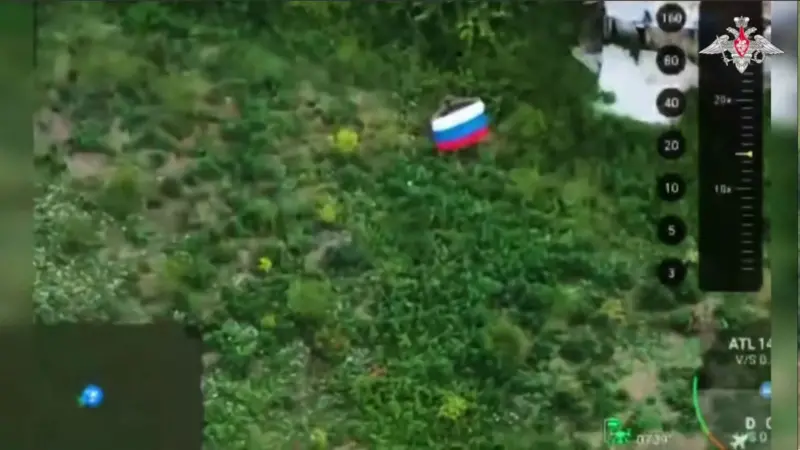
Moreover, on July 3, the Russian Ministry of Defense announced the capture of the village of Oleksandrivka (from which this sector takes its name).
To back up its claims, the Russian Ministry of Defense released a video showing a soldier unfurling a Russian flag on a street in the settlement.
During June and July, the Russian military also reported capturing a number of other neighboring villages, namely: Pisantsy, Novoskelevate, Bogodarivka, Volne, Khristoforivka (formerly known as Komunarivka), Dobropasove, and Blagodatne.
Thus, according to the Russian Ministry of Defense, it was they who managed to break through Ukrainian defenses in the Dnipropetrovsk region, rather than the Ukrainian Armed Forces driving them out of these positions.
Foreign OSINT analysts, such as the Institute for the Study of War (ISW), dispute this and emphasize that the Russian military’s claims of control over this territory do not correspond to reality.
Covert Operation
These settlements are located 20–25 km from the current front line.
According to the Ukrainian military, the enemy does not and has never had control over these villages; rather, it filmed propaganda videos featuring flags after one or two fighters infiltrated the rear of Ukrainian Armed Forces positions, after which these Russian soldiers were driven out of the area—no consolidation of positions took place.
The top echelons of the Russian command were providing false information about their advance, says Colonel Ruslan Marishev, commander of the 95th Brigade of the Ukrainian Armed Forces’ Airborne Forces, who is participating in this offensive.
“Many Russian commanders deceived their top leadership by providing false information about the front line—about where it actually was. Even when we had already advanced about 20–25 km deep into the Russian troops’ defensive lines, their leadership didn’t believe it and provided maps that we had captured and seized from them… [the maps indicated] that they were 25 km behind our lines,” he noted in an interview with the “1+1” TV channel.
For its part, the Ukrainian command did not publicly disclose details of the Ukrainian Defense Forces’ advance for a long time.
After the first phase of the operation in the spring, military officials—in particular, the commander of the Airborne Forces—disclosed only general figures regarding the number of settlements and the area of the liberated territories.
Thus, the actual location of the line of contact for Russian forces in this sector came as a surprise, says Colonel Marishev.
As an example, he cites a situation in which his subordinates were able to kill, in close combat, the commander of a Russian motorized infantry battalion who was inspecting the positions. He did not expect the Ukrainian army to have advanced so close to his positions.
The secrecy of the offensive operation allowed it to achieve significant results in less than half a year. What exactly?
Another breakthrough
The de facto expulsion of Russian troops from the Dnipropetrovsk region is, to a greater extent, a political achievement.
From a military standpoint, however, what matters is the Ukrainian Armed Forces’ advance toward the supply routes used by the Russian army in the south.
As of August 13, Ukrainian forces are 3–4 km from the Velyka Novoselka–Hulyaypole road and continue to advance in this direction near the villages of Uspenivka and Temirivka.
In other words, this route—which is vital for the Russian force’s logistics—is no longer secure. This is forcing the Russian military to seek alternative routes for transporting food, ammunition, and personnel, especially near Hulyaypole, which they captured late last year.
In addition, the Ukrainian Armed Forces managed to launch an offensive for the village of Komar, located on the banks of the Mokrye Yaly River, 15 km north of Velyka Novoselka.
Russian troops captured this large settlement in late winter 2025 and turned it into a stronghold.
Konstantin Mashovets, a military analyst with the “Information Resistance” group , points out that Ukrainian forces need to advance several more kilometers (approximately 5–6 km to the village of Volnoye Pole) to get close enough to establish fire control over Velikaya Novoselka.
“In that case, to achieve a significant operational effect across the entire operational zone of the Russian ‘Vostok’ task force … the Ukrainian command won’t even need to attack or storm Velyka Novoselka itself,” the expert notes.
“It is enough simply to bring the entire area—including the section of the Huliaipole–Velyka Novoselka road leading west—under tight fire control (including with the use of drones). The distance of 7.5–7.7 km makes it possible to do this quite effectively,” he believes.
Such an advance would complicate Russian logistics in the south, which would affect the combat effectiveness of Russian army units and help halt their offensive on Orekhov.
In other words, to put the enemy in a critical position, the Ukrainian Defense Forces must continue their offensive and make another 5–10 km advance.
Whether the Ukrainian Armed Forces can achieve this in the near future without redeploying reserves remains an open question.
It is also unknown whether the Russian command is prepared to deploy additional forces to halt the enemy in this direction, which, by all accounts, is not a priority for the Kremlin at this time.

Bank's name: Bank Millennium S.A.
Address: ul. Stanislawa Zaryna, 2A, 02-593, Warszawa
IBAN: PL97116022020000000216711123
SWIFT: BIGBPLPW
Name of the account holder: Fundacja “KARTA ‘97”
Purpose/title of payment: Donation for statuary aims
You can contact us by the e-mail charter97@gmail.com