Nikolai Statkevich: I Won't Stop Halfway Now
17- 6.08.2026, 14:10
- 24,812
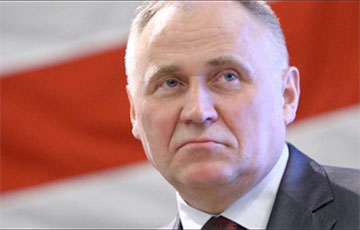
The opposition leader gave an extensive interview to the German newspaper *Die Zeit*.
Belarusian opposition leader and former political prisoner Nikolai Statkevich spent many years in a Belarusian penal colony. After his release, he refused to leave the country and remained in Minsk. Despite constant pressure, he speaks openly about freedom, love, and the courage not to give up.
Nikolai Statkevich gave an extensive interview to the German publication Die Zeit, in which he spoke in detail about his imprisonment, the attempted forced deportation, life in modern-day Belarus, and his views on the country’s future. Charter97.org publishes the full text of the interview.
— We cannot meet in person because you live in Belarus—a country that Western journalists can hardly ever enter. That’s why we’re having this conversation via video call. How freely can you speak at all?
— I can speak freely. I say what I think and what I consider necessary. Besides, I’m lucky.
— In what sense?
— My wife is a lawyer. She worries about me a lot. Before publication, we’ll go over the entire interview together, and she’ll say: “You’d better be careful with that statement—they’re handing out twelve years for that one right now, and ten for that one.”
— A few months ago, you were released after many years in prison, but, unlike other well-known former political prisoners, you remained in Belarus. You are the last prominent opposition figure still living in the country. How free do you feel?
— Completely free. But I know that could change at any moment. The authorities are silent about my status. Have I really been pardoned? Or have I simply been temporarily released so I can recover my health, only to be sent back to serve the remainder of my sentence afterward?
“Every day is a gift to me”
— You were arrested in May 2020 while organizing peaceful protests calling for free presidential elections in which you challenged Lukashenko, and were later sentenced to 14 years in prison.
— I don’t know my legal status, and no one has responded to my official inquiries. After my release, Lukashenko’s press secretary announced on state television that I had been pardoned, even though I never asked for one.
— In January of this year, you suffered a stroke in prison, and a month later you were released.
— I think the regime didn’t want to be held responsible if I had died in custody. Although this stroke was induced artificially: I was denied vital medication. When I was discharged from the prison hospital, I had great difficulty speaking, but my condition is improving.
— Many prisoners have died due to inhumane conditions.
— Now the regime’s representatives apparently hope that the constant fear of ending up back in prison will finish the job. Or that I’ll finally leave Belarus to seek treatment abroad. There were plenty of offers, including from Germany, where my daughters and grandchildren live. Thank you very much for that! The regime constantly makes my life here more difficult so that I’ll be forced to leave the country.
— How exactly?
— When I was released, I didn’t even have a passport, and I needed it to receive medical care. Later, when I started feeling better, the officials returned my passport. On top of that, our house is being demolished. We live in the so-called “Scientists’ Village” in Minsk, which they plan to redevelop—the process began a long time ago, but it accelerated after my release, and that’s clearly no coincidence. But all attempts to drive me out of Belarus have failed. I will not leave the country.
“Then I headed back toward Belarus”
— Are you being watched or monitored?
— The main task of the Belarusian KGB is to combat political opponents. It would be naive to think that the last opposition figure who still speaks out openly here isn’t under special surveillance. My wife and I have a rule—when we’re at home, we don’t discuss what we’re going to do.
— Actually, you could have been released a year ago as part of a deal between Lukashenko and U.S. President Donald Trump. Last September, you and 51 other prisoners were taken to the border with Lithuania, but you were the only one who refused to leave Belarus.
— They wanted to expel me from my own country. That’s a crime! I want to decide for myself where to live. Even if that means prison.
— What happened then?
— I was being held in a prison for particularly dangerous repeat offenders in the town of Glubokoye, in a solitary confinement cell measuring one meter by three. They put a bag over my head and took me to the KGB detention center in Minsk. That’s when I realized they were going to deport me. Once there, I said I would refuse to leave the country. Then they put us—the political prisoners—along with the KGB officers on a bus and took us north—toward the Lithuanian border.
— What happened next?
— I know that border crossing well; we often crossed through it—my wife likes to go to the flea market in Vilnius. When we left Belarusian territory, the KGB officers got off the bus. Only the driver and us prisoners remained on the bus. When we stopped in front of the barrier, I stood up and tried to kick the bus door open. My biggest fear was that I wouldn’t have enough strength because of my heart problems. But I managed it. As I was kicking out the window, one of my colleagues shouted to me:
“That button opens the door!” I did just that—and jumped out.
— And for a moment, you were free?
— Then I headed back toward Belarus. At some point, an American diplomat and a KGB officer approached me. The diplomat tried to persuade me to leave. I said: “All you want is a good PR stunt, and I’m supposed to give up my homeland for that? I definitely won’t do that!”
— Did you also want to derail the deal between Lukashenko and the Americans?
— No. It was a personal decision. I’m not some piece of livestock that can just be sold off like that!
— What happened next?
— They let me call my wife so she could convince me to leave the country after all. I told her, “I won’t let them force me out of the country.” She replied that she’d always known I’d do exactly that. But then she asked if we could at least say goodbye with a hug. I didn’t know what to say to her. Then, through her tears, she said, “Then at least let them let our letters through.” I knew everything would stay the same. But for the first time in three years, I heard her voice and learned that she had beaten cancer.
— But it never came to that meeting. You were sent back to the prison colony. How did you feel on the way back?
— I knew there would be retaliation. After all, I had ruined the media spin on the deal between Lukashenko and Trump. The KGB officers were also very angry with me. I think they themselves would have gladly gone to the West, but as members of the security apparatus, they’re forbidden from doing so. They pulled a thick riot mask over my face, and I nearly suffocated.
— You knew the regime would retaliate. Why did you go through with it anyway?
— I resisted forced deportation. No matter how harsh the circumstances, a person always has a choice. And, at the very least, my action later led to political prisoners no longer being forcibly removed from the country upon their release. Even if that means they remain in the country under strict surveillance.
— Did your conditions of detention worsen after you returned to the prison colony?
— I was certain I wouldn’t make it out alive. At the prison, they stopped giving me the medication I desperately needed due to heart rhythm irregularities I developed after COVID. My wife used to send it to me. It was through those care packages that I even knew she was still alive. Instead, they gave me aspirin. As the doctors at the prison hospital later explained, that’s exactly what led to my stroke.
— Were there moments when you regretted your decision?
— No, never. But I know how hard it was on my closest loved ones.
“Any form of self-organization is dangerous”
— Why did you want to stay in Belarus?
— For me, leaving the country is unthinkable. It would be like abandoning the millions of Belarusians who still live here. You know, people keep coming up to me on the street, shaking my hand, and thanking me.
— And today, too?
— Yes. So many people left after the mass protests of 2020. Imagine what it’s like for those who stayed behind. People whose friends, acquaintances, and children—everyone—has left. It’s as if there’s no hope left in this country, no future. And opposition to Lukashenko’s regime remains immense. I want to stay with those Belarusians who are here, waiting for the next chance to make a difference.
— The mass protests in the summer of 2020 were brutally suppressed, and people are still being jailed for participating in them.
— Today, you can get ten years just for a “like” or a “repost.” Entire families are being imprisoned. But these monstrous repressions exist only because the regime fears new protests. People hate Lukashenko even more, and he can feel it. I think Lukashenko sleeps worse at night than I do.
— Why do you think that?
— If mass protests break out again, they won’t be as peaceful as they were in 2020, when protesters even cleaned up after themselves.
— Right now, even the smallest form of resistance is impossible. How do you see your role today, as you remain one of the most well-known figures in the Belarusian opposition movement?
— In Belarus today, any form of self-organization is dangerous. But the gratitude, hope, and solidarity that people show me time and time again give me confidence. Can you tell us about one such instance?
— Of course!
— Recently, my wife and I were at “Museum Night” in Minsk. A saxophonist was playing in one of the halls. We stopped and listened. When the concert ended, we turned around—and suddenly saw a crowd behind us. People were applauding. And that’s when we realized they weren’t applauding the musician, but us. Even such small gestures of solidarity can be very dangerous. I’m worried about these people.
— What should Europe’s policy toward Lukashenko be? Should it continue with isolation and sanctions, as the EU is doing, or seek avenues for dialogue, as the U.S. is proposing?
— The West has been playing into Lukashenko’s hands for far too long. I think the European Union has finally found a rational policy toward him.
— Prominent opposition figures like Maria Kolesnikova warn that the EU could thereby push Belarus even further into Putin’s arms. Do you still believe the policy of isolation is the right one?
— The West has been fed this old fairy tale for many years—that Lukashenko supposedly wants to break free from Putin’s embrace. But how can Siamese twins be separated? That said, I’m against isolating the people of Belarus. People should have the opportunity to see something other than Belarus and Russia, and to visit relatives in the EU.
— What about the sanctions policy?
— I think that’s a question for my personal lawyer. Marina, how much are they offering these days for calls for sanctions?
— You seem calm and confident. Aren’t you afraid of what might still happen?
— I’ve been fighting with all my might for my country’s freedom for a long time now. I’ve already made many sacrifices, and I won’t stop halfway. How many times could I have died? But today I can look out the window and see the trees and the sky—things I haven’t seen in many years. And I’m here with my beloved wife. Every day is a gift to me.

Bank's name: Bank Millennium S.A.
Address: ul. Stanislawa Zaryna, 2A, 02-593, Warszawa
IBAN: PL97116022020000000216711123
SWIFT: BIGBPLPW
Name of the account holder: Fundacja “KARTA ‘97”
Purpose/title of payment: Donation for statuary aims
You can contact us by the e-mail charter97@gmail.com